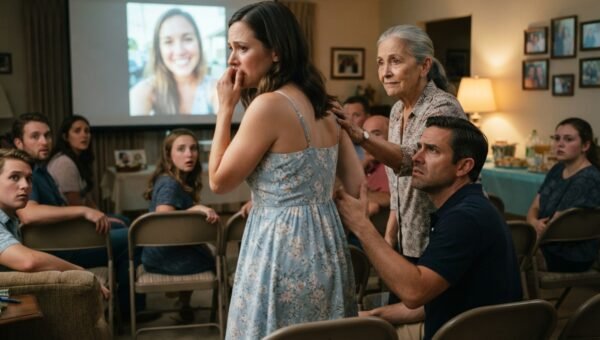
The gymnasium at Oak Creek High smelled of floor wax and old coffee, exactly the way it had smelled on a Tuesday afternoon in 1984.
We were standing near the punch bowl while a brassy recording of our old marching band played over the speakers. I had my hand resting on the linen tablecloth, smoothing down a fold, when a woman I had never seen before stepped right up into my space.
She wasn’t wearing a nametag. She looked to be about forty, maybe a little younger, with dark hair pulled back into a clip and eyes that didn’t blink.
“You left me at St. Agnes Hospital,” she said.
The music didn’t stop. People were laughing near the trophy case, clinking plastic cups together, talking about grandchildren and knee replacements. I stood there with my mouth half open, looking at her badge-less blouse.
“I think you’ve got the wrong person,” I said. My voice came out too high, like a schoolgirl caught in the hall. “I’m Brenda. Brenda Vance. I graduated in eighty-four.”
She reached into a canvas tote bag hanging off her shoulder. She didn’t pull out a phone or a purse. She pulled out a square of old acrylic yarn, pale yellow, worked in a bumpy double-crochet stitch that looped unevenly near the corner. My mother’s stitches. My mother sat in the front room for three solid weeks that spring, working that hook back and forth while the radio played farm reports, telling me it was for the baby quilt my sister’s firstborn would use.
“My name isn’t Brenda,” the stranger said, her voice dead flat. “And you didn’t lose this in the move to Madison. You left it on the second-floor radiator cover.”
I didn’t faint. People always say they faint in books, but my knees just locked solid. I looked past her shoulder and saw Shirley across the room. Shirley had been my shadow all through senior year, the one who drove the faded blue station wagon, the one who held my hand in the back booth of the diner when the world started closing in. Shirley was staring straight at us. Her face went the color of skim milk.
Before I could draw another breath, Shirley dropped her cup of punch right onto the polished gym floor and bolted for the exit doors.
The heavy double doors swung back and forth, squeaking on their hinges.
“Shirley!” I yelled.
I didn’t think about my heels or the people turning around to look.
I just moved. I pushed past the table with the photo collages and hit the heavy metal bar of the side exit, bursting out into the cool June air of the parking lot.
The sun had been down for an hour, and the gravel lot was dim, lit only by the amber sodium lights mounted high on the brick wall of the school. Shirley was already halfway to her sedan, her keys shaking in her hand as she tried to jam them into the door lock.
“Shirley, wait,” I called out, my breath catching in my throat. “Shirley, turn around.”
She didn’t turn. She managed to shove the key into the slot and wrench the door open, her shoulder hunching up toward her ears like she was bracing for a blow. I caught the edge of the door before she could pull it shut, shoving my palm against the gray metal.
“What did she just say?” I asked. My chest felt tight, like someone had cinched a belt too hard around my ribs. “What is she talking about, Shirley? St. Agnes?”
Shirley wouldn’t look at me. She kept her eyes fixed on the steering wheel, her fingers clawing at the leather strap of her purse. “I can’t talk about this, Brenda. Your mother made me swear on a stack of Bibles. Both of them. Before they passed.”
“My mother is gone,” I said, my voice dropping into a register I didn’t recognize. “My dad has been in the ground six years. What did you swear to?”
“You were seventeen,” Shirley whispered, finally turning her head just enough for me to see the wetness on her cheeks. “You were seventeen and your father was on the county board. You think he was going to let you walk across that stage with a belly? You think he cared what happened to you after the benediction?”
The gravel crunched behind us. Footsteps. Heavy, slow, deliberate steps that didn’t sound like someone running.
I turned around.
The stranger was standing by the corner of the brick wall, her arms crossed over that yellow blanket. And walking right beside her, leaning slightly on a wooden cane, was Arthur Gable.
Arthur had been our principal for twenty-two years. He retired back when the county consolidated the schools in ninety-nine, but he still had that same stiff, military posture, the gray hair trimmed so short you could see the pink scalp underneath. He wore a navy blazer with brass buttons that caught the amber light from the wall.
He didn’t look at Shirley. He looked straight at me, his eyes hooded and heavy with something that looked like exhaustion.
“Let her see it, Clara,” Arthur said. His voice was older now, gravelly around the edges, but it was still the voice that used to make the whole assembly hall quiet down with a single throat-clearing.
The woman, Clara, reached into her tote again. This time she pulled out a small, stiff strip of clear plastic with a yellowed paper insert tucked inside. She held it out on the flat of her palm.
I stepped closer under the amber light, my eyes straining against the glare.
There was a faded ballpoint pen entry on the card. *Vance, Brenda.* Date of admission: *June 8, 1984.*
And right below it, in the space marked for patient age, someone had written *Newborn* in a hurried, looping hand that I recognized instantly. It was my father’s handwriting. He had signed as the guarantor on the back.
“I was born at two in the morning,” Clara said quietly. “While you were backstage getting your diploma rolled up in a red ribbon. Your dad drove you straight from the auditorium parking lot to the back entrance of St. Agnes in the pickup truck. Shirley stayed in the car with you because you were bleeding through your skirt. Arthur was waiting inside with the papers already drawn up.”
I looked from Clara to Arthur. Arthur didn’t flinch. He just leaned a little harder on his cane.
“We wanted a family, Brenda,” Arthur said, and for the first time, there was a crack in that old principal’s authority. “My wife and I couldn’t. Your father came to me two months before. He said there was a situation that needed handling quietly, without the clinic in town getting involved. We paid the admitting clerk fifty dollars to lose the second page of the register.”
The gym door behind us banged open again, someone shouting out a laugh about the punch, but the sound didn’t reach us. We were in a pocket of cold air by the cars.
“You told me it died,” I whispered. I was looking at Arthur, but I was hearing my mother’s voice from forty years ago, flat and cold in the farmhouse kitchen while I lay upstairs with a fever. *It was too small, Brenda. It didn’t breathe. Your father took care of everything before the sun came up.*
“They told you that so you’d stop crying,” Arthur said. “They needed you back at the breakfast table by nine o’clock like nothing happened. They had your reputation to think of. The election for the grain cooperative was coming up in July.”
I looked down at the plastic bracelet. My name. My blood. My name on a baby’s wrist while I sat in the bleachers in a white cap and gown, waiting for my name to be called over the loudspeaker so I could walk across the plywood stage and shake the superintendent’s hand.
Shirley started her engine then. The Ford lurched backward, tires spraying loose gravel against my ankles, and she backed out of the space without looking back, her tail lights disappearing down the dark blacktop toward the highway.
I didn’t watch her go.
I stood there under the amber light with Arthur Gable and the woman who had my chin, my nose, and my mother’s crooked left thumb.
“You kept the blanket,” I managed to say.
Clara looked down at the folded acrylic in her arms. Her fingers stroked the lumpy yellow border just the way my mother used to do while she watched the evening news.
“Shirley gave it to me two years ago,” Clara said. “When she found out she had the cancer. She said she couldn’t die with it in her cedar chest. She said it belonged to the girl in the photograph.”
Arthur reached out and touched Clara’s elbow, a small, protective gesture that belonged to a father who had raised her, fed her, taught her how to drive on the back roads outside of town. He looked at me, just for a second, then looked away toward the dark treeline at the edge of the schoolyard.
“I’m sorry about the rest of it, Brenda,” Arthur said softly. “The papers are legal. They were legal the day I signed them. But she’s your blood. She’s been living twenty miles down the road in Richland Center for ten years.”
He turned and walked slowly toward his Buick parked near the faculty entrance, his cane tapping a steady rhythm against the asphalt.
Clara and I were left alone by the open door of my car.
I didn’t know what to do with my hands. For forty years I had carried a dull, heavy ache in the back of my ribs, a hollow space I always blamed on a bad summer and a fever that kept me in bed for three weeks after graduation. I had spent half a lifetime wondering why my body felt like it was missing an anchor.
“Do you want to get some coffee?” I asked. My voice shook so hard the words barely came out straight. “There’s a diner still open over on Route 14.”
Clara looked at me for a long, quiet moment. The wind came across the flat cornfields behind the school, carrying the smell of damp earth and summer hay.
“Only if you let me drive,” she said.
We got into my car. I folded the yellow blanket across my lap, feeling the bumpy, uneven stitches under my palms, and for the first time in forty years, the weight in my chest shifted and let the air back in.