PART 1
The key was at the very bottom of Greg’s canvas gym bag, jammed into the corner seam beneath a pair of dirty crew socks. It was bright brass, sharp-edged, and completely new.
We had been married for twenty-six years, and I knew every single key on his ring. We had the square-headed brass one for our front deadbolt, the small silver file-cabinet key he kept for his tax folder in the den, his truck key, and the padlock key for the riding mower shed out back. This key did not belong to our life.
I took it into the kitchen on a Tuesday afternoon while he was still at the lumber yard. I walked from our front door to the back porch, then out through the laundry room to the side garage door. I tried it in every cylinder. It did not even slide halfway into the side door lock, and on our front door it slipped in smooth but refused to turn. Not even a fraction of an inch.
I did not ask him about it that night. When a woman has been married to a man for over two decades, she learns the difference between an innocent mistake and something kept out of sight on purpose. Greg had been quiet since late 2023. He had started keeping his phone face down on the nightstand, and he took long Saturday morning trips to what he called his fitness boot camp out by the industrial park.
He would come home with dry hair and a clean shirt, toss his gym bag near the bench, and take a shower before lunch.
On Wednesday morning, while Greg was at work, I took the brass key to Miller’s Hardware on 4th Street. Old man Miller charged me $15 to look it over and test the cut on his gauge.
He squinted through his bifocals, turned the key twice under the desk lamp, and set it on the rubber counter mat.
“This isn’t an automotive key, Ruth,” he said. “It’s a five-pin residential cut. Standard Kwikset deadbolt. Freshly stamped, too. Whoever bought this had it made within the last month or two.”
“Could it fit an office or a storage unit?” I asked.
“Not unless somebody put a house lock on a warehouse door,” he said. “This is for a residential front door.”
I paid him the fifteen dollars in cash, drove home, and slid the key right back into the corner seam of Greg’s bag under the dirty socks.
I waited until Saturday morning.
Greg woke up at five-thirty, pulled on his gray sweatpants and hooded sweatshirt, and zipped his gym bag.
He kissed my forehead while I pretended to be half-asleep under the quilt.
“See you around eight, honey,” he whispered. “Going to get some miles in on the track.”
“Have a good workout,” I muttered into the pillow.
The front door clicked shut. His pickup started in the gravel driveway with that familiar low rumble, and the headlights swept across the bedroom ceiling before fading down the road.
I was already dressed beneath the covers. I pulled on my sneakers, grabbed my purse, and walked out to my six-year-old Buick parked on the curb.
I didn’t turn on my headlights until I reached the county road. I kept three car lengths behind a milk delivery truck, watching Greg’s red taillights move through the dark morning fog.
He didn’t turn toward the industrial park. He didn’t turn toward the gym on Highway 12.
He drove straight past the bypass, crossed the river bridge, and took the south exit toward the old rail district. It was fourteen miles from our front door.
He turned down Crane Avenue, a quiet street lined with cracked sidewalks and small two-family homes built in the late fifties. He pulled his truck into the gravel drive of a freshly painted gray duplex with dark blue shutters.
I parked half a block away under the shadow of a large overgrown maple, cut the engine, and sank down in my seat.
Greg stepped out of the truck. He didn’t carry his gym bag. He walked up the three wooden porch steps, pulled the new brass key out of his pocket, and slid it into the lock.
Before he could even turn it, the door pulled open from the inside.
A woman stood in the warm light of the hallway wearing a faded red flannel bathrobe. She was in her late thirties, with dark hair tied back in a messy knot, holding a ceramic coffee mug in one hand. She stepped back, smiled, and Greg walked inside without hesitating. He closed the door behind him and locked it.
I sat in my cold car for forty minutes with my hands shaking on the steering wheel.
At seven-fifteen, the front blinds twitched, and the porch light clicked off. I picked up my phone, rested my wrists on the dashboard, and took eleven clear, focused photographs of his truck parked in that driveway, the house number beside the mailbox, and the front entrance.
Then I started my car and drove straight to my sister’s house.
PART 2
My sister Martha didn’t ask me twenty questions. She poured me a cup of black coffee, sat down across from me at her kitchen table, and wrote down the name of an attorney named Evelyn Vance.
“Evelyn handled my coworker’s divorce two years ago,” Martha said, keeping her voice dead level. “She doesn’t waste time, and she doesn’t tell people what they want to hear. Call her office at eight-thirty on Monday.”
When I got home around nine that Saturday, Greg was sitting at our kitchen island eating buttered toast. His hair was damp from the shower, and he had his iPad propped up against the fruit bowl, reading the local sports section.
“Good workout?” I asked, hanging my coat on the peg by the door.
“Brutal,” he said, chewing slowly. “Trainer had us on the rowing machines for forty-five minutes. My back is killing me.”
I walked over to the sink, rinsed out an empty glass, and filled it with tap water. I watched his reflection in the kitchen window. There was no guilt in his eyes. There was no nervous twitch. He looked like a man who believed he had arranged his world so neatly that nothing could ever touch him.
“You should stretch more,” I said.
“Yeah,” he replied, turning a digital page. “I probably should.”
Monday morning at nine o’clock, I walked into Evelyn Vance’s office on the third floor of the downtown bank building. Evelyn was fifty-eight, with sharp silver hair cut short at her jaw and reading glasses hanging from a silver chain around her neck.
I showed her the eleven photographs on my phone. Then I set Miller’s receipt for the fifteen-dollar key identification on her blotter.
“He went there at six in the morning,” I said. “He had his own key. The woman opened the door in a robe.”
Evelyn didn’t gasp or offer me a tissue. She pulled a yellow legal pad toward her, uncapped a black pen, and looked up at me over her glasses.
“Cheating is common, Ruth,” she said evenly. “It’s painful, but in this state, it rarely changes the division of marital property by itself. What we need to know is where the money is going. What’s the address on Crane Avenue?”
“418 Crane Avenue,” I told her.
She swung her desktop monitor around and opened the county property appraisal portal. Her fingers clicked rapidly across the keyboard.
“Here it is,” Evelyn said, staring at the screen. “418 Crane Avenue. Parcel number 04-882-19. Single-family duplex. Purchased in November 2023.”
She paused, clicking on the recorded deed.
“The deed is registered under Gregory Thomas Miller. Just his name. Sole ownership.”
A cold pressure tightened in my chest. “How much was it?”
“Purchase price was $167,000,” Evelyn said, reading off the transfer tax lines. “Closed on November 14th of last year. Let’s see the mortgage recording.”
She clicked into the county clerk’s public filings, searching the lien index under Greg’s Social Security number. She went quiet for nearly a full minute. When she looked back at me, her face was completely still.
“Ruth,” she said, her voice dropping lower. “There’s no mortgage recorded on Crane Avenue. The property was bought with a cashier’s check.”
“We don’t have $167,000 in cash,” I said immediately. “Our joint checking has $4,200. We have about $18,000 in a regular savings account for emergencies. Greg’s 401(k) has about $210,000, but he hasn’t touched that. He couldn’t.”
Evelyn leaned forward. “Did you take out a line of credit on your primary residence recently?”
“No,” I said. “We paid our house off four years ago. We burned the mortgage note in the backyard with our kids.”
Evelyn didn’t answer. She opened the lien records for our home address on Oak Ridge Road.
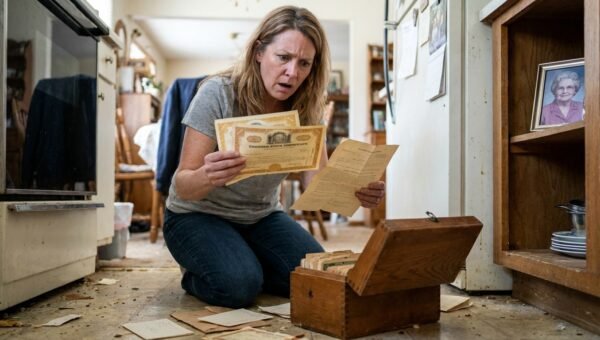
A document popped onto her screen. It was a recorded deed of trust dated October 28, 2023. First National Community Bank. A home equity line of credit secured by our home.
The approved credit limit was $185,000.
A total draw of $170,000 had been taken against our house on November 2, 2023. Twelve days before he closed on the duplex.
“Ruth,” Evelyn said, her eyes locked on mine. “Look at this signature page.”
She turned the monitor fully toward me.
There were two signature lines at the bottom of the bank’s notarized equity agreement.
The first line had Greg’s signature, signed in his heavy, slanted hand with the looped ‘G’.
The second line was labeled *Ruth Ann Miller, Co-Owner*.
On that line was my name, written in thin, shaky cursive. The ‘R’ leaned the wrong way. The cross on the ‘t’ was too long, cutting all the way into the middle of the ‘h’.
It wasn’t my handwriting. I hadn’t stepped inside First National Community Bank since 2019.
“My signature is forged,” I whispered.
“Yes, it is,” Evelyn said. She pushed her chair back from the desk. “And that changes this from a messy marriage into a series of federal and state felonies. He encumbered your unencumbered home, used bank wire facilities across state lines, and submitted a forged legal instrument to a federally insured lender. The fraud charges alone carry up to thirty years.”
PART 3
I didn’t scream, and I didn’t cry. When an ordinary person discovers the person they sleep next to has gambled away their roof, the panic doesn’t come out as noise. It turns into pure lead.
“What do we do right now?” I asked.
Evelyn picked up her desk phone. “First, I file an immediate lis pendens against the Crane Avenue property so he cannot sell it, transfer it, or encumber it with a secondary loan. Second, we notify First National’s fraud division in writing with an affidavit of forgery. Third, I draft the divorce complaint alleging marital dissipation, fraud, and breach of fiduciary duty. We do not tip him off until the freeze is on the accounts.”
For four days, I went home and cooked dinner. I made meatloaf on Tuesday. I folded his work shirts on Wednesday. On Thursday, I watched him watch television from the opposite end of our living room sofa. Every time I looked at him, I didn’t see the man who helped me raise two daughters. I saw a man who had looked at the house we spent twenty-four years paying for and decided he had the right to pawn it to buy a hideaway for another woman.
The notarization on the loan had been handled by a mobile notary named Brenda Simmons. Evelyn tracked down the notary log within forty-eight hours through a formal demand letter. The notary log showed Greg had met Brenda at a diner near the highway, claiming his wife was ill in the truck, and handed over an expired driver’s license with my name on it and a check for $150 cash.
On Friday morning at ten o’clock, the bank’s internal fraud division froze Greg’s checking accounts and flagged the HELOC. At ten-fifteen, the process server walked up to the lumber yard where Greg was yard supervisor and handed him two thick manila envelopes.
By eleven o’clock, Greg’s truck tore into our driveway, throwing loose gravel against the garage siding.
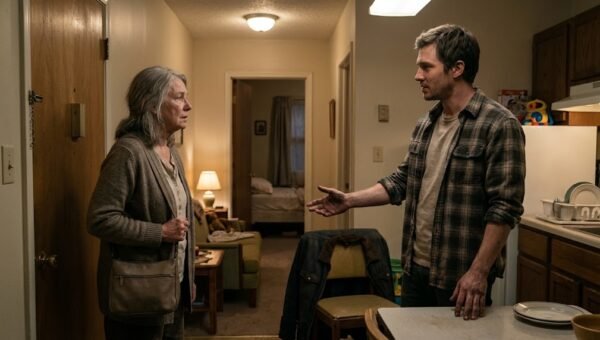
The kitchen door banged open so hard it bounced off the baseboard.
“What the hell is this, Ruth?” he shouted, holding the papers above his head. His face was blotchy, mottled with angry red patches under his gray stubble. “Are you out of your mind? You froze the checking account! The bank just called me! What are you doing with an attorney?”
I was sitting at the kitchen table. My hands were folded flat on the wood. The new brass key from his gym bag sat directly in front of me, catching the midday sun.
Greg’s voice cut off mid-sentence. His eyes dropped to the key.
The kitchen went completely quiet except for the hum of the refrigerator.
“You left it under your socks,” I said. My voice was quiet, so steady it surprised even me. “Miller’s Hardware charged me $15 to tell me what kind of lock it fit. Then I sat on Crane Avenue for forty minutes last Saturday and watched her make you coffee.”
Greg’s shoulders dropped two inches. His mouth opened slightly, but no words came out. He set the legal papers on the counter by the breadbox.
“Ruth,” he started, his voice suddenly thick and pleading. “It’s not what you think. Her name is Brenda… no, Carla. Carla. She was in a bad spot with her landlord. Her kids needed a place. It was an investment. I was going to flip it in two years and put the profit right back into our retirement.”
“You didn’t invest our money, Greg,” I said. “You stole it. You forged my name on a $185,000 line of credit on this house. You put a debt on our home after we spent twenty-four years sweating to pay it off.”
“I was going to pay it back!” he shouted, stepping toward the table, his hands open. “The rent from the upper unit was going to cover the monthly interest! Nobody was going to lose anything! You’re turning this into a federal case over a paperwork mistake!”
“It isn’t a paperwork mistake,” I said. “It’s bank fraud. Evelyn Vance told me the prison term it carries. The bank has the notary’s affidavit already. The county has the lien notice on Crane Avenue.”
The color drained out of his face then. Not because he was sorry he had betrayed me, but because he finally realized the walls were solid and closing in.
“You wouldn’t send me to prison,” he whispered. “We have kids, Ruth. We have grandkids. You’d destroy our family over this?”
“You signed my name, Greg,” I said, looking him dead in the eye. “You decided what our family was worth when you picked up that pen.”
ENDING
The divorce did not go to a jury trial. Men who commit felony bank fraud do not want their bank records read aloud in an open courtroom before a county judge.
Greg’s attorney spent three months trying to negotiate a settlement that would keep the county prosecutor from filing criminal indictments. Evelyn Vance gave him exactly one option, and she did not budge an inch.
Under the final property settlement signed six months later, the Crane Avenue duplex was sold on the open market for $182,000. Every single dollar from that sale went straight to First National Community Bank to pay down the principal on the fraudulent home equity line.
Greg was forced to liquidate his entire $210,000 401(k) to pay the remaining $8,000 balance on the HELOC, cover the early withdrawal penalties and taxes, and pay my legal fees of $14,500. What remained of his retirement went directly into an escrow account to buy out my half of our marital assets.
In exchange for his total surrender of the marital home and his retirement share, I signed a civil release, and the bank agreed not to refer the completed fraud investigation to the United States Attorney’s Office, provided their principal and interest were satisfied in full.
Greg lives in a rented one-bedroom apartment over an auto repair shop on the east side of town now. He still works at the lumber yard, but forty percent of his weekly paycheck is garnished under our domestic support order until the remaining adjustments are satisfied. Our daughters know what happened. I didn’t have to tell them much; the public county deed records are open to anyone with an internet connection. They visit him on holidays, but they don’t leave their checkbooks on his kitchen counter.
Last Thursday, I hired a young carpenter from the hardware store to replace the front door of my house on Oak Ridge Road.
The old door was scratched near the handle where Greg used to kick it shut when his arms were full of groceries. I picked out a solid oak door with frosted glass panels at the top, painted forest green.
When the carpenter finished, he handed me two silver keys on a small ring.
“You want me to throw the old deadbolt in the scrap bin, ma’am?” he asked, wiping his brow with his forearm.
“Yes,” I told him, closing my fingers around the cold silver keys. “Throw it away.”
I walked inside my home, locked the deadbolt behind me, and listened to the clean, solid click. It was my house. My name was on the deed, and nobody in the world had a key except me.