PART 1
I thought I was just helping my girl get on her feet.
Her name is Courtney, she is thirty-one, and for the last four years, she and my grandson Leo have been bouncing between cheap rentals and temporary sublets. Every time a lease ended, she had a fresh reason why the landlord was unfair or why the neighborhood had gone downhill. I stayed out of it as much as I could, but Leo is seven years old.
He needs his own bedroom. He needs to know what school he will attend in the fall without packing his backpack into trash bags every eight months.
So when Courtney came to my kitchen on a rainy Tuesday morning with folders and printouts, I actually felt a wave of relief. She sat across from me at the oak table my late husband, Richard, built forty years ago, spread out color pictures of a bright, sunlit condominium, and told me she had found a real path forward.
“It is only one hundred and eighty-five thousand dollars, Mom,” she told me, her voice shaking with that nervous, eager energy she gets when she wants something badly. “Two bedrooms, updated kitchen, brand-new flooring. It is five minutes from Leo’s elementary school. The monthly payments will be less than what I pay in rent right now.”
The photos looked beautiful. Pale gray walls, clean subway tile, stainless steel appliances, and a small balcony overlooking a courtyard of trimmed grass.
“The only problem is my credit,” Courtney said, looking down at her hands. Her fingers were picking at a fraying edge of her sleeve. “Because of that medical collection from two years ago, the bank will not approve the loan on my income alone. They told me if I have a solid cosigner, it goes right through. Just a cosigner, Mom. I make every payment. You never pay a dime. But it gives Leo a permanent home.”
I looked at the pictures, and then I looked at the picture frame hanging by my refrigerator. It was Leo at his last birthday party, grinning with icing on his cheek.
“I am not handing over cash, Courtney,” I warned her. “Everything I have is tied up in this house, and my pension barely leaves me room for car repairs.”
“I would never ask you for cash,” she insisted, leaning across the table to squeeze my wrists. “You are just lending your signature.
That is all. The paperwork is almost ready. We can sign on Friday.”
I told her I would consider it, but I insisted on an independent home inspection first. I am sixty-four, not foolish. I worked thirty years as an administrative clerk for the county water district, and I know that buying any property without a neutral set of eyes is asking for trouble. Courtney complained that an inspection would slow things down and cost money she did not have, but I paid the three hundred and fifty dollars out of my checking account and hired a local inspector named Martin Vance, whom Richard had used years ago.
The inspection was scheduled for Thursday afternoon. I expected an email report on Friday morning.
Instead, my phone rang at five o’clock on Thursday evening. It was Martin.
“Evelyn?” he said, his tone low and clipped, the way men sound when an accident just happened on the highway. “Are you somewhere you can speak privately?”
I walked out of the grocery store aisle and stood near the automated doors. “Yes, Martin. What is it? Is there a roof leak?”
“Evelyn, do not sign a single page for that unit,” Martin said. He was breathing heavily, like he had just walked up several flights of concrete stairs. “No one should be living there. That entire building was red-flagged by the municipal code enforcement office nine months ago. There is an active foundation failure on the east wing. The structural pillars in the subterranean garage are cracking, and there is a documented vacate order pending in the city records.”
My heart gave a heavy, sickening thud against my ribs. “Martin, the listing photos showed fresh drywall and brand-new laminate flooring.”
“They put cosmetic drywall over sheer wall fractures, Evelyn. Someone threw fresh paint on condemned masonry. It is lipstick on a corpse. If you cosign on that mortgage, you are putting your name on a debt backed by an uninsurable pile of cracked concrete. And that is not the worst of it.”
“What do you mean?” I asked, my grip tightening on my phone until my knuckles turned white.
“The listing agent was not even there. But when I was walking around back to check the foundation grading, I noticed someone had left the basement utility access unlocked. There are storage bays down there, Evelyn. One of the units had personal belongings stacked high against the chicken wire, completely blocking the fire clearance.” Martin paused, hesitating. “I saw a carved wooden crib in there, Evelyn. A heavy cherrywood crib with an engraved floral rail. I remember that crib from when your daughter had the baby, because Richard brought it to the lumber yard to be refinished when I worked the counter there.”
The grocery store around me seemed to go entirely silent.
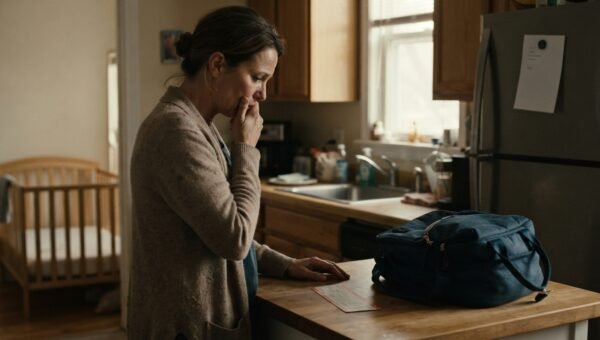
My husband, Richard, died four years ago. That cherrywood crib had been sitting in my attic storage room, directly above my garage, untouched since Leo grew out of it.
“Martin,” I whispered. “That crib is in my house.”
“It was not in your house three hours ago,” Martin answered grimly. “It was sitting in a damp basement on Tenth Street.”
I did not finish my shopping. I left my cart right beside the register, walked out to my sedan, and turned the key in the ignition with trembling hands.
The drive to Tenth Street took barely twenty minutes, but every red light felt like an hour. When I pulled up to the curb outside the brick condo building, the exterior looked deceptively neat from the street, just as the pictures showed. But parked in the circular driveway was Courtney’s beat-up silver crossover, and right beside it was a clean white sedan with a gold real-estate decal on the driver’s door.
Courtney was standing on the concrete front steps next to a tall, middle-aged man wearing a sharp navy blazer and holding a black leather clipboard. She was gesturing with both hands, looking animated, but the moment my car tires crunched against the curb and my door swung open, all the color drained straight out of her face.
She did not look guilty. She looked furious.
“Mom?” she shouted, coming down the steps in rapid, jerky strides. “What are you doing here? I told you we were doing the walk-through tomorrow! You were not supposed to be here today!”
I did not answer her. I walked straight past her toward the low ground-level basement windows set into the foundation wall. The glass was filthy, but through the grime, the sunlight hit the storage bay directly beneath the porch.
There was my cherrywood crib. Stacked behind it were four large plastic storage tubs with my handwriting on the masking tape labels: *Richard’s Books*, *Linens*, *Winter Coats*. Beside them sat the two antique side tables my mother had left me.
My throat closed up. “Why is my furniture here?” I turned around to face her. “Courtney, why are my belongings in this condemned basement?”
Before Courtney could open her mouth, the man in the navy blazer walked down the steps, consulting his clipboard with a polite, practiced smile.
“Good afternoon,” the agent said, extending a hand I did not take. “You must be Evelyn Vance. I am glad you could make it after all. We were just running through the preliminary timelines before Monday’s turnover.”
He glanced at his papers, tapping a pen against the metal clip. “We do need to confirm one detail, though. Your daughter mentioned you would be staying with her here in the upper unit temporarily, but the title company called our office thirty minutes ago asking why the final payoff authorization for your property on Maple Street has not been signed yet. We already have the cash buyer’s deposit in escrow.”
The world tilted. “My property on Maple Street?”
“Yes, ma’am,” the agent said, clearly oblivious to the terror creeping across my skin. “The Maple Street house. The sale is scheduled to close this coming Monday.”
Courtney lunged forward, her hand snatching at a thick manila folder tucked beneath the agent’s arm. Stamped across the front in red block ink were the words: *MOVE-IN DATE: MONDAY*.
PART 2
“Do not look at that, Mom,” Courtney snapped, pulling the folder against her chest. “It is just paperwork. It is just the scheduling paperwork.”
“What cash buyer?” My voice came out flat, stripped of any warmth. “What payoff authorization?”
The agent’s smile vanished. He lowered his clipboard, his eyebrows pulling together as he looked between Courtney and me. “Mrs. Vance, your house at 414 Maple Street. It went under contract three weeks ago. We accepted an all-cash offer from an investment group out of Columbus. The closing is set for Monday morning. Your daughter said you had authorized her to handle the listing because your health prevented you from managing the showings.”
“My health?” I stared at Courtney.
Courtney stepped between me and the agent, her shoulders tense, her eyes wide and desperate. “Mom, please. Just get in your car and let me explain this at home. You are embarrassing both of us.”
“I am not going anywhere,” I said, holding my ground. I looked directly at the agent. “What is your name, sir?”
“Marcus Bennett,” he said slowly, his eyes darting to Courtney with sudden wariness. “Bennett Realty Group.”
“Mr. Bennett, I am sixty-four years old. I retired from the county water department two years ago. I have lived at 414 Maple Street for thirty-four years. My mortgage was paid off in full five years ago. There is no payoff authorization because there is no loan on the property. And I have never, in my life, authorized anyone to sell my home.”
Marcus Bennett’s face went dead white. The clipboard dropped to his side. “The listing agreement has your signature on it, Mrs. Vance. We received a notarized power of attorney giving Courtney Vance full administrative authority over the Maple Street property.”
“Power of attorney?” The words tasted like ash.
Then it hit me. Six weeks earlier, I had been in the hospital for three days with a severe case of pneumonia. I had been feverish, hooked up to an IV, and barely able to sit upright without coughing. Courtney had brought a stack of papers to my bedside, telling me they were hospital intake forms and an authorization for her to speak to the doctors regarding my insurance billing. I had signed them while struggling to breathe, trusting my own child to handle my hospital stay.
She had slipped a general power of attorney into that stack of medical releases.
“Courtney,” I said, turning to her. “Tell me what you did.”
“I did what I had to do!” Courtney cried out, her voice cracking as tears finally sprang to her eyes. People walking their dogs down Tenth Street turned to stare, but she did not care. “You sit in that four-bedroom house completely alone, Mom! Richard is gone. You do not need all that space. You hoard everything he ever touched. Leo and I are barely surviving on my retail shifts, paying nine hundred dollars a month for a place that smells like mold, and you are sitting on three hundred thousand dollars of equity that is doing nobody any good!”
“You put my house on the market behind my back?”
“I was going to buy this condo for all three of us!” she shouted, holding up the manila folder like a shield. “I used your name to get the condo under contract, and the cash from Maple Street was going to pay it off completely, with over a hundred thousand left over in a fund for Leo! We would all live together. You would have your own bedroom. You would not have to worry about yard work or roof repairs ever again. I was fixing everything for us!”
“This building is condemned, Courtney,” I said, my voice shaking with rage. “The foundation is fractured. The city has a vacate order pending. Who sold you this unit?”
Marcus Bennett took a quick step back, holding both hands up defensively. “Wait a minute. I did not represent the seller of this condo. My firm was only hired by Miss Vance to handle the listing and sale of Maple Street. Miss Vance brought in an independent broker for the Tenth Street purchase. If this structure has an active municipal vacate order, that transaction cannot legally close.”
“The seller gave me a twenty-thousand-dollar discount if we closed without title insurance,” Courtney blurted out, wiping her nose with her sleeve. “He said it was just an old drainage issue from two winters ago and that the HOA was fixing it in the spring. He said if we waited for the city paperwork to clear, the price would go up to two hundred and twenty thousand.”
A predatory flipper had caught her in a trap. He had found a desperate young woman with access to someone else’s clean assets, offered her an off-market deal on a condemned shell, and convinced her to skip title insurance so she wouldn’t see the demolition notice filed with the county. And to pay for it, Courtney had taken my home, packed up my attic while I was out running errands, and handed over my title to an investment firm looking for cheap suburban inventory.
“Give me that folder,” I said, stepping toward her.
“No!” Courtney pulled it back. “You do not understand, Mom! The buyer already paid fifty thousand dollars in earnest money into escrow! If we back out now, they will sue us! They will sue you!”
“They will sue a thief,” I said coldly. “Give me the folder, or I am dialing the police from this curb right now.”
She looked at my face, realized I was not bluffing, and let the folder slip from her hands. It hit the pavement, spilling papers across the damp concrete.
PART 3
I spent the next four hours sitting at the kitchen table on Maple Street, surrounded by documents, bank receipts, and contracts.
I did not go alone. I called my younger brother, Thomas, who retired as a lieutenant from the county sheriff’s department. When Thomas arrived, he did not raise his voice. He simply walked into the living room, looked at the bare spots where my antique tables had stood, and sat down beside me.
Marcus Bennett, terrified of losing his broker’s license and facing criminal fraud charges, brought over every file his office had collected on the sale of 414 Maple Street.
The notary seal on the power of attorney was from a mobile notary service. Courtney had brought the woman to my hospital room during visiting hours, while I was heavily medicated on codeine and sleeping between coughing fits. She had held the clipboard, flipped to the signature tab, and watched me sign what I believed was a patient representative waiver.
The cash buyer was a corporate LLC called Buckeye Heritage Holdings. They had offered two hundred and eighty thousand dollars for my house, well below its fair market value of three hundred and fifty thousand, but Courtney had accepted it immediately because they promised a fourteen-day cash close with no contingencies.
“She has already accessed eight thousand dollars of the earnest money advance,” Thomas said, running his finger down the settlement statement. “Bennett’s escrow released a hardship advance for moving expenses based on the forged authorization.”
“Where is the eight thousand?” I asked.
“She gave a five-thousand-dollar non-refundable cash deposit to the flipper on Tenth Street to hold the condo,” Thomas said, shaking his head in disgust. “The rest is gone. Truck rentals, storage fees, probably back rent on her old apartment.”
Courtney sat on the sofa across from us, her knees pulled up to her chest, sobbing uncontrollably.
“I was doing it for Leo,” she kept repeating, her voice muffled against her denim jeans. “Mom, please. If you call the police, they will put me in jail. Who is going to take care of Leo? You cannot let them take me to jail.”
I looked at my daughter. The child I had nursed through scarlet fever, the girl Richard had taught to drive on the backroads behind the county reservoir, the mother of my only grandchild. For years, I had made excuses for her instability. When she lost jobs, I paid her utility bills. When her boyfriends walked out, I bought the groceries. Every time her life started to tilt, I rushed in with a checkbook and a sympathetic ear, believing that love meant absorbing the damage so she wouldn’t have to feel the fall.
And while I was lying in a hospital bed with fluid in my lungs, she had looked at my life’s work, looked at the house her father had bled to pay off, and decided it was hers to spend.
“You are not going to jail tonight,” I told her, my voice completely steady. “Not because of you. Because of Leo.”
She looked up, a glimmer of relief touching her face. “Thank you, Mom. I knew you would understand. We can just cancel the sale and—”
“Be quiet,” I said.
The sharpness in my tone cut her off instantly. She shrank back into the cushions.
“Tomorrow morning at eight o’clock, Marcus Bennett is going to deliver a formal cancellation notice to Buckeye Heritage Holdings along with an affidavit of fraud,” I said. “Thomas and I will be at the county recorder’s office when the doors open to record a formal revocation of the power of attorney and a lis pendens notice against the title of this house.”
“What about the earnest money?” Courtney whispered. “The eight thousand dollars?”
“You owe Bennett Realty eight thousand dollars,” I said. “And if you do not pay them on a monthly schedule that Mr. Bennett’s legal team agrees to, they will file civil and criminal charges against you, and I will testify on their behalf.”
She stared at me in horror. “Mom, I do not have eight thousand dollars! I make twelve dollars an hour at the outlet mall!”
“Then you had better find a second job,” I said. “Because I will not pay one single cent to cover your fraud.”
“And the condo?” she asked, her voice trembling. “What about the Tenth Street place? My five-thousand-dollar deposit?”
“That money is gone, Courtney,” Thomas interjected, his voice cold and flat. “That flipper took your cash and probably has three other marks lined up. If you try to enforce that contract, the city will condemn the unit before you get the keys. You got swindled while trying to rob your own mother.”
Courtney looked at me, waiting for me to soften. She waited for the familiar sigh, the reaching for the purse, the gentle reassurance that we would figure it out together.
I stood up, walked to the front door, and opened it wide to the dark street.
“You have two hours to bring my furniture back from Tenth Street,” I said. “Thomas has his truck outside. You will load the crib, you will load my mother’s tables, and you will carry every single box back up to the attic. And when you are done, you will take your car and you will leave my property.”
“Where am I supposed to go?” she wailed. “My lease on the apartment ended on the first! I have nowhere to sleep tonight!”
“You should have thought about where you were going to sleep before you put my home up for sale,” I said. “Get moving.”
ENDING
It took four weeks of legal wrangling to untangle the mess.
Buckeye Heritage Holdings threatened to sue for specific performance, claiming they were a bona fide purchaser without knowledge of the fraud. But once my attorney presented the hospital admission logs proving my medical incapacity on the date the power of attorney was executed, alongside the municipal inspector’s fraud report regarding the listing agent’s documentation, their corporate counsel decided that a protracted court battle over a disputed residential deed was not worth the legal expense. They withdrew their claim, released the escrow hold, and walked away.
The city code enforcement division moved faster than the lawyers. Within ten days of Martin Vance’s inspection report, the building on Tenth Street was formally padlocked with red condemnation notices posted across the front entry. The seller, an unlicensed developer operating under three shell corporations, fled the county and is currently under investigation by the state attorney general’s consumer protection bureau. Courtney’s five-thousand-dollar deposit disappeared into the wind.
Marcus Bennett’s agency agreed not to press criminal charges against Courtney under one condition: she signed a legally binding confession of judgment for the eight thousand dollars she had misappropriated, with an agreed repayment plan of two hundred dollars a month deducted directly from her wages.
She had to move into a tiny, one-bedroom basement apartment thirty miles south, in a town where rent was cheap enough that she could survive on her paycheck while making those restitution payments. She works thirty hours a week at the mall and takes weekend shifts cleaning office suites downtown.
Leo stays with me three nights a week.
I set up the cherrywood crib in the back bedroom, though we do not use it anymore; it sits against the wall as a reminder of what was saved. Instead, Richard’s old study is now Leo’s room. He has a sturdy twin bed, a desk where he does his second-grade spelling homework, and a bookshelf filled with the paperbacks his grandfather left behind. He knows that no matter what happens on the weekends or where his mother moves next, his bed on Maple Street will always be here, exactly where it belongs.
Courtney barely speaks to me when she drops him off at the curb on Wednesday afternoons. She pulls up, lets him out with his school bag, and keeps her engine idling. She looks tired, worn down by the extra shifts, her eyes avoiding mine whenever I walk out to the driveway to take Leo’s hand.
Last week, as Leo ran inside to wash up for dinner, she finally rolled her window down an inch.
“You could have just helped me, Mom,” she said, her voice bitter and thin. “A family is supposed to protect each other. You chose a house over your own daughter.”
I looked at the peeling paint on her car door, then looked up at the brick porch where Richard and I had sat every summer evening for thirty years.
“I did protect my family, Courtney,” I told her quietly. “I protected Leo from growing up homeless because his mother thought she could steal her way into stability. And I protected the only roof he has left.”
She did not answer. She rolled her window up, shifted into reverse, and drove away into the evening traffic.
I walked back inside, locked the front door with my own key, and went to the kitchen to make my grandson his dinner.