PART 1
When my mother-in-law died, I was happy. I felt relief. She never liked me. Never once gave me a gift or said a kind word.
For twenty-two years, Evelyn treated me like a stray cat my husband brought home and forgot to put back outside. When Mark and I got married at the county courthouse, she showed up wearing a black raincoat, sat in the third row, and left before we signed the certificate.
At Thanksgiving, she would thank Mark for carving the turkey, thank our daughter Clara for setting the table, and look right through me while I set down the platter I spent four hours roasting. When Clara was born, Evelyn sent a sterling silver rattle engraved with Clara’s name and Mark’s initials. My name was never on a card, a package, or an invitation.
Mark always asked me to be patient. “She’s just cold, Sarah,” he told me early on. “She was like that with my father. Don’t take it personally.”
It was easy for him to say. He was her only child, and she adored him. She paid for his master’s degree, praised his promotions at the civil engineering firm, and called him every Sunday at five in the afternoon sharp. If I answered the landline back when we still had one, she would say, “Put Mark on,” without saying hello first.
After a while, I stopped picking it up. I stopped trying to make conversation when we visited her two-story brick home in Oak Park. I accepted that in her eyes, I was simply the woman who lived with her son.
Then she got sick. The decline was quick, lasting barely six months from the day her doctor found the mass in her pancreas. Mark went to her house three nights a week after work. I offered to go with him to help with laundry, groceries, or the bathroom chores, but Mark told me she didn’t want visitors seeing her frail. So I stayed home, kept the kitchen stocked with easy meals for Mark, and stayed out of the way.
When the hospice nurse called on a rainy Thursday morning in October to tell Mark she was gone, I put my arm around his shoulders while he cried at the breakfast counter.
I did my duty as a wife. But deep down, under the quiet house and the funeral arrangements, I felt the heavy iron weight lift off my chest. I would never have to sit at her dining table again feeling invisible. I would never have to watch my daughter wonder why her grandmother didn’t want to hug her mother. The hostility was finally over.
The memorial was held at a funeral chapel near her neighborhood. There were maybe forty people there, mostly older neighbors, people from her bridge club, and two distant cousins from Michigan. Mark gave a short eulogy about her discipline and how much she loved classical music. I sat beside Clara in the front row, wearing my black wool coat, holding Mark’s hand when he sat back down.
After the service ended and people moved toward the church hall for coffee and sheet cake, Mark asked me to step into the quiet side hallway near the coat racks. Clara was talking with a cousin near the guest book.
Mark reached into his inside coat pocket and pulled out a small, flat box wrapped in plain brown parcel paper, tied with a thin piece of rough household twine. It was roughly the size of a paperback book, but heavier.
“What is that?” I asked.
Mark looked tired, his eyes red and swollen behind his glasses. He pressed it into my hands.
“She asked me to give you this on her funeral day,” he said.
I looked down at the rough brown wrapping. There was no card, no bow, and no name written on it.
“To me?” I asked. “Are you sure?”
“She gave it to me two weeks ago,” Mark said. “She made me promise not to hand it to you until after the service was completely over. She said, ‘Give it to Sarah when I am in the ground, not a minute before.'”
My stomach knotted. Even from beyond the grave, Evelyn had found a way to single me out. I wondered if it was a final insult, a list of grievances, or some cold family heirloom she wanted to make sure I knew wasn’t truly mine.
“Did she tell you what’s in it?” I asked.
“No,” Mark said. “She sealed it herself in her bedroom. She wouldn’t let me watch.”
He rubbed his face and walked back toward the hall to greet an elderly woman who had just arrived with a walker.
I stood by the coat racks, alone in the dim hallway. I untied the coarse twine, pulled back the stiff brown paper, and opened the gray cardboard box inside.
PART 2
Inside the box was an old navy-blue leather passbook from First National Bank of Oak Park, a key taped to a yellow index card, and a thick stack of folded bank receipts held together with an ordinary rubber band.
I lifted the passbook. It had my name written across the front cover in blue fountain pen ink: *Sarah Jane Miller*.
The handwriting was unmistakably Evelyn’s, sharp, precise, and slanted to the right.
Under my name, in the same neat hand, she had written: *Special Trust – 2004*.
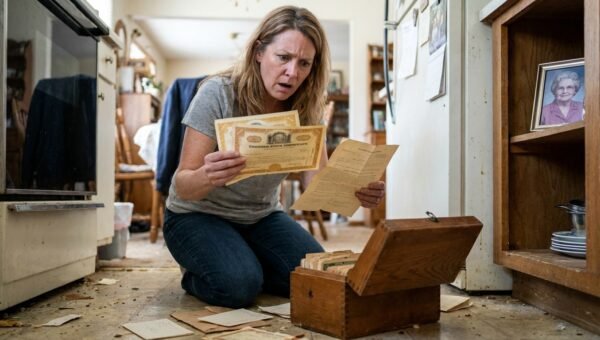
I opened the booklet. The very first entry was dated twenty-two years ago, exactly three weeks after Mark and I signed our marriage license. The deposit amount was $1,500.
The next entry was a month later: $300. Then another: $300. Page after page, running through the years, there were regular monthly deposits. Sometimes $250, sometimes $500, occasionally an extra thousand around Christmas. Beside several of the entries, there were small notations written in pencil: *Sarah’s roof share*, *Clara’s braces*, *Sarah’s car repair*.
My hands were shaking so badly the paper receipts slipped from my fingers, scattering across the carpeted floor.
I knelt down to gather them. They weren’t just standard receipts. They were cashier’s check stubs and certified transfer slips, every single one made out to banks, contractors, and medical offices.
The top one was from twelve years ago, when the roof on our first house developed a leak so severe the dining room ceiling collapsed during a spring storm. Mark had come home that week saying he worked extra overtime at the firm and received an advance on his quarterly bonus to cover the $4,800 repair bill. But the slip in my hands was a direct cashier’s check drawn from this exact account, signed by Evelyn, made payable directly to Larson Roofing.
The next receipt was for $3,600 to Dr. Kenneth Vance, the orthodontist who handled Clara’s severe crossbite when she was eleven. Mark had told me he won an internal safety design award at work that paid for Clara’s mouth gear.
Every financial emergency we had ever faced, every time Mark had magically “worked things out” or “gotten an unexpected bonus,” was right here in this stack of paper.
I flipped to the very last page of the passbook. The final entry was stamped six months ago, right around the week Evelyn received her terminal diagnosis.
The printed balance on the ledger read: $148,250.
Tucked behind the back flap was a single sheet of cream-colored stationery, folded in thirds. I unfolded it carefully.
*Sarah,* the letter began.
*If you are reading this, I am gone, and you no longer have to endure my presence at your table. I know you hated me. You had every reason to. I made sure of it.*
*When Mark was twenty-four, before he met you, he took $65,000 from his father’s estate account to invest in a friend’s logistics startup without telling anyone. Within eight months, the company went bankrupt. His father died believing our savings had been drained by bad market luck because I covered for Mark. I never let his father know the truth. Mark was charming, impulsive, and completely blind to the reality of money. He believed everything would work out because someone always cleaned up after him.*
*When he brought you home, I saw an honest, hardworking girl. You worked thirty-five hours a week at the community college library while finishing your accounting degree. You budgeted every dollar. You loved my son, but you did not know him yet.*
*I knew that if Mark knew I had money set aside for his family, he would spend everything he earned, take careless risks, and borrow against your future, assuming his mother’s safety net was always there. And if he knew I was giving you money, he would pressure you to hand it over for his schemes.*
*I could not protect you from his nature with words. A mother telling a wife about her husband’s flaws only destroys the marriage. So I made myself the enemy.*
My throat felt completely parched. I looked toward the open doorway of the fellowship hall. Across the room, Mark was laughing softly with his cousin, holding a paper plate with a slice of cake.
PART 3
I leaned against the wood paneling of the hallway, holding the letter with both hands.
*I let him believe I was hard on him,* the letter continued. *I let him believe I watched every penny and resented you. But every time a real crisis hit your household, Mark came to me in private. He didn’t ask for advice. He asked for money. He begged me to keep it between us so you wouldn’t worry, but really, he was terrified you would realize he hadn’t managed his paycheck.*
*I paid the bills directly to the roofers, the doctors, and the car mechanics. I made Mark promise to tell you he earned it through hard work. I wanted you to respect your husband, even if he didn’t fully earn it on his own. But I made him repay every cent he took, plus a little extra, back into this account.*
*Whenever he wanted money from me, I told him I would only lend it if he signed an automatic transfer agreement from his personal checking to this trust account. He thought he was paying back an old woman’s cold demands. In reality, he was funding your security.*
*The passbook in your hands is in your name alone. It was registered under a private trust twenty years ago. Mark has no signature authority on it. He does not know how much is in it. He believes I gave you a family pendant.*
*The key taped to the card is for Safe Deposit Box 412 at the Oak Park branch. Inside are the original transfer agreements signed by Mark, the title to my home, and the deed transfer paperwork. The house is deeded directly to you and Clara, with life estate protections so Mark cannot mortgage it or sell it without your consent.*
*I was not a warm mother to you, Sarah. I could not be warm and maintain the wall. If I had been kind, Mark would have used that bridge to make you ask me for bailouts. You would have been caught between your husband’s pride and my purse.*
*Do not let him touch this money. It is yours. You earned it by keeping a home together with a man who never learned how to carry his own weight.*
*I am sorry for the cold rooms and the silent dinners. I hope you can forgive an old woman who knew only one harsh way to protect what mattered.*
*Evelyn.*
The hallway was quiet except for the muffled sound of hymn music playing over the chapel speakers.
I carefully folded the letter and put it back into the passbook. I put the passbook, the receipts, and the brass key back into the gray box, wrapped the brown paper around it, and tied the twine back into a knot.
When I walked into the hall, Mark was standing near the coffee urn. He saw me holding the box against my ribs.
“Everything okay?” he asked quietly, glancing at the plain package. “What was it? Some old jewelry?”
“Just something she wanted me to keep,” I said.
Mark looked down at his shoes, then nodded. “She was strange at the end. Obsessed with keeping things private. Don’t feel bad if it wasn’t much, Sarah. You know how she was.”
“Yes,” I said. “I know exactly how she was.”
ENDING
We drove home in the late afternoon rain. Mark drove, talking about the turnout, the nice things his cousins said about Evelyn, and how we needed to decide what to do with her furniture.
“We should probably sell the house quickly,” Mark said, tapping his fingers on the steering wheel as the wipers swept back and forth. “The market in Oak Park is high right now. We could pay off our credit cards, maybe look into that commercial property Tom was telling me about last month. It could set us up for retirement.”
I looked out the passenger window at the gray suburbs passing by. For twenty-two years, I had believed I was walking on eggshells around a woman who thought I wasn’t good enough for her son. For twenty-two years, I had carried the shame of her cold stares, wondering what defect in me made her look away whenever I spoke.
Now I knew the truth. She hadn’t looked away because she hated me. She looked away because she couldn’t afford to let her son see that we were on the same side.
“We aren’t selling the house, Mark,” I said.
He glanced over at me, surprised by the tone of my voice. “What do you mean? It’s going to be in probate for months anyway, but why wouldn’t we sell it?”
“It’s not in probate,” I said. “And we aren’t investing in commercial real estate.”
Mark frowned, his grip tightening on the wheel. “Sarah, you don’t know the first thing about my mother’s estate. She handled her own affairs.”
“I know,” I said. “And she handled them very well.”
On Monday morning, while Mark was at work, I drove to the First National Bank of Oak Park. I showed the teller the passbook, the certified trust papers, and my identification. The manager took me down into the vault, unlocked Box 412, and handed me the heavy metal tray.
Inside were twenty-two years of signed promissory notes, the original deed to the Oak Park house with my name and Clara’s listed as primary beneficiaries, and an updated bank draft confirming the $148,250 balance sitting safely in an account Mark could never touch.
I sat in the small private booth inside the vault, looking at the documents spread across the green felt table.
I didn’t yell at Mark when I got home. I didn’t present him with a stack of papers or demand an apology for twenty-two years of manufactured overtime and hidden debts. Instead, I laid out a simple family budget on the kitchen table and told him our credit card balances would be paid down from his monthly salary starting this month, without exceptions. When he started to argue that we had other avenues, I simply looked him in the eye and said, “There are no other avenues, Mark. Your mother’s safety net is gone.”
He went quiet. The color drained from his face, and he never asked about the brown box again.
Every month now, I drive over to the brick house in Oak Park. I open the windows, let the fresh air through the living room, and dust the dark mahogany dining table where I sat in silence for two decades.
Before I leave, I always pause at the small marble console table by the front door. There is a photograph of Evelyn sitting there, taken when she was around forty, looking straight into the camera with her chin up and her mouth set in a firm, unyielding line.
I don’t feel anger when I look at her anymore. I don’t feel relief that she is gone.
I pick up my keys, lock the front door, and say what I should have said every time I walked out of that house:
“Thank you, Evelyn.”