PART 1
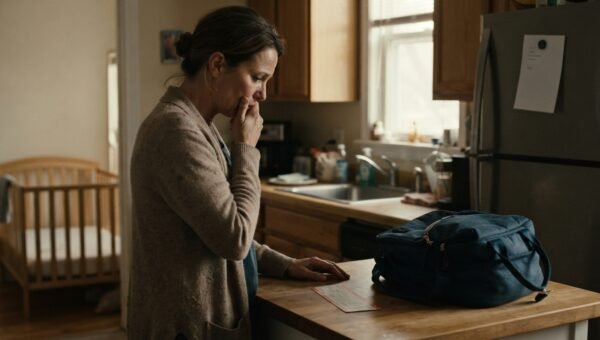
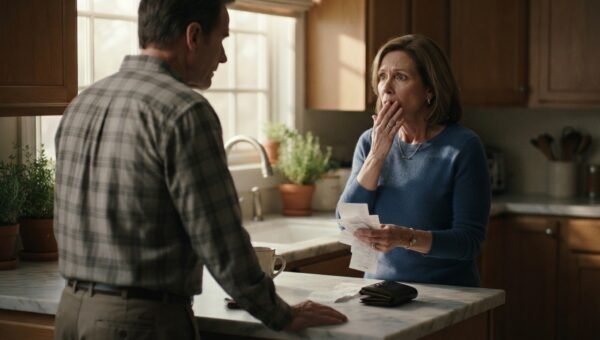
The manila folder hit our dining room table so hard it rattled the salt shaker. I was standing there in my wool cardigan with a dish towel still draped over my forearm, wiping down the counters after dinner.
David didn’t look like a husband of twenty-eight years in that moment. His jaw was set like iron, his face flushed red beneath his graying stubble.
“Don’t bother denying it, Nora,” he said, his voice shaking with a fury that felt rehearsed. “I went into the closet to get the extra blanket from the top shelf.
Your tan leather bag was unzipped on the floor. Look at what fell out.”
He dropped a small white cardboard sleeve onto the placemat. Inside was a magnetic plastic keycard stamped in green ink: Lakeside Inn, Room 217.
I stared at it. “David, what are you talking about? I haven’t carried that purse since my cousin’s wedding last autumn. It stays locked inside my cedar trunk in the back of the walk-in closet.”
“Cut the crap!” he shouted, slapping the table. Beside the keycard, he pulled out a thick stack of printed papers from the inside pocket of his jacket. I caught the bold header on the first page: Petition for Dissolution of Marriage. “You think I’m blind? You think I don’t see you pulling away? You’re sleeping with someone at a cheap motel forty miles outside town.”
My hands went cold. We had hit a rough patch after his father passed away eighteen months ago, but divorce papers already drawn up and printed?
It was insane. I leaned closer to the cardboard sleeve on the table. Printed right below the hotel logo was a faint dot-matrix timestamp from the front desk: Check-in: March 18.
March 18 had been three weeks ago. It was a Tuesday.
“David,” I said slowly, looking directly into his bloodshot eyes. “On March 18, you told me you were driving down to Columbus to stay two nights at your brother Greg’s house to help him rebuild his back porch. You took your truck. I stayed here alone, took my blood pressure medication, and went to bed by nine.”
“Don’t try to turn this around on me!” he snarled, snatching the papers back up. “You made your bed. Literally. I want you out of this house by Friday, or my lawyer files these downtown with every scrap of proof I’ve got.”
He turned on his heel and slammed our bedroom door shut, turning the brass lock from the inside.
I didn’t sleep that night. I sat on the sofa in the dark living room, staring out the front window at the streetlights reflecting on our wet driveway.
The whole scene made no sense. Why would a keycard be in a purse I had locked away in a trunk? David had the spare key to that cedar trunk on his workbench ring. Why were divorce papers already drafted by an attorney before he even confronted me?
At seven the next morning, I heard the shower run, followed by the sound of David pulling his truck out of the gravel drive. He had left for his plumbing supply warehouse without saying a single word.
I walked to the kitchen, poured black coffee into a mug, and picked up the keycard. The phone number for the Lakeside Inn was printed in small font along the lower edge.
My fingers trembled slightly as I dialed.
“Lakeside Inn front desk, this is Ray,” a gravelly voice answered after three rings.
“Good morning,” I said, forcing my voice to sound polite and brisk. “I’m calling to clear up an old billing discrepancy from last month.
I have a room keycard here for Room 217, checked in on March 18. I need to know what credit card was used to secure the booking.”
I heard the rhythmic tapping of a computer keyboard on the other end. Ray sighed heavily.
“March 18… let’s see. Room 217. No card on file, ma’am. The room was paid in full with three one-hundred-dollar cash bills at check-in. But it was reserved over the phone two days prior.”
“Under what name?” I asked, my pulse pounding in my ears.
“Under Nora Callahan.”
Callahan was my maiden name. I hadn’t used that name on a legal document or a reservation in nearly three decades. David knew it, of course. His family knew it. Nobody else in my current daily life ever called me that.
“Ray,” I said, gripping the countertop, “is there any way you have security footage of the lobby from that evening? I am dealing with a serious identity fraud issue.”
The clerk paused. “Look, lady, I’m not supposed to show security tapes to random callers. That’s for the manager or the sheriff.”
“Please,” I pleaded, hearing the raw desperation leak into my own voice. “My husband just handed me divorce papers over this exact room. If you can just let me see who checked into that room under my name, I’ll pay whatever fee you need.”
There was a long silence on the line. Ray grunted softly. “The manager doesn’t come in on Wednesdays. I’m here alone until three. If you can get here before noon, I’ll let you look at the lobby monitor. But you didn’t hear it from me.”
I grabbed my jacket, took my car keys, and drove forty miles south along Route 4 through the pouring rain.
The Lakeside Inn was a faded two-story brick motor lodge sitting behind an overgrown row of pine trees. Inside the front office, the carpet smelled like stale cigarette smoke and damp carpet cleaner. Ray was an older man with wire-rimmed glasses and a faded navy windbreaker. He looked at my driver’s license, nodded silently, and motioned me behind the laminate counter into a cramped back room.
A small black-and-white CRT monitor sat beside an old digital video recorder. Ray clicked the mouse a few times, pulling up a grainy video file timestamped March 18, 9:14 PM.
On the screen, the front double doors opened.
A man walked into the lobby, wearing a heavy hooded coat and a baseball cap pulled low. I recognized the square set of his shoulders and his distinct, heavy limp immediately. It was David. My stomach dropped into a sickening void. He hadn’t been in Columbus with his brother. He was here.
Behind him walked a woman. She was bundled up in a beige trench coat with a silk scarf wrapped entirely around her head and sunglasses covering her eyes, hiding her face from the counter. On her right shoulder hung my tan leather purse.
Ray fast-forwarded the clip. David handed cash to the night clerk, grabbed the room sleeve, and guided the woman toward the side hallway leading to the guest elevator.
Just before they reached the elevator doors, the woman stopped. She adjusted her scarf in the full-length mirror mounted on the lobby wall. As she lifted her chin and pulled the silk fabric down to breathe, the mirror angle caught her face squarely under the fluorescent lighting.
My breath caught in my throat.
It wasn’t an affair partner. It was David’s younger sister, Brenda.
Brenda was forty-nine years old, a former certified nursing assistant who had fallen into massive credit card debt and pill addiction five years ago. David had spent years bailing her out behind my back, constantly making excuses for her missed rent and unpaid utility bills. But why was Brenda using my maiden name, carrying my purse, and checking into a remote motel with my husband in the middle of a Tuesday night?
Ray rewound the clip five seconds and paused it. The image showed Brenda’s face in profile, hollow-cheeked, pale, and terrified, clutching my bag against her chest like a shield.
I took out my phone and took three crisp photos of the monitor screen. I thanked Ray, slipped him a fifty-dollar bill from my wallet, and walked out to my car.
My hands were shaking so hard I could barely steer onto the highway. When I got back to our house, I sat at the kitchen island with my coat still on, waiting.
At five-thirty, David’s truck pulled into the gravel drive. He came through the mudroom door carrying his lunch cooler, looking irritated and tired. When he saw me sitting there at the island, his scowl deepened.
“Still here, Nora? I told you, my lawyer is submitting the filing on Friday. Don’t make this uglier than it has to be.”
I didn’t yell. I didn’t cry. I picked up my phone, brought up the high-contrast photo of Brenda looking into the lobby mirror with my purse on her arm, and laid the screen flat on the counter in front of him.
David glanced down dismissively, then froze. The color drained from his skin so fast he looked like a corpse. His mouth opened slightly, his throat working as he tried to swallow.
He didn’t yell. He didn’t defend himself. He stared at his sister’s face on the glowing glass, his hands trembling at his sides, and whispered:
“She wasn’t supposed to survive that night.”
PART 2
The silence in our kitchen was so heavy I could hear the hum of the refrigerator.
“What did you just say?” I asked, rising slowly from the stool. “What did you do to Brenda, David?”
David staggered back against the refrigerator, his hands gripping the edge of the countertop. His eyes were wide, darting toward the front door as if he expected state troopers to walk through it.
“She called me,” he stammered, his voice thin and cracked. “March 18. She was at her apartment in Marion. She was three months behind on rent, and she had taken something. She was slurring, crying that she couldn’t take the collection calls anymore. She told me she had taken half a bottle of sleeping pills washed down with vodka.”
“And you didn’t call 911?” I yelled, my voice breaking. “You drove two hours to get her and put her in a cheap motel forty miles away?”
“You don’t understand!” David cried, throwing his hands up. “Brenda had two warrants out for failure to appear over unpaid medical bills and passing bad checks. If paramedics went to her apartment, the police would have taken her straight to the county jail the second she woke up. She begged me not to call them. She begged me to help her hide.”
“And the purse? The name? Framing me for an affair?” I demanded, tapping my finger fiercely against the glass screen. “Explain that, David!”
He slumped forward, putting his head in his hands. He was weeping now, ugly, choked sobs.
“When I got to her place, she was half-conscious on the couch,” he whispered. “She had a suicide note written out on the coffee table. She told me she wanted to vanish. She didn’t want to exist anymore. I panicked. If she died in my truck, they’d charge me with neglect or hiding a fugitive. I drove her out toward the county line, intending to let her sleep it off at the Lakeside Inn. But when we got near the desk, I realized they’d ask for an ID if we used a card. I had three hundred dollars cash in my wallet.”
“Why my name?”
“Because Brenda didn’t have her wallet,” David said, his voice dropping to a harsh whisper. “She had lost her purse days before. I grabbed the spare key to your cedar chest two days earlier because I had taken your old leather purse to give her something to carry her clothes in. Your old expired library card and an old insurance card were still tucked in the interior zipper pocket. I used your maiden name because if Brenda died in that room overnight, I wanted the reservation tied to someone else. I wanted time to figure out what to do.”
The cold, calculated monstrosity of what he had done washed over me.
“You set me up,” I whispered. “You planted the keycard in the purse later, didn’t you?”
“No,” David said, looking up with tears streaming down his cheeks. “Brenda didn’t die. She woke up at four in the morning vomiting. She was hysterical. She walked out of that room before sunrise while I was asleep in the chair. When I woke up at dawn, she was gone, but she had left your purse behind on the bedside table. I took the purse, threw it in the back of my truck, and went to look for her. I couldn’t find her anywhere. When I got home two days later, I hid the purse back in the closet. But then last week, I got a call from an investigator.”
“What investigator?”
“A private investigator hired by Brenda’s landlord,” David said, his chest heaving. “They traced her cell phone’s last ping to the cell tower near the Lakeside Inn. The investigator told me they were pulling the guest logs for March 18. Nora, if the police find out I took her to that motel while she was overdosing, and she’s dead somewhere in the woods, I’m an accessory. I panicked again. I had the lawyer draw up divorce papers, planted the keycard where you’d see it, and planned to claim you were the one at the motel having an affair. I thought if I threw suspicion on you, nobody would look at me.”
I stared at the man I had shared a bed with for nearly three decades. He hadn’t just made a mistake; he was willing to destroy my reputation, drag me through divorce court, and let me be suspected of adultery and criminal evasion just to save his own miserable skin.
“Where is she now, David?” I asked coldly.
“I swear to God, Nora, I don’t know,” he sobbed. “I thought she died by the river. That’s what I meant when I saw the tape. When you showed me that picture, I thought you were telling me she died that night and they found the body.”
“Pack your bags,” I said quietly.
“Nora, please—”
“Pack your bags and get out of this house tonight,” I told him, picking up the divorce papers he had printed. “Because tomorrow morning, I’m going to the sheriff’s department with these photos and the hotel records. If you’re still in this house when the sun comes up, I’ll have them arrest you right here in the kitchen.”
PART 3
David left that night in his truck with two duffel bags, heading for his brother Greg’s house in Columbus for real this time.
The house was dead silent, but I couldn’t sleep. My mind kept returning to that paused video frame on my phone: Brenda’s gaunt, terrifyingly thin face reflected in the elevator mirror.
If Brenda had walked out of that motel room alive at dawn on March 19, where could an unemployed woman with no car, no money, and no identification have gone on foot in the freezing March rain?
The Lakeside Inn sat at the intersection of Route 4 and State Route 314. There was nothing out there except a truck stop, an abandoned grain silo, and three miles south, St. Jude’s Catholic Parish, an old stone church that ran a small volunteer soup kitchen on Wednesday mornings.
At seven-thirty on Thursday morning, before going to the county sheriff, I got back in my car and drove down to St. Jude’s.
The church basement smelled of bleached floors and brewed decaf coffee. A few elderly volunteers in aprons were stacking plastic folding chairs. Behind the serving counter was Father Thomas, a man in his sixties with white hair and kind, tired eyes whom I recognized from community charity drives years ago.
“Excuse me, Father,” I said, approaching the counter. I pulled out my phone and showed him the screen. “I am looking for my sister-in-law. Her name is Brenda. She was seen near Route 4 on the morning of March 19. Has she been here?”
Father Thomas looked at the photo, his expression shifting from polite curiosity to solemn recognition.
“She was here,” he said softly. “On the morning of the nineteenth. A semi-truck driver found her walking along the shoulder of the highway in the rain without a coat. He brought her here. She was suffering from severe hypothermia and dehydration.”
My heart jumped into my throat. “Is she alive? Where is she?”
“She is alive, Mrs. Callahan,” Father Thomas replied, using my family name gently. “She was terrified. She told me she had taken pills, that her family was better off without her, and that she had nowhere left to run. We called an ambulance from St. Anne’s Mercy Hospital in Newark. They placed her on a temporary psychiatric hold. Last week, our parish charity fund helped transfer her to a women’s residential recovery center in Zanesville.”
Tears pricked the corners of my eyes, but this time they were tears of profound relief. Brenda hadn’t died alone in the woods. She was safe, receiving medical care, and out of the cold.
“Does David know?” I asked.
“No,” Father Thomas said. “Brenda explicitly requested that we do not contact her brother. She said he had made it very clear that her existence was a burden he could no longer carry.”
I thanked Father Thomas, walked out to my car, and sat in the front seat. The puzzle was finally complete.
David hadn’t just tried to protect himself from warrants; he had treated his sister like a piece of toxic trash to be abandoned in a remote motel room to either die or disappear, and then used her tragic spiral as a weapon to divorce me and seize control of our marriage assets before his fraud was discovered.
I drove straight to the county courthouse.
I didn’t hire David’s slick divorce attorney. I hired Marilyn Vance, a formidable family lawyer who had handled high-conflict domestic cases in our county for thirty years. I sat in her office and laid everything out on the desk: the hotel keycard, the printed time logs from the Lakeside Inn showing the cash payment under my forged maiden name, the photographs of the security monitor showing David and Brenda, and Father Thomas’s contact information documenting Brenda’s admission to St. Anne’s Mercy Hospital.
“This isn’t just grounds for divorce, Nora,” Marilyn said, scanning the documents with a sharp, calculating gaze. “This is intentional infliction of emotional distress, attempted fraud, and reckless endangerment. If he tries to contest a single penny of your marital property, we will take these materials to the county prosecutor’s office.”
ENDING
David tried to fight back at first. Two weeks later, his attorney sent a formal letter offering a fifty-fifty split of our joint savings and demanding that I buy out his half of our four-bedroom house.
Marilyn sent back a single response packet. Inside was a copy of the Lakeside Inn lobby security still, a sworn affidavit from Ray confirming the cash check-in under my maiden name, and a notarized statement from Father Thomas detailing the condition Brenda was in when she was abandoned on the highway. Attached was a cover letter stating that if David did not sign our settlement agreement within forty-eight hours, the full file would be delivered directly to the Ohio State Highway Patrol and the county district attorney.
David signed the agreement the very next morning.
Under the final divorce decree finalized four months later, I retained sole ownership of the house, our joint retirement accounts were divided with seventy percent awarded to me to offset the money he had secretly siphoned over the years, and David was ordered to assume full responsibility for his own outstanding personal debts. He moved into a small, rented two-room duplex outside Columbus and took a job working night shifts for an industrial maintenance contractor.
He tried calling me once, late on a Friday night in August. His voice was thick with alcohol, mumbling apologies and asking if we could sit down over coffee to talk about thirty years of memories. I didn’t say a word. I simply ended the call and blocked his number permanently.
As for Brenda, I drove out to the recovery center in Zanesville three weeks after the divorce was finalized.
When she walked into the visitor’s lounge, wearing a plain gray sweatshirt and jeans, she looked ten years younger. Her color was back, her hands were steady, and for the first time since I had known her, the frantic, hunted look in her eyes had been replaced by a quiet calm.
She started crying the moment she saw me, apologizing over and over for taking my bag, for letting David use my name, and for the destruction her addiction had brought into our lives.
I didn’t lecture her. I sat beside her on the vinyl couch, handed her a tissue, and told her the truth: David’s choices were his own, and her recovery was hers.
I set up a small trust account with five thousand dollars from my settlement to ensure she had rent covered for her first three months in sober housing once she graduated from the program.
Today, my home is quiet. The cedar trunk in my closet is gone, replaced by shelves of books and sewing supplies. Some evenings, when the sun sets behind the oak trees in my backyard, I still feel a dull ache for the marriage I thought I had for almost three decades. But the ache passes quickly. I would rather live alone in absolute truth than spend another second sharing a life with a man who could look at the people he was supposed to protect and calculate the cost of their destruction.