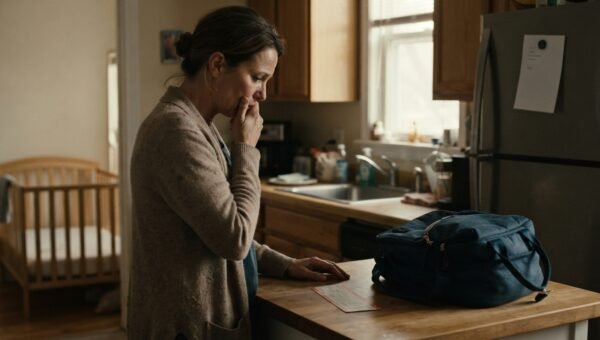
The kitchen smelled of stale coffee and damp paper towels because I hadn’t taken the trash out since Tuesday. Julian had called me two days before that, his voice thin and hurried over the line, telling me not to make any plans for Saturday morning. He said they were keeping it small, just a quiet thing down at the county courthouse with a judge and maybe two witnesses, so I didn’t need to bother driving forty miles into the city or buying a new dress.
I told him I understood, because that was what I always told him, that I wanted whatever was easiest for him and his new life among people who had more money than we ever did.
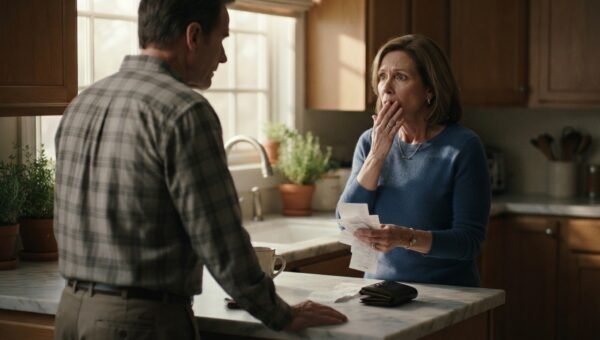
I was tossing out an empty tin of soup when my thumb hit something stiff at the bottom of the bin. It didn’t belong in the food scraps. I pulled it out by the corner, my glasses sliding halfway down my nose, and stared right at the heavy ecru card stock with raised gold lettering. It was an invitation. Not for a courtroom bench and a tired clerk, but for the Oakridge Country Club. One hundred and twenty guests, string quartet on the terrace, prime rib carving stations at six in the evening. My name was printed right there on the fold beneath the words Mother of the Groom, except someone had taken a black felt-tip marker and scrubbed it out so hard the paper was starting to feather and tear.
I stood there by the sink for a long time holding that ruined piece of cardboard while the kitchen faucet leaked a slow, steady drip against the stainless steel basin. My chest felt tight, like someone had wrapped a wet belt around my ribs and pulled it one notch too far. Julian had never been a cruel boy, just a weak one, the kind of person who bent whichever way the wind blew hardest. His fiancée, Celeste, came from a family that owned three car dealerships down in Greenville and a house with pillars out front that looked like a bank. They didn’t talk about my old kitchen or the five years I spent working the register at the hardware store to keep the lights on after his father left. To them, I was just a background detail they couldn’t afford to crop out of the wedding album, so they decided to paint over me instead.
My hand was shaking when I picked up the landline, the little plastic numbers feeling greasy under my thumb. I didn’t wait for him to answer. Celeste picked up on the second ring, her voice crisp and bright like she was answering the phone at a law office. When I asked her why my name was crossed out of the trash and what kind of courthouse had a string quartet, the silence on the other end wasn’t even hesitant. It was just cold.
“We decided your presence would confuse people, Clara,” she said, and she didn’t even bother calling me Mrs. Hayes. “Julian has worked very hard to build a certain reputation at the firm, and we simply didn’t think you’d fit in with our guests. It’s better for everyone this way.”
Before I could get a single word past my teeth, the line went dead with a sharp click.
I didn’t cry. You don’t spend thirty years raising a boy alone in a drafty house without learning how to swallow your own tongue when things go sideways. Instead, I walked over to the sideboard in the dining room and opened the velvet-lined box resting behind the silver teapot. Inside sat the heavy gold cuff links my grandfather had worn every Sunday of his life, the ones Julian had asked for three weeks ago with that shy, sideways smile he used when he wanted me to do something he knew he didn’t deserve. He told me he wanted to wear them at the altar to feel like family was right there with him.
The drive down to the country club took forty-eight minutes because I hit every red light on the bypass and got stuck behind a tractor hauling three tiers of square hay bales. My knuckles were white against the steering wheel, locked tight around the vinyl. The sky over the golf course was turning that bruised purple color that usually meant a summer thunderstorm was about to break over the trees. I didn’t have an invitation, and I wasn’t wearing my good shoes, but I had those cuff links sitting in their velvet bed on the passenger seat, and I had a stubborn streak that my grandmother always said would get me into trouble one day.
The parking lot was full of imported sedans with temporary paper plates and shiny silver hoods that reflected the gray clouds overhead. I parked my old sedan right between a black Mercedes and a Land Rover that looked like it had never seen a gravel road in its life. When I pushed through the heavy glass doors of the clubhouse lobby, the air-conditioning hit me like cold water, smelling of expensive lilies and floor wax. A young woman in a sharp black blazer was standing by a mahogany table covered in place cards, checking names off a leather-bound clipboard with a silver pen.
“Can I help you, ma’am?” she asked, her voice dropping into that professional singsong people use when they want you to leave before you track mud on the carpet. “If you’re looking for the reception, it doesn’t start until six, and the ceremony terrace is private.”
I reached into my handbag and pulled out the small leather box, setting it right on the mahogany table among the place cards. “I’m Clara Hayes,” I said, and my voice sounded lower and steadier than I felt inside. “I’m here to see my son. Julian Hayes. He asked me to bring these for his cuffs, though I suppose he doesn’t need them now that he’s got a new family.”
The coordinator stopped writing. Her pen hovered an inch above the paper for three full seconds before she looked up at me, her forehead wrinkling into a small, tight knot. “You’re… Clara Hayes?” she asked, her eyes darting from my face down to the box and back up again. “That’s impossible. Mrs. Hayes arrived an hour ago. We were all wondering why you missed the rehearsal dinner yesterday, seeing as how we hosted it specifically in your honor.”
I didn’t blink. “My honor?”
“Yes,” she said, her voice dropping as if she were letting me in on a secret. “Julian told us you were a retired schoolteacher from out of state who raised him single-handed after a tragic accident. He said you were arriving early to help with the table arrangements.”
She reached down, picked up a heavy cream-colored seating chart from the corner of the table, and turned it around so I could read the names printed in neat gold script at Table One, right beside the bride and groom. There was my full name, Clara Elizabeth Hayes, written in elegant calligraphy. Only the woman sitting in that chair wasn’t me.
Before I could ask what kind of sick game they were playing, the heavy mahogany doors at the far end of the lobby swung open with a soft, pneumatic hiss. A wave of low laughter and the sound of clinking crystal floated out from the ballroom. A woman stepped through the doors into the hallway, turning back to say something to someone inside. She was wearing a floor-length gown made of heavy blue silk that caught the light from the crystal chandelier overhead. It was my dress. The one Celeste had come over to my house three weeks ago to admire, the one she insisted needed a professional dry cleaner’s attention before the ceremony because of a tiny water spot near the hem that nobody else could even see.
The woman turned around and looked straight across the lobby at me. She was older than me by a few years, with dyed blonde hair pulled back into a neat French twist and diamond studs in her ears that caught the light. She froze halfway down the carpeted runner, her mouth parting slightly as she looked down at my sensible walking shoes and then back up at my face.
The coordinator looked between the two of us, her mouth opening and closing like a fish out of water. “Oh,” she whispered, and the word sounded thin and sharp in the quiet lobby. “Oh, no.”
The woman in my blue silk dress didn’t run, but she didn’t move either. She just stood there by the open doors with her hands clasped in front of her waist like an actress who had forgotten her next line in the middle of the third act. I could hear the string quartet tuning up inside the ballroom, playing something light and cheerful that didn’t fit the air in the hallway at all. My heart was beating hard against my ribs now, but my hands stopped shaking entirely. Every bit of noise in the room went quiet except for the hum of the air conditioner overhead.
“I see she found my dress,” I said to the coordinator, my voice barely above a whisper. “Does she have my name on her driver’s license too, or did Celeste just pay her by the hour?”
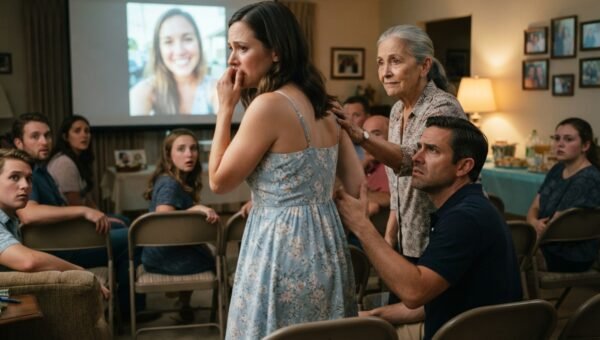
The coordinator didn’t answer. She just stepped back, her hands flying up to cover her mouth as the doors behind the woman in my dress pushed open further and Julian stepped out into the hall. He was wearing a rented tuxedo with a white rose pinned to the lapel, looking every bit the successful young man his father had never managed to be. When he saw me standing there by the seating chart with my old canvas purse over my shoulder, the color drained right out of his face until he looked almost gray.
“Mom,” he said, and his voice cracked on the first syllable. “What are you… how did you get in here?”
I walked past the coordinator without looking at her, my shoes making a dull, heavy sound on the carpet. I didn’t stop until I was standing three feet away from my son, close enough to smell the expensive cologne he was wearing that he probably bought with money he borrowed from Celeste’s father. The woman in my dress stepped back into the shadows of the doorway like she wanted to melt right through the wood paneling.
“You told me it was a courthouse,” I said, and every word came out slow and plain, without any shouting or theatrics. “You told me nobody was going to be here.”
Julian tried to step forward, his hands twitching at his sides, his eyes darting toward the open ballroom doors where forty or fifty guests were starting to turn around in their seats to see what was holding up the procession. “Mom, please. Just let me explain. Celeste’s family… they have different expectations. They don’t understand things like we do. It was just for one night to keep the peace.”
“To keep the peace,” I repeated. I reached down and picked up the leather box containing the gold cuff links from the mahogany table where I’d left it. I popped the brass clasp with my thumb, letting the lid flip back. The gold caught the light from the chandelier, glowing warm and bright against the old blue velvet. “You asked for these. You told me you wanted your grandfather’s things with you when you started your new life.”
“Mom, don’t,” he whispered, his voice dropping into a ragged plea as he reached out to grab my arm. “Don’t do this here.”
I pulled my arm back before his fingers could touch my sleeve. I didn’t want him to touch me. I didn’t want anything he had to offer. I tipped the small velvet box upside down right there on the polished hardwood floor between our feet. The two heavy gold cuff links tumbled out with a sharp, metallic clatter, rolling a few inches across the floor before coming to a dead stop against the toe of his shiny patent leather shoes.
“Keep them,” I said, and my voice didn’t shake once. “You’re on your own now, Julian. Go in there and tell your new family whatever you want about who you are. But you don’t have a mother anymore.”
I turned around before he could say another word. I walked back past the coordinator, past the mahogany table with the place cards, and out through the glass double doors into the heavy evening air. The thunderstorm was finally breaking over the hills, dropping fat, warm drops of rain onto the concrete as I walked across the parking lot toward my car. When I climbed behind the steering wheel and pulled the door shut, the silence inside the cab was absolute, broken only by the sound of the rain drumming against the roof. The passenger seat was completely empty except for one small, open square of faded blue velvet where the cuff links used to be.