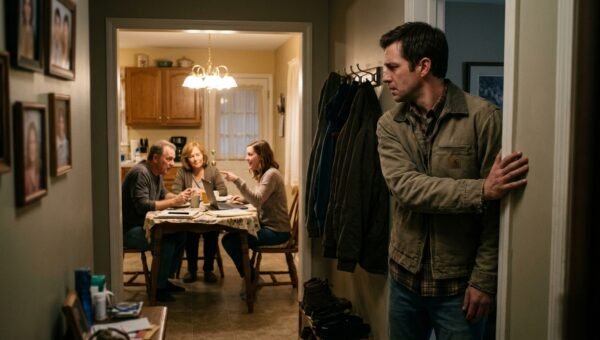
I was holding a warm bottle when Randall came up my porch with two police officers and called Tessa a kidnapper. I knew my son’s boots before I saw his face. For years, he’d left them by my back door, even after I asked him not to.
This time he had a badge on either side of him.
“Open the door, Mom,” Randall said. “She took my daughter.”
Behind me, Tessa had the baby pressed to her chest. She didn’t answer him.
She looked at me, and I could tell she was asking me to make the choice she was too scared to ask for.
I’m writing this because I keep going over the first thing I did. I opened the door wider.
I thought I was helping.
Tessa had been married to Randall for four years. Their baby, Mae, was eight months old. I won’t pretend I knew everything going on in their house. I didn’t. I knew they argued, and I knew Randall could get mean when he felt someone was taking his side away from him. He always had a reason ready. Money was tight. Tessa was too sensitive. He was only trying to keep the family together.
Then, one Thursday night, he put her bags and the baby’s carrier on the porch of their apartment and told her to leave.
He called me after midnight. He said Tessa had walked out and taken Mae.
He said she was unstable. I asked if the baby had her medicine and enough clothes. He said, “This isn’t your problem.”
It was, actually. The next morning, Tessa came to my house with two bags and a box of diapers. Mae had a dry patch on one cheek and a little white sock was missing. I don’t know why I remember the sock. I helped Tessa carry the bags into the spare room, and she kept saying she was sorry.
“Just until I figure things out,” she said.
“Stay tonight,” I told her. “We’ll deal with tomorrow after we sleep.”
I was certain I was doing the right thing. I also liked feeling needed. That’s a thing I have to admit. I’d spent too many Sundays telling myself Randall would call when he was ready, and here was a chance to be useful without asking him to come back.
For a while, the house was quiet in the plain, good way. Tessa washed bottles at the sink. Mae made a snorting sound when she laughed. I started warming the bottle before Tessa even asked. She thanked me every time, which got on my nerves a little, because she was living through enough without thanking me for every small thing.
Then Randall started calling.
At first, he wanted to know where Tessa had gone. I told him she was safe. He asked if Mae was with her. I said yes. He said I had no right to keep his daughter from him.
“I’m not keeping anyone from you,” I said. “You know where the baby is.”
“I’ll come get her when I’m ready,” he said.
That was the part that scared me. Not that he wanted to see Mae. Of course he did. It was the way he said “get her,” like Tessa was a coat he’d left behind.
Tessa asked me not to tell him when she took Mae to the clinic. She didn’t want an argument in the parking lot. I kept the appointment time from him, and I’m not proud of how relieved I was when he didn’t show up there. I was glad he didn’t know. I was also glad he still answered my texts about the electric bill at his old place. I kept trying to be the person who could hold both ends of the family together.
That was foolish.
The morning Randall came with the officers, I’d just taken Mae’s bottle out of the microwave. I remember testing a drop on my wrist and thinking it was too hot. Then I heard the knock.
Randall had his work jacket on. The younger officer introduced himself as Officer Bell. The other one, Officer Cormier, had a tablet tucked under his arm. Both were polite at first. Randall did most of the talking.
“She took my child,” he said. “I want her handed over.”
Tessa came down the hall with Mae held tight against her shoulder. “I didn’t take her,” she said. “He told me to leave.”
“You left with my daughter,” Randall snapped.
“I left because you put my bags outside.”
He stepped toward her. I put my hand on his chest and pushed him back before I’d even thought it through. He looked at my hand, then at me.
“Move.”
“No.”
I heard my own voice shake. I didn’t move.
Tessa began crying, but she was trying to keep her voice down because Mae was starting to fuss. She kept rubbing the baby’s back in the same little circles.
“Please don’t hand her over,” she said to me. “Please. Not to him. Not like this.”
“I’m not handing anybody anywhere,” I said.
Randall pointed at the officers. “They’re here because she kidnapped my daughter. She has no right to keep her.”
Officer Bell asked to see the custody paperwork. Randall handed him a folded packet. It was the first thing he’d brought that made him look prepared. He’d printed court forms. There were neat tabs along the side.
I’d thought, for one stupid second, that the officers would read the papers, tell Tessa what she had to do, and leave. I wanted the truth to be easy. I wanted my son to be the man I thought I’d raised, the one who’d helped carry groceries into my house when my knees were bad.
Officer Bell read the first page, then checked something on his phone. He frowned.
“Your daughter’s birth date is listed as March 4,” he said.
Randall nodded. “That’s what it is.”
Officer Bell looked at Tessa. “Her hospital record says February 4.”
The bottle was still in my hand. I set it on the little table by the door so carefully that it didn’t make a sound.
Randall glanced at Tessa. “They got it wrong.”
“No, they didn’t,” she said. “You know they didn’t.”
Officer Bell checked the registry again. “This entry was changed last month.”
Tessa looked at me. I could see she’d known something was wrong with the papers, but she hadn’t known how bad. She said Randall had asked her to sign a form weeks earlier. He told her it was for insurance. She didn’t sign it because the date was wrong. He told her she was making a big thing out of nothing.
“What did you change it to?” I asked him.
He looked at me like I’d betrayed him by asking.
“I didn’t change anything,” he said.
Officer Bell turned one page toward him. “Your login was used.”
Randall’s voice went up. “This is a family matter.”
Officer Cormier had stopped looking at the papers. He was watching the blanket wrapped around Mae.
It wasn’t one I’d made. I could tell because the yellow ducks were too tidy. I’d seen it at the house before, though. A small knitted blanket with three ducks across one corner. Tessa had said Randall brought it home in the baby’s carrier after he kicked them out. He told her it had been in the car.
Officer Cormier took a step closer, but he didn’t touch Mae.
“Where did this blanket come from?” he asked.
Tessa looked down. “Randall brought it.”
Randall shook his head. “It’s hers. It came with the baby.”
Officer Cormier took out his tablet. “I’ve seen this before.”
The room seemed to get smaller, which is a silly way to put it. There was the hall, the little table, the bottle cooling in the open air. But I couldn’t find a place to put my eyes.
“Where?” I asked.
“In an open case file,” he said. “It was in a picture connected to an investigation into false birth records and illegal placements. We’ve been trying to identify the people involved.”
Randall cut him off. “That’s ridiculous. It’s a blanket.”
Officer Cormier turned the tablet so Officer Bell could see it. Then he showed it to me. The photo was grainy and taken from far away. I could still see three yellow ducks on the corner of a knitted blanket. The same tight little loops. The same uneven border.
I remember thinking the ducks looked cheerful. I hated that I noticed that.
Officer Bell pulled Randall’s paperwork closer. “You changed Mae’s date of birth to match a child listed in this case.”
Tessa made a small noise. She tightened her arms around the baby.
Randall’s voice dropped. “That’s not what happened.”
“You told me that blanket came from your car,” Tessa said.
“It did.”
“Then why is it in their file?”
He didn’t answer her. He looked at me instead, as if I could still fix it by telling the officers they had it wrong.
“I was trying to get my daughter back,” he said.
I had heard that line before, in different words. I’d let it stand in for an apology more than once.
Officer Bell said, “You came here and reported a kidnapping after changing the child’s birth date.”
“I didn’t change it.”
“Your account did.”
“I’m her father.”
“That doesn’t explain the blanket.”
The two officers were no longer treating this like a custody dispute. They asked Tessa to sit down. Officer Cormier asked if she and Mae were hurt. Officer Bell told Randall to step away from them.
Randall looked at me, angry now, but not loud. That was worse somehow.
“Tell them she’s been keeping my daughter from me,” he said.
“You put her outside,” I said. “With a baby.”
“I was mad.”
“You made her leave.”
“I didn’t know she’d run here.”
“You knew I’d let her in.”
He opened his mouth, then shut it. I hated that I could still see the boy he’d been when I said that. I hated more that I was using the boy to excuse the man.
Officer Cormier tapped the tablet and asked me to look at another image. The screen showed the courthouse hallway, dated the day the birth record was changed. Randall stood near a door with a folder in his hand. There was a woman behind him, half turned toward the camera.
Officer Cormier asked, “Do you know her?”
I took the tablet. My thumb was damp on the edge of the case.
The woman was Marcy Venn. She’d come to my house once for Easter dinner, wearing a cream sweater and carrying a grocery-store pie. Randall introduced her as someone from work. She said very little. I remembered her because she’d watched Mae while I carried plates into the kitchen, and when I came back she was holding the baby as if she’d done it a thousand times.
I’d told myself Randall deserved a new start. I even let Marcy take a picture of Mae.
“Yes,” I said. “That’s Marcy.”
Officer Cormier asked if I knew her last name. I did. I told them. He and Officer Bell exchanged a look that didn’t need explaining.
Randall took one step toward the tablet. “She has nothing to do with this.”
“Then why were you with her at the courthouse?” Officer Bell asked.
“She was giving me a ride.”
“With a folder?” I said.
He turned on me. “You don’t know what you’re talking about.”
“No,” I said. “I didn’t. That was the problem.”
Officer Cormier told him to sit down. Randall refused. Officer Bell repeated the order, and Randall finally sat on the chair by the wall, jaw working like he was chewing something. The officers called another unit and contacted the investigator on the open case. They photographed the paperwork and logged the blanket as possible evidence. Tessa signed a statement saying Randall had brought it to her.
Nobody took Mae away. Officer Bell checked Tessa’s original hospital record and called the clinic to confirm the date. They told her the kidnapping complaint would not be pursued against her. The officers said the new information had to be reviewed, but the altered record, blanket, and courthouse footage were enough to shift the investigation toward Randall and Marcy.
Randall kept saying it was a misunderstanding. He said Marcy was only helping with forms. He said he was trying to protect his family. The officers didn’t argue with him. They wrote down what he said.
Before they led him outside, he looked back at me.
“Mom, don’t do this.”
I’d spent years making room for that sentence. I’d let it mean he was sorry, or scared, or asking me to be kind. This time it meant he wanted me quiet.
“I’m telling the truth,” I said.
“You’re choosing her over me.”
“I’m choosing Mae.”
He looked past me at Tessa, who was holding the baby close and watching him leave. Then he went out with the officers.
The investigation didn’t end at my front door. Over the next few weeks, I gave a statement and handed over the messages Randall had sent me about the papers. Marcy was questioned too. The police logged the altered birth record and connected the courthouse video and blanket to the active case. Later, Randall was charged with forgery and conspiracy tied to the false identity records. I was told the case would take time. That part was out of my hands.
I stopped answering his calls. I didn’t block him right away. I wanted to hear whether he’d say something that sounded like the truth. He never did. He sent one message saying I’d ruined his life. I saved it for the investigator and didn’t reply.
Tessa and Mae stayed with me until she found a small apartment closer to her job. She didn’t ask me to take sides. She didn’t have to. I helped carry the crib over there, and she made coffee in a chipped mug she’d brought from my kitchen.
“I’m sorry you had to see that,” she said.
“I’m sorry I believed him for so long.”
She didn’t tell me it was all right. I was grateful she didn’t.
When I came home, Randall’s boots were still by my back door. I put them in a box and left it outside for him to collect. I didn’t keep a key for him. I didn’t call to check whether he’d picked them up.
The last time Tessa and Mae slept in my house, the police cruisers were already gone. I closed the heavy front door and slid the deadbolt into place. The click was small, but I heard it.
Then I helped Tessa lay Mae down with the familiar blanket tucked under her chin. The three yellow ducks were turned toward the wall. I turned the blanket so Mae could see them.