One year after I stopped taking the Sunday drives with Dad, I stood on a stranger’s porch while she shut the door in my face. She’d asked if I’d brought his blue thermos. I said no. From inside, a child called out, “Is that Pip?”
I stayed there longer than I should have, looking at the little patch of paint where the door had hit its frame. I didn’t know who Pip was to that child.
I only knew my father had been the one driving those roads for as long as I could remember, and I’d helped end the trips because I thought they were hurting him.
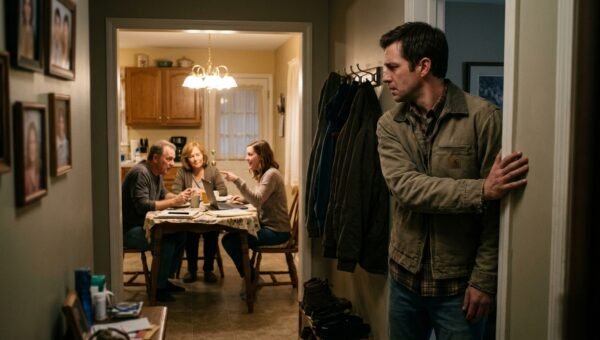
A year earlier, my brother Ron and my sister Beth had both said the drives were confusing Dad. He had dementia by then. Sometimes he couldn’t tell me which town we were passing through, or why we’d taken a turn he’d made hundreds of times. I didn’t want him upset, so I agreed to stop going.
I wasn’t forced. That part matters. I made the choice, and I’ve had to live with it.
The mechanic called because Dad’s old sedan had been sitting in his garage since Dad moved into full-time memory care. Joe said he’d kept it there as long as he could, but he needed the space. “Do you want it, or should I let it go?” he asked.
I bought it back. I told myself I wanted to keep Dad’s car in the family. Honestly, I wanted to see if it still smelled like his peppermints and the old cloth seats. It did.
The glove compartment stuck when I pulled it open. A folded piece of paper slid onto my lap. Dad’s handwriting was small and neat, the same way he wrote grocery lists. Three town names were crossed out. The last one, Elm Hollow, was circled.
I knew the route. We’d taken it every month, usually on the first Sunday. Dad never called it an errand. He called it a drive.
When I was little, we stopped at a diner near the junction for pie. Dad ordered coffee and whatever pie they had that wasn’t cherry. He’d let me pick first, even if he wanted the same thing. After that we climbed to the ridge overlook, where he checked the weather on an old radio that crackled if he held it too close to the window.
Then we drove on. I’d usually fall asleep before we got home.
I hadn’t thought much about what came after the overlook. Dad drove. I listened to the radio or watched the fence posts go by. There was no big talk, no special moment. The routine was ordinary enough that I never asked why we kept doing it.
So when Joe called, I took the car back out on the same route. The first turn came easily. The second one did too. At the diner, I sat in the booth where Dad always sat and ordered a slice of apple pie. The fork had a loose handle that clicked against the plate. I remembered that sound from years of Sundays.
The waitress, Mavis, recognized me before I finished explaining. She remembered Dad. She remembered the thermos, too.
“He’d bring that blue thing in,” she said. “Asked me to fill it with cider or tea.”
I asked what he did with it.
“Never told me. He’d leave an envelope for the county pharmacy, though. Said it was already taken care of.”
I didn’t know what to say. I asked if she knew who the envelope was for. She shook her head. Dad hadn’t invited questions, and Mavis hadn’t pressed him.
That was how he was. Quiet enough to make people think there wasn’t much going on.
At the overlook, I got out and stood beside the car. The wind shoved at my jacket. Dad used to check the weather there, but I never thought to ask what he was checking for. He’d look at the clouds, listen to the radio, then say, “We’ve got time.”
At the time, I took that to mean time to get home before dark. Now I’m not sure.
Elm Hollow was smaller than I remembered. I had the address from the list, but I still drove past the house once. It was a modest place with a sagging porch step and a metal mailbox leaning toward the road. I sat in the car for a minute. Then I got out and knocked.
The woman who answered looked old enough to be my father’s age, though she stood straight and watched me carefully. I gave her my name and said I was Pip’s daughter. That didn’t seem to help.
“Did you bring the blue thermos?” she asked.
I said, “No. I’m sorry.”
She closed the door.
The child’s voice came from farther inside. “Is that Pip?”
I walked back to the car without knocking again. I had the list in my pocket and no idea what I’d found. I could’ve driven home. Instead, I went to Dad’s old workshop.
Ron was there, sorting through some tools we’d been told to divide up. When I asked if he knew about the towns, he shrugged.
“Dad probably just liked the drive,” he said. “You saw how he was near the end.”
I got mad at him, then felt bad because he wasn’t being cruel. He’d been trying to make a hard decision with the information he had. So had I. Still, I said, “He knew the route better than either of us.”
Ron looked down at the tools. “Not at the end.”
That was true. Near the end, Dad sometimes asked where the bathroom was in his own house. But I remembered the way he kept tapping the turn signal before each familiar turn, like his hand knew something his mind couldn’t reach.
I searched his workbench. It took longer than it should have because the back of it was stacked with oil cans and old rags. Behind the winter oil, I found the blue thermos. It had a dent near the bottom and a scratched lid. The inside smelled faintly sweet, though it had been sitting for a year.
There was a folded slip tucked beneath the lid. It had the name of a valley apiary on it, and a faded note about honey. Beneath that was a photo of two boys in overalls. The edges had gone soft. On the back, Dad had written: “Pip & Ray, 1954.”
I knew Dad had been called Pip as a boy, but I’d never heard him use the name. It belonged to another time, before he was my father, before he was the quiet man who fixed a loose cabinet hinge without telling anyone.
I took the photo to Beth’s house. She looked at it for a long time.
“Ray was his best friend,” she said. “I remember the name. Dad didn’t talk about him much.”
She didn’t know about Elm Hollow or the thermos. Neither did Ron. I wasn’t surprised. Dad had made a whole life out of not asking for attention.
I went back to the diner and asked Mavis about the county pharmacy slips. She couldn’t tell me exactly what Dad had paid for, but she remembered the same envelope every month. She remembered him bringing honey from the orchard and asking her to heat the thermos with cider or tea.
“He’d check the lid twice,” she said. “Like he didn’t trust it.”
I laughed a little. Dad checked everything twice. The stove knobs. The garage door. The back gate. It had always seemed like a habit. Maybe some of those habits had been holding up more than I knew.
When I returned to Elm Hollow, I carried the thermos in both hands. I didn’t want to put it on the porch step or leave it where it could roll.
Clara opened the door after the first knock. I held out the thermos.
“I found it in Dad’s workshop,” I said. “I’m his daughter.”
Her hand went to the dent at the bottom. She didn’t take it right away. Then she looked at my face, and something in hers changed.
“You have his eyes,” she said.
She stepped aside and let me in.
Clara was Ray’s sister. She told me that Ray had died in a logging accident when he and Dad were young men. They’d worked the same crew. Dad had traded shifts with Ray, and Ray died on the shift Dad was supposed to work.
I sat at her kitchen table with the old photo between us. Clara didn’t tell it like a speech. She stopped to wipe the counter, then sat back down. She said Ray had been gone before he could build a life of his own. Dad came around afterward and told her he’d look out for her.
“He never made a big promise,” she said. “He just kept showing up.”
Dad had helped Ray’s family in small ways for years. He found relatives in three other towns who needed a hand. He helped with bills, medicine, groceries, and repairs, and kept going until each branch could manage on its own. The towns on his list were places where those people lived. Dad crossed them off when they no longer needed him.
Clara’s was the last one.
She’d been raising Arthur, her great-grandson, after his parents died. He had trouble with his breathing, especially in winter. Dad brought medicine from the valley pharmacy and a warm broth made with elderberry and honey. The thermos kept it hot.
“He’d check the roof, too,” Clara said. “Never wanted me paying for a repair if he could patch it.”
She explained why she’d closed the door. A stranger had come by asking about a debt not long before. She thought I might be someone else trying to collect money. Dad had stopped coming a year earlier, and she’d figured he’d finally given up on them.
“He didn’t give up,” I said. “He got sick. We stopped the drives.”
I hated how small that sounded. Clara looked at the thermos, then at me.
“I thought he was gone,” she said. “Arthur kept asking when Pip was coming back.”
Arthur came in from the next room and reached for the thermos. He was a bright little kid with the serious look children get when they’re checking if adults are telling the truth.
“Did Pip send you?” he asked.
I said, “He couldn’t drive anymore.”
That was all I could manage. Clara told him his Pip was in memory care now. Arthur nodded slowly, like he understood the words but not the distance between them.
I stayed long enough to ask what they needed. Clara didn’t want charity. I understood that better after hearing how Dad had handled things. He hadn’t shown up with a lecture or made her tell him what she couldn’t afford. He’d left the medicine and the groceries, checked the roof, and gone home.
I told her I could do that. I could bring the monthly groceries, keep up with the pharmacy, and check the house. I didn’t want to pretend I could be Dad. I just didn’t want them to be left with an empty spot in the routine because I’d thought it didn’t matter.
Clara said, “You don’t have to do this.”
“I know,” I said. “I want to.”
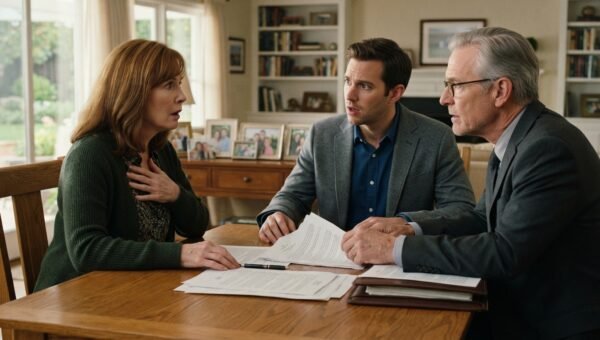
I talked with Ron and Beth afterward. They felt bad, but I didn’t blame them. They’d seen Dad getting lost and tried to keep him safe. I had seen it too. What none of us understood was that the drives weren’t only about Dad remembering roads. They were about a promise he’d made so long ago that he’d stopped needing words for it.
The next month, I drove to Elm Hollow again. I stopped for pie, went up to the overlook, and checked the weather. I didn’t bring the old radio. The car made a small rattle when I turned onto the last road, and I found myself listening for it every time after that.
Arthur was in the yard when I arrived. He ran to the car, then stopped short when he saw me. I gave him the thermos. Clara had filled it with hot elderberry honey broth, using the old recipe Dad had brought her.
At home, I unfolded the road map beside me. I didn’t cross out Elm Hollow. I underlined it once.
The blue thermos rode in the passenger seat, steady in its metal cup holder.