PART 1
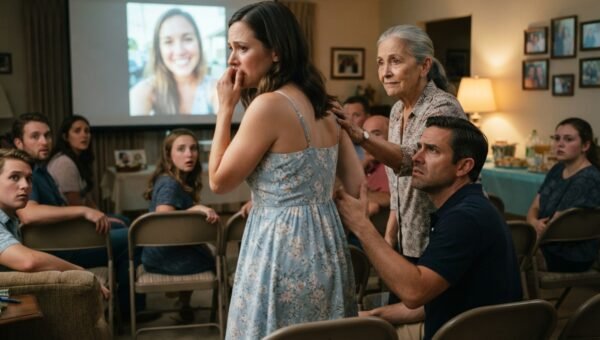
The gym smelled like floor wax, catered roast beef, and forty years of people trying to look successful. I was standing near the punch bowl with a cheap paper napkin in my hand, listening to someone talk about their knee replacement, when a woman I had never laid eyes on walked straight toward me.
She looked to be in her late thirties, maybe forty. She had dark hair pulled back in a silver clip and steady, gray eyes that did not blink once as she closed the distance between us. In her arms, folded over her forearm like a freshly laundered towel, was a heavy swatch of yellow yarn.
My stomach dropped before she even opened her mouth.
The yarn was bright lemon-yellow acrylic with a specific shell stitch. There was a tight border of white running around the hem. My mother had crocheted that blanket at our kitchen table in the spring of 1984, sitting under the dim yellow light while I was supposed to be studying for final exams. When I asked about it that August, right before I left for community college, my mother told me it had been ruined by basement mold and thrown away during our move across town.
“You left me at St. Agnes Hospital,” the woman said.
Her voice was entirely calm. It was not loud enough to draw a crowd, but it cut clean through the brassy recording of an eighties pop song playing over the rented speakers.
I stared at her. “Excuse me? I think you have the wrong person.”
“You lived at 414 Elmcrest Drive,” she said. “Your father drove a blue Buick wagon. Your bedroom had wallpaper with tiny blue sprigs on it. And your mother spent three months making this blanket.”
My throat felt completely dry. “Who are you?”
She did not answer. Instead, her eyes flicked past my shoulder.
I turned around to see what she was looking at. Standing about ten feet away was Brenda Hollis. Brenda and I had been inseparable from seventh grade until the day we walked across the football field to get our diplomas. We had shared lockers, clothes, and cheap bottles of lip gloss. We had drifted apart in our twenties, the way people do when jobs and marriages scatter across different states, but she had hugged me hard near the coat check an hour earlier.
Right now, Brenda was not smiling. Her face had drained to the color of oatmeal.
She was staring directly at the yellow blanket in the stranger’s arms, her knuckles white around her leather clutch.
Before I could call her name, Brenda spun on her heel and headed fast toward the double exit doors that led out to the parking lot.
“Brenda!” I called out.
She did not look back. She pushed through the heavy steel doors with her shoulder and vanished into the damp September evening.
I looked back at the stranger. She had not moved an inch. She held the yellow blanket like a ledger sheet waiting to be settled.
“Stay right there,” I told her.
I hurried toward the back doors, pushing through the cold air outside. The asphalt was wet from a light rain that had passed through around sunset. I heard the sharp click of Brenda’s low heels against the wet pavement. She was almost to her car, a gray sedan parked near the perimeter fence under a flickering sodium streetlight.
“Brenda, stop!” I yelled, jogging until the stitch in my side forced me to slow down. “What is going on?”
She reached her driver’s side door, but her hands were trembling so violently that she dropped her key fob onto the wet blacktop. She bent down to grab it, and when she stood back up, tears were streaking right through her foundation.
“Brenda, look at me,” I said, catching her by the arm. “Who is that woman? How does she have my mother’s blanket?”
Brenda would not meet my gaze. She stared fixedly at the chain-link fence behind my head.
“I can’t talk to you, Laurie,” she whispered, her chin quivering. “I promised. Your mom and dad sat me down at your kitchen table the morning after graduation. They made me swear on a Bible that I would never speak a single word about what happened on graduation night. Not to anyone. Especially not to you.”
“My parents have been dead for ten years, Brenda,” I said, my voice rising. “What happened on graduation night? I got sick. I had food poisoning from the banquet and slept for two days.”
“That wasn’t food poisoning,” Brenda choked out.
Before she could finish the sentence, footsteps approached quietly from behind us.
It was the stranger. She had followed us out into the misty air, wearing a dark coat over her shoulders. Without saying a word, she reached into her coat pocket and pulled out a small plastic ziplock bag. Inside was an old, faded plastic band.
She unzipped the bag and held the hospital identification bracelet out toward the streetlight so I could see the stamped lettering.
It was dated June 8, 1984.
The hospital was St. Agnes Memorial.
On the line for the patient name, stamped in smudged blue ink, was my name: *Laurie Ann Mercer*.
On the line directly below it, under age, it read: *Newborn Female*.
My head began to spin. “This has my name on it. But I was eighteen in 1984. I wasn’t an infant.”
“That’s because you didn’t give birth to me,” the stranger said quietly. “You were the mother of record on the admission intake, but you weren’t the one who carried me. I was registered under your name so nobody would trace who really walked into that maternity ward.”
“That’s impossible,” I stammered, pulling back. “Who are you?”
Footsteps crunched against the wet gravel behind her.
“Abby,” a deep, aged voice called out through the mist. “Abby, please. Don’t do it like this.”
I turned. Walking slowly toward our small circle was Mr. Davenport. He had been our high school principal forty years ago. He was in his late eighties now, leaning heavily on an aluminum cane, wearing the same quiet, grave expression I remembered from the principal’s office in high school.
He stopped three feet from us, his breathing ragged in the chill night air. He looked at the stranger with unmistakable sorrow, reached out an old, spotted hand, and said, “Abby. Sweetheart. Let me tell her. You don’t have to carry this alone anymore.”
PART 2
The cold air seemed to freeze in my lungs. I looked from the plastic hospital bracelet to the old man leaning on his cane.
“Mr. Davenport?” I managed to say. “What are you doing out here? Who is this?”
“This is Abigail,” Mr. Davenport said softly. “She’s my daughter.”
Brenda let out a small, ragged sob beside me and pressed the heel of her palm against her eyes. “Mr. Davenport, please don’t. You swore Laurie would never have to know.”
“She has to know now, Brenda,” he replied, not taking his eyes off me. “I’m eighty-six years old. I don’t have much time left, and Abby has spent twenty years digging through county archives, old yearbooks, and hospital records trying to figure out why she was abandoned. If I don’t tell the truth tonight, I’ll take a lie into the dirt with me.”
“Abandoned?” My voice rose, thin and sharp. “Mr. Davenport, you had a family. You had a wife, and you had a son who went to state for track. You didn’t have a baby in 1984.”
“I did,” he said quietly. “Just not with my wife.”
The parking lot was silent except for the faint hum of the highway a mile away.
Abigail stepped closer, holding the yellow blanket against her chest. “Show her the records, Dad. Show her so she doesn’t think I’m crazy.”
Mr. Davenport reached inside his overcoat and pulled out a manila folder, worn at the edges and folded in half. He handed it to me. My hands shook so badly that I could barely open the metal clasp.
Inside were photocopies of microfilmed newspaper clippings, an intake ledger from the emergency department at St. Agnes Memorial Hospital, and a handwritten letter on lined notepad paper dated June 9, 1984.
The handwriting on the letter was unmistakable. It belonged to my mother. The loops of the capital letters, the heavy slant to the right, the blue ballpoint ink she always used for grocery lists and church envelopes.
*To the Sister in Charge,* the note read.
*The child is healthy. She was born at 4:15 this morning. We are leaving her in your care under the Safe Haven agreement discussed with Father Thomas. The mother cannot raise her. Please do not look for us. The blanket belongs to the baby.*
“My mother wrote this,” I whispered, the paper fluttering in my trembling fingers. “Why would my mother leave a baby at St. Agnes? And why does the hospital bracelet have my name on it?”
“Because your mother didn’t write it for herself,” Brenda interrupted, her voice cracking as she finally stepped away from her car. “She wrote it to protect someone else. But she used your driver’s license at the intake desk so it wouldn’t trace back to her or the school.”
I spun around to face Brenda. “Whose baby was it, Brenda? If it wasn’t mine, and it wasn’t my mother’s, whose baby was she?”
Brenda looked at Mr. Davenport, who nodded slowly, his eyes heavy with forty years of shame.
“She was mine, Laurie,” Brenda said.
PART 3
The words made no sense. They bounced off my ears like stones off glass.
“Yours?” I stared at Brenda. We had spent senior year attached at the hip. We ate lunch together every single day. We shared clothes. We went to football games. “Brenda, you weren’t pregnant. I would have known. I saw you every day of my life.”
“You didn’t see me that spring,” Brenda said, tears spilling freely now. “Remember when I got mononucleosis in February? Remember how I was out of school on homebound study for three months?”
I stood frozen. I remembered. Brenda had suddenly stopped coming to classes after winter break. Her mother told everyone at church that Brenda had severe mono and enlarged lymph nodes, and that doctors insisted on strict bed rest. I used to bring her homework packets to her front porch, but her mother always took them at the door, telling me Brenda was sleeping and too weak for visitors.
“It wasn’t mono,” Brenda whispered. “I was terrified. I was seventeen years old, Laurie. And the father was the principal of our school.”
I turned to look at Mr. Davenport. The man who had handed out our diplomas, who had led the morning pledge over the intercom, who had represented moral authority in our small town for three decades. He stood in the damp asphalt glare, his head bowed, unable to meet my eyes.
“I took advantage of a girl who came to my office crying about her grades and her family,” Mr. Davenport said, his voice thick with self-disgust. “There is no excuse for what I did. None. I was forty-six years old. She was a child.”
“When my parents found out,” Brenda continued, “my dad wanted to kill him. Literally kill him. But Mr. Davenport had connections on the school board, at the bank, and at the diocese. If the scandal broke, my father would have lost his job at the lumber mill, and Mr. Davenport would have gone to prison. Instead, the adults made a deal.”
“What kind of deal?” I asked, barely able to hear my own voice over the pounding in my ears.
“A quiet one,” Brenda said. “They kept me locked in our spare bedroom until June. On the night of graduation, while you were at the senior party at the lake, I went into labor. My parents called your mother. Your mother was a registered nurse at the county clinic, Laurie. She was the only person in our church circle who knew how to deliver a baby without filing an immediate public birth certificate.”
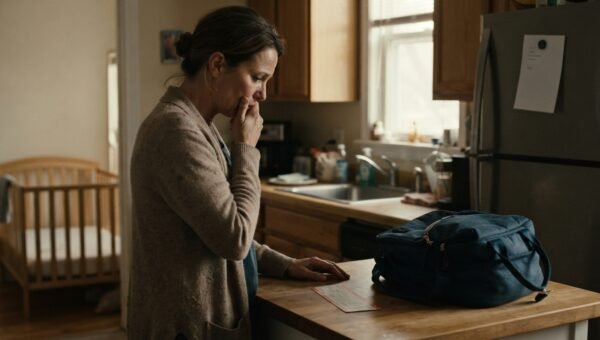
The memory hit me with sudden, brutal clarity. The night of graduation, my mother had told me she had a sudden migraine and couldn’t attend the post-commencement reception. When I came home at two in the morning, our station wagon was gone from the driveway. When I woke up the next day, my mother had made a massive breakfast, but her eyes were bloodshot and she had a bandage taped across the palm of her hand. She had told me she burned herself on the skillet.
“Your mother delivered Abigail in my parents’ sewing room,” Brenda said. “She was the only one who treated me like a human being that night. Everyone else was talking about protecting reputations, protecting pensions, protecting the church. Your mother just held my hand and told me I was going to survive.”
“Then why put my name on the bracelet?” I demanded, tears finally burning my own eyes. “Why bring me into this?”
“Because St. Agnes had security cameras at the drop-off entrance,” Mr. Davenport spoke up, his voice shaking. “Your mother knew that if she used her own name, the hospital staff would recognize her as a local clinic nurse. But the hospital required an adult identification for the intake ledger before they would accept an infant into custody under the church board’s private arrangement. Your mother took your spare student ID and driver’s license from your desk drawer. She used your name on the intake slip, dropped the baby with the night sister, wrapped in that yellow blanket, and walked away.”
“She told me the blanket had mold,” I whispered, the realization settling in like ice. “She told me she threw it away.”
“She couldn’t bear to let Brenda’s baby freeze on the steps,” Mr. Davenport said. “She brought the blanket she had just finished making. It was the only warm, clean thing in her car that night.”
Abigail stepped forward then. She reached out and touched my wrist gently.
“I was adopted through Catholic Charities three months later,” Abigail said. “A couple from upstate took me. They were good parents. They gave me a wonderful life. But when my adoptive mother passed away two years ago, I found this blanket and the intake copy inside her safety deposit box. The name on the file was Laurie Ann Mercer. I spent eighteen months tracking you down, thinking you were the mother who left me behind.”
She looked at Brenda, then back at me.
“I didn’t come here to ruin a reunion,” Abigail said softly. “I came here because I wanted to know why my mother didn’t want me. And I wanted to know why she gave me this blanket.”
ENDING
The wind picked up, rustling the dry oak leaves along the perimeter fence of the parking lot. Inside the gym, the bass from the speakers vibrated against the brick wall, a muffled reminder of a room full of people pretending that the last forty years had been simple and clean.
Brenda moved toward Abigail. Her movements were cautious, hesitant, like someone approaching a frightened animal.
“I wanted you,” Brenda said, her voice dropping to a harsh whisper. “I never stopped wanting you. My father took you out of the room before I even held you. Your grandmother cut your cord, and your grandfather handed you to Laurie’s mother. I begged them to let me look at your face, and my mother told me that if I ever spoke your name, they would put me in a state home for wayward girls.”
Abigail’s composure finally broke. The steady, stern expression she had worn across the gymnasium dissolved, leaving behind a woman who simply looked tired and hurt.
“You were so young,” Abigail whispered.
“I was a coward,” Brenda said, shaking her head. “I went to college in Ohio. I got married. I had two sons. And every single year on June 8th, I locked myself in my bathroom and cried until my ribs ached. When your father called me last month and told me you had reached out to him through an ancestry registry, I told him to stay away. I was terrified my husband would find out. I was terrified my sons would look at me differently.”
“I was the one who insisted on coming tonight,” Mr. Davenport said. He took a heavy, painful step forward and stood beside Brenda. “I kept this secret for forty years because I was afraid of losing my pension, my reputation, my standing in this town. When Abby found me, she didn’t ask for money. She didn’t threaten to go to the police. She just asked who the woman was on the hospital bracelet. She deserved the truth, and so did Laurie.”
I looked down at the letter in my hands. The familiar blue ink of my mother’s handwriting seemed to leap off the page. All those years, I had thought my mother was quiet and strict, a woman of few words who spent her evenings knitting and reading church bulletins. I had never known she carried the weight of someone else’s child across town in the dark, shielding an abused teenage girl from total ruin, even if it meant borrowing my identity to keep the wolves away from Brenda’s door.
“What do you want to happen now?” I asked, looking at Abigail.
Abigail wiped a tear from her cheek with the corner of the yellow blanket. “I don’t want a lawsuit. I don’t want a public scandal. I just wanted my real name. And I wanted to give this back to the person whose family made sure I didn’t freeze on that doorstep.”
She extended her arms, offering the crocheted blanket to me.
I looked at the lemon-yellow yarn, slightly faded around the edges, preserved carefully in a cedar chest for four decades. Then I looked at Brenda, who was standing with her arms crossed over her chest, shivering under the streetlight.
I pushed Abigail’s hands gently back toward Brenda.
“It doesn’t belong to me,” I said quietly. “My mother made it, but she gave it to you for a reason. It belongs to the two of you.”
Brenda let out a broken breath and reached out. Her fingers caught the soft yellow wool, and for the first time in forty years, mother and daughter held the same piece of fabric between them.
Mr. Davenport turned away, his shoulders shaking silently against the cold night air. There was no redemption for him in that parking lot, and none of us offered it. The law might have expired on his crimes, but the look on his daughter’s face was a sentence he would carry for whatever days he had left.
We stood together by the chain-link fence as the reunion music finally stopped inside the gym. Brenda and Abigail walked slowly toward Brenda’s car, talking in low, hesitant voices, beginning the painful work of putting forty lost years into words.
I stood by myself under the streetlight for a long time before I walked back to my car. I thought about my mother, sitting alone at our kitchen table in 1984, working her crochet needle through bright yellow yarn, knowing exactly how heavy the world could be, and choosing to leave behind something warm in the dark.