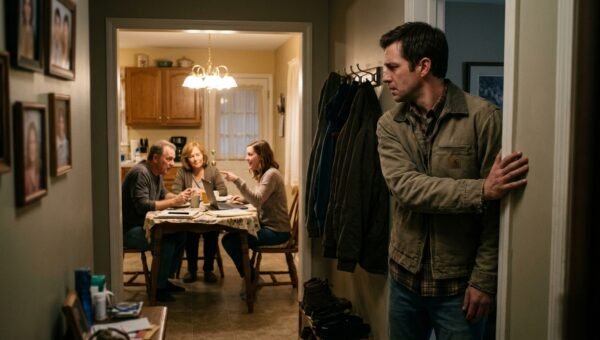
The smell of wet canvas was always in my duffel bag. I’d leave it by the front door on Friday night, and by Saturday morning it had picked up the smell of the mudroom: damp coats, old boots, and the lemon cleaner my mother used on the tile.
At 10:52, my phone would buzz.
“Be gone by 11.”
That was my mother, Doreen. Eight years of Saturdays, same time, same text.
I’m 28 now, and I still remember the minute because I’d watch the clock while I tried to make myself small enough not to be noticed.
My brother Caleb was five years older than me. When his girlfriend Blythe started coming around, I was sixteen and living at home. She came from money, or at least that’s how my parents talked about it. Her family had a big house outside Pittsburgh and a name people in our town seemed to know.
My mother called her “a lovely girl from a good family.”
Then she’d look at me. “Don’t embarrass us.”
I didn’t know what I’d done to embarrass anybody. I was quiet. I got decent grades. I worked weekends at a grocery store and paid for my own clothes. I did have a mouth sometimes, and I could be sulky. I wasn’t a saint. But I wasn’t doing anything that required being sent out of my own home.
Dad, Warren, usually said the same thing from his chair in the living room.
“Just disappear for the weekend.”
He said it like he was asking me to take out the trash.
At first I thought it was temporary. Blythe was Caleb’s girlfriend, not family. She’d come over for dinner, or stay on a Saturday, and I’d crash at my friend Tessa’s house. My parents said they wanted everybody to get along. I wanted to believe them, so I went.
But the visits became every weekend. If Blythe was coming, I was expected to be gone before she arrived. Sometimes I stayed with Tessa. Sometimes I sat in the public library until it closed, pretending to read the same pages. Once, when Tessa’s parents were out of town, I slept on their basement couch with a scratchy throw blanket over my head.
I told myself it wasn’t worth making a fuss. I was sixteen, and I wanted my parents to like me. That’s not a very grown-up thing to admit, but it’s true.
When I turned eighteen, I had a little money saved from work. I could afford the occasional motel, though not a decent one. I remember one place where the ice machine clanked all night, and I kept thinking I’d rather be at home, even though home was the place that had told me to leave.
Blythe and Caleb got engaged a few years later. My mother was thrilled. She bought a dress for the engagement dinner and kept saying how lucky we were to join “a family like that.”
I was allowed to come to dinner. That felt like progress.
My mother hugged me before we left the house. “See? We’re going to do this right.”
For a while, I believed her. I was twenty-two. I’d just started a job doing drafting work for a small design office, and I thought maybe my parents had finally decided I belonged in the family picture.
Then Caleb married Blythe.
After the wedding, I figured the weekly visits would stop. They lived in their own place. Surely my parents didn’t need to keep clearing me out of the house so a married couple could have a nice Saturday.
The first weekend after their honeymoon, my mother texted at 10:52.
“Be gone by 11.”
I stared at the message. I actually laughed once, though nothing about it was funny.
When I asked her later why I still had to leave, she made a face like I was being difficult on purpose.
“Blythe’s parents are coming over,” she said. “They’re used to a certain kind of home.”
I said, “I live here too.”
Mom pressed her lips together. “Don’t start.”
That was how it went. When Blythe’s parents came, I was gone. When there was a family lunch, I was told to pick up a shift or go see a friend. When Caleb and Blythe visited alone, I was expected to give them the living room and go somewhere else.
I brought it up with Caleb once. He was in the kitchen looking for a clean mug.
“You know Mom’s like this,” he said.
“She’s like this to me.”
He rubbed his thumb over the rim of the mug. “I don’t want to get in the middle.”
I wanted him to say something else. I wanted him to say he’d noticed. He hadn’t, or he didn’t want to.
The last Saturday I left for good, I was twenty-four. I’d been back at my parents’ house for a few months after a cheap apartment got sold out from under me. I was working long days at the design office and trying to save enough to move again. It wasn’t the life I’d planned, but I thought it was a short stop.
That morning, the duffel was already by the door. I’d been sleeping at home all week, so the bag was packed with work clothes, socks, and my little drafting notebook. The notebook had a bent corner from getting jammed under the bag’s zipper.
At 10:52, my phone buzzed.
“Be gone by 11.”
I read it twice. I don’t know why. It was the same text as always.
Mom called from upstairs. “Nora, did you see my message?”
“Yeah.”
“Then don’t make this hard.”
Dad came into the hall while I was zipping the bag. He didn’t look angry. He looked tired, which almost made it worse.
“Just disappear for the weekend,” he said.
I remember my hand on the zipper. The little metal pull was cold against my finger.
“I’m not coming back Sunday,” I said.
Mom stopped at the top of the stairs. “What does that mean?”
“It means I’m done leaving so everybody else can feel comfortable.”
She came down a few steps. “You’re being dramatic.”
Maybe I was. I was angry and twenty-four and had no plan. I’d like to say I calmly explained the last eight years, but I didn’t. I told her she cared more about Blythe’s family than me. I told Dad he could keep his house and his weekends. Then I took the bag and walked out.
I didn’t have a new place lined up. I had my car, two hundred and some dollars, and a friend from work who said I could sleep on her spare-room floor for a couple of weeks. I drove past the turn for the usual motel. Then I drove past the town limits.
I kept going because turning back felt like agreeing to do it all again.
Those first months were rough. I rented a room from an older woman who didn’t ask questions, worked late, and took on small drafting jobs after hours. I ate a lot of peanut butter toast. My car needed a repair that cost $638, and I put it on a credit card I was already carrying a balance on.
There were nights I wanted to call home. Not because I thought they’d suddenly understand. I just wanted somebody to say, “You can come in. You don’t have to leave.”
I didn’t call.
I changed my number and didn’t give it to anyone who might pass it along. An aunt said my parents had asked about me once. I told her I was safe and asked her not to share where I was. That was the whole message.
I wasn’t trying to punish them. I was trying to stop being available for the next command.
I stayed at the design office and learned whatever they’d let me touch. I saved for software. I took night classes, passed the exams for my interior design certification, and picked up small jobs from people who wanted a kitchen layout or help making an old shop usable again. I made mistakes. I undercharged. I once ordered the wrong cabinet fronts and spent two Saturdays fixing it without pay.
Still, people started sending other people to me.
After a few years, I rented a small office above a print shop. The stairwell smelled like paper dust and burned coffee. I hired one person, then another. By the time I’d been gone four years, Whitaker Studio had six of us and a steady list of projects. We did home renovations, small restaurants, and the occasional office for someone who wanted the place to feel less like a dentist’s waiting room.
I’m not saying I became some huge success. I had a good business, bills paid on time, and a door with my name on it. At the time, that was plenty.
The office was in a renovated brick building on the edge of downtown. The nameplate beside my door read NORA WHITAKER, PRINCIPAL DESIGNER. I’d picked a Saturday morning to meet a new client because the project deadline was tight and my week was full.
The client had told my assistant she was sending her mother to look at the space first. A high-end remodel for a friend’s family, she said. I expected somebody I’d never met.
I was checking a set of kitchen plans when I heard the front door open. My assistant, Lena, said hello. There was a pause, then footsteps in the hall.
A woman stopped outside my office.
I heard her say my name, slowly. “Nora Whitaker.”
I looked up.
My mother was standing at the door. She had a leather folder tucked under one arm and her good coat on. For a second, neither of us spoke. She looked from the nameplate to me, then back to the nameplate.
Her mouth opened a little.
“That’s my daughter,” she whispered.
I didn’t answer right away. I’d imagined seeing my parents again, if I’m honest. I’d imagined yelling, or crying, or having some perfect sentence ready. I had none of those things. I just sat there with my pencil in my hand.
Mom took one step into the office. “Nora?”
“Hi, Mom.”
She looked at the drafting table, the shelves, the computer, and the project boards on the wall. She looked at me again, like she was trying to find the kid who used to wait by the front door with a bag.
“I didn’t know this was yours,” she said.
“You didn’t know where I was.”
She flinched at that, but then she pulled herself together. My mother could do that fast. She set the folder on the edge of my desk.
“I came about a project,” she said. “A friend recommended your firm.”
“I understand.”
“I thought I was meeting with someone else.”
I put my pencil down. “You’re meeting with me.”
She swallowed. “Well, I’m glad you’re doing well.”
It was the first kind thing she’d said to me in years, and it came out like a comment about a new coat. I almost let myself take it as an apology. That was the old habit. A little warmth, and I’d start making room for her again.
Then she glanced toward the hall.
“Could we talk somewhere private?” she asked. “Not with your staff listening.”
“This is my office.”
Her shoulders tightened. “Nora, don’t make this difficult.”
There it was. Same tone. Same expectation that I’d step aside because she’d asked.
I stood up. I didn’t raise my voice. “You can leave the project folder with Lena. If you want to hire the studio, she can send you our normal intake form.”
Mom stared at me. “You won’t even talk to your own mother?”
“I’m talking to you.”
“I came all this way.”
“You came for a consultation.”
She looked down at the folder, then back at me. “I thought we could start over.”
I was quiet for a second. I did want to start over, once. For years, I’d wanted it so much that I’d accepted scraps and called them progress.
But I couldn’t make a fresh start out of the same old order.
“No,” I said. “You can’t come in here and act like nothing happened.”
Her fingers tightened on the folder. “I was trying to keep the family together.”
“You kept sending me away.”
“I thought you understood.”
“I understood. I just didn’t agree.”
She shook her head as if I’d said something unreasonable. Then she tried one more time, softer now.
“Come on, Nora. We’re family.”
I looked at the nameplate beside the door. I’d paid for it myself, after I’d been in that office long enough to know I was staying. My name wasn’t there because my parents had put it there. It was there because I had.
“I’m not taking the project,” I said.
Mom blinked. “You’re turning down the work?”
“Yes.”
“You can’t separate business from family?”
“I can. That’s why I’m saying no.”
She picked up the folder. For a moment, it seemed like she might say something else. Then she backed into the hallway. Lena stood a few feet away, holding a clipboard and not looking at either of us.
Mom said my name once more, but she didn’t ask me to come with her.
She left.
I closed the office door. The brass bolt turned with a small click. Then I went back to my desk, where the plans were still open and my pencil was still where I’d set it down.