Constance took both dinner plates from my daughters at Grant’s estate celebration, and Grant told me not to make a scene. I took the girls by the hands and walked out. I didn’t shout, and I didn’t cry in front of his family. I was too busy trying to make sure my daughters didn’t think their mother had agreed they deserved it.
It was outside Potomac, at the Holloways’ big annual celebration. There were hundreds of people, champagne, a photographer near the front steps, and enough food to feed a wedding.
My daughters, Tessa and Molly, were ten and twelve then. They’d been sitting at the end of a long table, picking at dinner while I stood nearby talking to a woman I barely knew.
Constance came up and lifted one plate, then the other. She didn’t ask either girl if they were finished. “They’ve had enough,” she said. Tessa looked at me. Molly looked at her plate, like she was checking whether she’d done something wrong.
I looked at Grant. He barely turned his head. “Don’t start anything.” That was all. I can still hear how plain he made it sound, like I was the one about to embarrass the family.
So I went to my girls and said, “Come on, honey.” I didn’t look at Constance again. My hands were shaking by the time I reached the car, but I got the doors open and buckled both girls in.
Grant laughed behind us. I heard it. I knew he thought I’d cool off and come back before midnight.
For eleven years, that was how it went. The Holloways had a version of me that suited them: Grant’s wife, home with the kids, doing some little work on the side. Constance called my consulting business “your little job” so often I stopped correcting her. Grant didn’t say it exactly that way, but he never bothered to explain that I had a company, either.
I helped build that picture. I didn’t tell them what I owned or what my work brought in. I told myself it was easier to keep my business separate. I also liked having one part of my life they couldn’t weigh in on. That wasn’t all noble. I was proud, and I didn’t want Grant’s family to start asking for a say in something I’d built before I met him.
My inheritance came from my grandmother. Not a fortune at first, but enough to buy a small commercial property and pay for training when I started consulting on property systems and leasing. I was good at figuring out what a building needed and what a business could actually afford. I kept reinvesting. I bought another property, then another, and set up separate companies for the work.
By the time I married Grant, I had a solid business and a property in my own name. I kept the accounts separate after the wedding. Grant knew I had a small office and clients. He never asked to see a balance sheet. He liked that I was home for the girls, and I liked being there too. Somehow, that became proof in his mind that I had no life outside of him.
The Holloways talked about money constantly, but not in a way that made it easy to talk back.
Constance knew who had the right invitations, the right schools, the right seats at dinner. She’d say things like, “We take care of our own,” and look at me as if I should be grateful she’d let me in.
I kept my mouth shut more than I should have. I wanted the girls to have their cousins and holidays, and I thought I could swallow a few remarks without making life harder for them. Then I started noticing how often they heard the remarks too. They heard Constance call my work a hobby. They heard Grant tell me to let his mother handle the seating, the gifts, the family plans.
After the gala, the girls were quiet in the car. Molly rubbed a napkin into a little ball on her lap. I don’t know why I remember that part. Maybe because I’d told her not to play with her food a hundred times, and here she was trying to make herself smaller with a napkin.
“Did we do something bad?” Tessa asked.
“No,” I said. “You didn’t do anything wrong.”
“Grandma said we had enough.”
“She shouldn’t have taken your plates.”
I wanted to say more. I wanted to tell them their father should have stood up for them. But I didn’t want them carrying my anger on top of the hurt they already had. I drove to the house Grant and I shared, listened to them brush their teeth, and waited until they were in bed.
Grant came home after midnight. He didn’t come upstairs. I heard him in the kitchen, then the television. The next morning he said, “You made it awkward.”
I was packing a bag for the girls. “Your mother took their dinner.”
“They’d eaten plenty.”
“They hadn’t finished.”
“She was trying to keep the evening moving.”
I folded Molly’s sweatshirt and set it on top. “She took food from children at a table full of food.”
Grant let out a breath through his nose. “You always make my mother the villain.”
I almost apologized. It came up in my throat out of habit. Then I pictured Tessa looking at me to see whether I agreed she’d done something wrong.
“I’m taking the girls with me,” I said.
“Where?”
“I’ll send you the address.”
He laughed again, smaller this time. “You’re going to a hotel?”
“No.”
I didn’t tell him more. I put their school things in the car, along with our overnight bags. I’d packed the important papers the night before while the girls slept. I hadn’t planned to leave that week, but I’d had a place ready for years. I had keys in my desk drawer and spare blankets in the upstairs closet.
The girls knew about my office, but not the house. I wanted it to be theirs before it became something the Holloways could comment on. I’d bought the property years earlier, a historic estate outside the city limits that needed more work than sense would recommend. The business used it as its headquarters. I also kept rooms there for the girls and me.
When we pulled up, Tessa leaned forward between the seats. “Is this your office?”
“It’s one of them.”
Molly looked at the front doors. “You own this?”
“I do.”
She glanced at me like she wasn’t sure I was allowed to say that. I understood. For years I’d let Grant act as if the family home was the only home that counted, and I’d let my daughters think my work happened on a laptop at the kitchen table.
Inside, I turned on the hall lights and carried in their bags. The old front lock sticks unless you pull the door toward you as you turn the key. My grandmother used to say every old door had an opinion. I hadn’t thought about that in years.
Tessa walked slowly through the foyer. “How long have you had this?”
“Before I married your dad.”
“Why didn’t you tell us?”
“I wanted to keep it private. I should’ve told you sooner.”
That was the part I could own. I had thought secrecy would protect them from the Holloways’ judgment. It had also kept them from knowing their mother had choices. I was going to have to fix that, and not with a speech.
I made toast and eggs. Molly asked if she could take hers upstairs, and I said yes. She ate sitting on the floor by the bed because she was still in her party dress and didn’t want to wrinkle it. I went through the house, checked the locks, and looked at the papers I’d brought from my office.
I didn’t sleep much. At 6:18, Grant called. I let it ring twice before I picked up.
“Where are you?”
“I’m with the girls.”
“I know that. Where?”
“I’ll text you the address.”
“Are you serious?”
“Yes.”
“You’re making a huge mistake.”
I didn’t answer that. I sent him the address and wrote, We can talk here. The girls are safe. Bring no one.
At 8:07, I heard a car stop outside. Grant knocked hard enough to make the old door rattle. I opened it but didn’t step aside right away.
“What is this place?” he said.
“My house.”
He looked past me into the foyer. I saw him take in the tall ceiling, the restored staircase, the framed business licenses on the wall. I’d hung those licenses there because they belonged in my workplace. I’d never thought of them as a message to him.
“You own this?”
“Yes.”
He walked in without waiting for me to invite him. “Since when?”
“Before we got married.”
He turned toward the framed filings. “You’ve been hiding this from me?”
“I kept my business separate.”
“Your business?” He gave a short laugh, but it didn’t last. “You said you did consulting.”
“I do.”
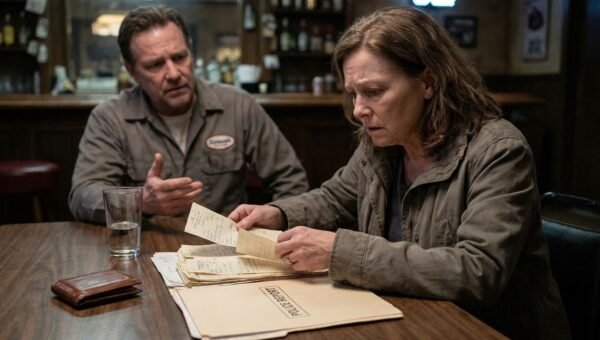
I set a folder on the table. I’d put the deed on top. My maiden name was printed across it, the same name I’d had when I bought the property. Grant read it once, then touched the page with his thumb as if it might change.
“This is worth millions,” he said.
“Yes.”
He looked at me, then at the papers again. “How much else?”
I didn’t answer right away. I wanted to see what he would ask first. He could have asked whether the girls were all right. He could have asked if I’d been planning to leave. Instead he wanted a number.
“The company has several commercial properties,” I said. “And I run the consulting firm.”
“Those buildings your company rents?”
“Some of them.”
His face changed when he saw the name of the holding company on the next page. He knew that name. The Holloway business had been paying rent to it for years. He just hadn’t known who stood behind it.
I opened the second folder. Grant picked up the loan documents and turned several pages. The Holloway company’s debt had been secured against its commercial properties. Through my holding company, I owned the primary lien. I’d bought into that debt when the family business needed a restructuring. Grant’s relatives had dealt with the lender’s company name and its lawyers. No one had thought to ask who owned it.
He stopped at the restructuring papers. “You own our debt?”
“I own the majority of it.”
“You’ve been collecting payments from us?”
“The company has been making payments under the agreement. I haven’t taken money out of your personal account.”
“That’s not what I mean.”
“I know what you mean.”
He flipped back through the pages. “You could have told me.”
“I could have. You could have asked what I did for work without making a joke of it.”
His voice went low. “You’re going to use this against my family?”
“No. I’m not going to pretend the agreements don’t exist because your mother was rude to the girls.”
“She took their plates. This is a lot bigger than that.”
“It is bigger than that. It’s also not the only reason I’m leaving.”
He pushed the papers down. “You’re leaving me over one bad night?”
I looked at the girls. They were near the stairs, dressed for the day. Tessa had one hand around Molly’s. They’d heard enough to know this wasn’t about a plate anymore.
“I’m leaving because you watched your mother humiliate them and told me to be quiet,” I said. “And because when I told you what happened, you blamed me for noticing.”
Grant glanced toward the girls. “They don’t need to be part of this.”
“They already are. They were at the table.”
He rubbed his forehead. “My mother gets carried away. You know how she is.”
“I do. You know how she is too.”
He started to say something, then stopped. That was the first time all morning he looked like he understood I wasn’t waiting for him to tell me what happened next.
I told him I’d spoken with my lawyer and was starting a formal separation. The girls would stay with me while we worked out a schedule through the proper process. I wasn’t going to keep them from their father, but I wasn’t sending them back into that house to be told they’d imagined what happened.
Grant picked up the debt papers again. “What are you going to do about the company?”
“Follow the loan terms. I’m not making another private extension or covering missed payments. Your business can work with the lender under the contract like anyone else.”
“You could ruin us.”
“I didn’t create the debt. I’m not changing the terms to punish you, and I’m not changing them to rescue you either.”
He stared at me for a long moment. Then he looked again at the deed, my name alone across the top. He didn’t apologize for the gala. Not then.
I told him he needed to leave. He said, “This is my family’s business.”
“It isn’t this house.”
He gathered the papers, then set them down when I reminded him they were copies. I walked him to the front door. He stopped on the threshold and looked back at the foyer, as if he expected me to ask him to stay.
I didn’t.
When he stepped outside, I closed the heavy doors. The latch caught on the first try. Behind me, Tessa and Molly stood with their own keys in their hands.