PART 1
When I told my son, “Caleb, I can’t breathe… my chest hurts,” I expected fear in his voice. Maybe even irritation mixed with concern. Anything that sounded like he still remembered I was his mother. Instead, he sighed into the phone. It was that slow, heavy, theatrical sigh he always gave when his weekend plans got slightly inconvenienced.
“Mom, don’t call me over every little thing,” he snapped. “You do this whenever I have dinner plans.
Take an aspirin and lay down. I am in the middle of picking up takeout with Alyssa, and I cannot deal with another panic attack tonight.”
The call clicked dead.
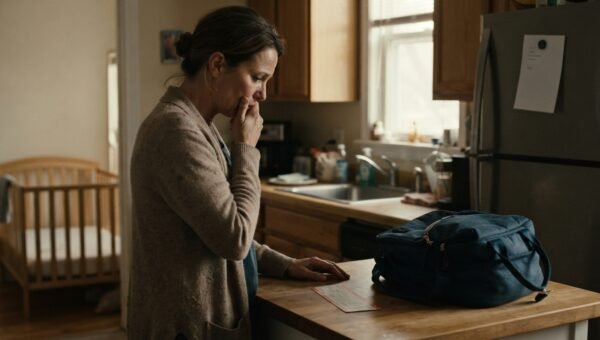
I stood there in my kitchen, clutching the edge of the granite island while the room tilted. The pain in the center of my chest was not a dull ache. It felt like an iron band ratcheting tighter around my ribs with every shallow breath I tried to drag into my lungs. Sweat was prickling along my hairline, cold and oily. My left arm had gone strangely numb, tingling down to the fingertips like it had fallen asleep in ice water.
I looked at the house phone lying on the counter. Then I looked at my purse hanging by the front door.
I am sixty-two years old. I spent thirty-four years working as a head administrator for the county school district before my husband, David, passed away four years ago.
I know how emergency calls work. I know what sirens bring to a quiet cul-de-sac. But in that exact second, something raw and bitter snapped inside my chest, right alongside the physical pain. I had called Caleb first because he lived only eight minutes away in the townhouse I paid the mortgage on. He was the only family I had left in this city.
He had not just hung up on me. He had decided, without checking, that my life was an annoyance.
I did not call 911 to sit in my living room waiting for paramedics while wondering if my son would ever answer another ring. I picked up my car keys.
Getting into my sedan took three tries because my knees buckled on the driveway gravel. The drive to St. Jude Regional was four miles down Old Creek Road. I drove with my left hand locked at the top of the steering wheel, knuckles white, and my right hand pressed flat against the sternum where the burning ache was spreading into my jaw.
Every red light felt ten minutes long. I focused on the dashed white lines on the asphalt, forcing myself to inhale through my nose and exhale through cracked lips.
When I finally turned into the emergency room bay, I pulled right past the visitor stalls and bumped the curb near the ambulance intake. I left the engine running, pushed the door open, and fell halfway onto the concrete before an orderly spotted me and shouted for a triage nurse.
They had me on a gurney within ninety seconds. Wheels clattered beneath me, bright fluorescent panels flashed overhead in a blinding rhythm, and hands were tearing open my blouse to stick cold sensor pads across my chest.
“Blood pressure is 185 over 110,” someone yelled above the hiss of oxygen tubing. “ST-segment elevation. Page the on-call cardiologist now.”
A nurse with calm, steady gray eyes leaned directly over my face. “Sweetheart, look at me.
You are having an acute cardiac event. We are moving you straight to the cath lab. Can you tell me your name?”
“Eleanor,” I whispered. My voice sounded thin, like dry paper tearing. “Eleanor Vance.”
“Eleanor, do you have your purse with your insurance card?”
I nodded slightly toward the small leather cross-body bag the orderly had tossed onto the shelf beneath my gurney. Then, as the team hurried my bed down the hall toward the double doors, a sudden, piercing clarity hit me through the haze of the nitroglycerin tablet they had placed under my tongue.
I reached down with my right hand, my fingers shaking violently, and fumbled open the zipper of my purse.
“Ma’am, keep still, we need this IV line secure,” the nurse warned gently.
“One second,” I gasped. “Just… give me ten seconds.”
I pulled out my phone. My thumb was slick with sweat, but my muscle memory was intact. I opened my banking application.
For three years, Caleb had been carrying a platinum authorized-user credit card linked directly to my primary brokerage account. He also had a debit card drawn from the household expense account David and I had funded decades ago. Caleb was thirty-one. He worked part-time as an independent marketing consultant, which mostly meant he sat in coffee shops building websites that rarely launched, while I quietly covered his car lease, his premium health insurance, his groceries, and the bulk of his lifestyle so he could “find his footing” after his father’s death.
His girlfriend, Alyssa, lived with him in that townhouse. Just last week, she had proudly shown off her new leather jacket at Sunday dinner, laughing about how Caleb always treated her right. I had paid the bill for that jacket on my statement three days later without saying a word.
Not tonight.
With three quick taps of my index finger, I went into the security dashboard.
*Card ending in 4108: Authorized user Caleb Vance. Status: Frozen.*
*Card ending in 9022: Secondary debit access. Status: Blocked.*
*Online recurring transfer to Valley Auto Finance: Canceled.*
I slid the phone face-down into my bag, closed my eyes, and let the hospital ceiling swallow me whole.
PART 2
The cardiologist placed two stents in my left anterior descending artery before midnight.
They kept me in the cardiac intensive care unit under heavy monitoring through the early morning hours. By the time the gray light of dawn crept through the fifth-floor window, the burning ache in my chest had settled into a dull, hollow soreness. The heart monitor beeped in a steady, measured cadence beside my bed. My head was clear.
At 7:15 AM, my phone began vibrating on the metal bedside table.
It was Caleb.
I let it ring until it went to voicemail. Two minutes later, it buzzed again. Then a text message popped up on the lock screen:
*Mom, where are you? My card got declined at the grocery store this morning, and now the gas pump won’t take the debit card either. I need to get gas to drop Alyssa at the airport. Fix this right now.*
Not: *Are you okay?*
Not: *Did you get through the night?*
Only: *Fix this right now.*
I picked up the phone. My fingers were steady now, even with the blue hospital band taped tight against my wrist. I dialed his number.
He answered on the first ring, his voice sharp with grievance. “Finally. Mom, what did you do to the accounts? I was standing at the register looking like an idiot with a cart full of groceries, and both cards bounced. The teller said the issuer blocked the entire account line.”
“Good morning, Caleb,” I said quietly.
He paused for half a beat, slightly thrown by how flat my voice sounded, but his irritation rushed back immediately. “Don’t ‘good morning’ me. Alyssa’s flight to her sister’s bachelorette party boards in two hours. I don’t have enough gas in the Audi to make it across the bridge to the airport, and my wallet is totally locked up. Call the bank from your app and unlock the platinum card.”
“I am at St. Jude Regional Hospital,” I said.
Silence hung on the line for three full seconds. I listened closely, wondering if the gravity of those words would finally pierce the thick wall of his self-absorption.
“Wait… what?” he asked, his tone suddenly cautious. “Why are you at St. Jude?”
“I had a heart attack last night, Caleb. Exactly when I called you.”
“Mom… come on. You told me you just had chest tightness. You always exaggerate when your blood pressure goes up. Why didn’t you say it was real?”
“I told you I couldn’t breathe. I told you my chest was crushing me. You told me not to call you over every little thing and hung up on me.”
“I was picking up food!” he shouted, his defense instinct kicking in like a reflex. “How was I supposed to know? You should have called an ambulance if it was that bad! Why do you always make these things a test for me? Look, I’m glad you’re okay, but I really have a crisis here right now. If Alyssa misses this flight, her whole weekend is ruined. Can you just unlock the card so I can buy gas, and then I’ll come over to visit you this afternoon?”
The cruelty of it was almost magnificent in its simplicity. Even with me hooked to an IV drip in a hospital bed, his priority was fifty dollars worth of premium gasoline so his girlfriend wouldn’t be late for a party.
“No,” I said.
“What do you mean, no?”
“The cards are shut down permanently. You are thirty-one years old. Use your own checking account.”
“My checking account has forty-two dollars in it, Mom, and you know that! My client payment doesn’t clear until next Friday! You can’t just leave me stranded like this!”
“Then you had better figure out how public transit works,” I told him, and pressed the red button to end the call.
Within twenty minutes, my phone rang again. This time it was Alyssa. I did not answer. She left a voicemail, her voice trembling with indignation, demanding to know why I was “taking out my family drama” on her travel plans and accusing me of trying to sabotage her relationship with Caleb.
I deleted the voicemail without listening to the end.
Later that afternoon, my attorney and longtime friend, Martin Hayes, arrived at my room. He was holding a leather folder and a cup of tea. He looked at the cardiac monitor, then looked at me, shaking his head with genuine concern.
“Eleanor, you scared the hell out of me when your message came through,” Martin said, pulling a vinyl visitor chair close to the bed. “How are you feeling?”
“Better than I have in three years,” I answered, and for the first time in twenty-four hours, I meant it.
“Good. Because you asked for the complete asset inventory, and I brought it.” Martin opened the folder. “The deed to the townhouse on Maple Ridge is held solely in your name. David bought it through the family trust, and you are the sole surviving trustee. Caleb has never been on that title. The lease on the 2024 Audi A5 is in your name with him listed as a secondary permitted driver. The cell phone plan, his health insurance premium, and the quarterly HOA dues all debit from your personal account.”
“How quickly can we terminate his authorized status across all of it?” I asked.
Martin looked up over his half-moon reading glasses, studying my eyes carefully. “Eleanor, legally? Immediately. But once we pull these levers, there is no stepping back. He has lived rent-free with full subsidies since David died. If you cut the cords all at once, he will crash hard.”
“He let me drive myself to the hospital while my heart was failing,” I said, my voice dropping to a calm, dead register. “He didn’t care if I died on Old Creek Road as long as his takeout stayed warm. If he crashes, Martin, it will be the first time in his life he feels the actual weight of gravity. Start the paperwork.”
PART 3
I was discharged on Tuesday afternoon.
Martin had arranged for a private home-care nurse named Sarah to stay with me for the first forty-eight hours to manage my medications and monitor my incision sites. When the transport car dropped me off at my house, the front yard was quiet, the lawn freshly cut by the service I paid for. The silence inside my home was profound. For the first time in my life, I did not feel lonely in the quiet. I felt protected by it.
At 5:30 PM on Wednesday, tires crunched violently over the driveway gravel.
I was sitting in the sunroom, drinking hot water with lemon, when the front door handle rattled. Then came the heavy pounding of a fist against the wood.
“Mom! Open the door! I know you’re in there!”
Sarah stood up from the kitchen table, looking startled. “Mrs. Vance, do you want me to call the police?”
“Not yet,” I said calmly. “Just stay inside, please.”
I walked to the front foyer, unlocked the deadbolt, and pulled the heavy oak door open.
Caleb stood on the front porch. His hair was disheveled, his button-down shirt wrinkled, and his eyes were rimmed with red. Behind him in the driveway sat the black Audi.
“Are you insane?” he demanded, taking a step toward the threshold. “Are you completely out of your mind?”
“Lower your voice,” I said, staying firmly behind the screen door. “You do not scream at me on my own porch.”
“I had to borrow two hundred dollars from Alyssa’s brother just to put gas in the car and buy groceries!” he yelled, waving a crumpled sheet of paper at me. “And then this morning, a courier hands me a legal notice from Martin Hayes! You gave me thirty days to vacate the townhouse? My home?”
“It is not your home, Caleb. It is my property. David bought it as an investment property, and I allowed you to live there while you established your business. It has been three years. You haven’t paid a dime in rent, you haven’t paid property taxes, and you don’t maintain the grounds.”
“Alyssa walked out yesterday!” he shouted, his voice cracking with humiliation. “She packed two suitcases and went to her mother’s house because the Wi-Fi got cut off and the power company sent a shutoff warning for non-payment! She told me I’m a thirty-one-year-old fraud who lives off his mommy’s allowance! Do you have any idea what you did to me?”
I looked at him standing there. The resemblance to his father was uncanny, the same jawline, the same hazel eyes. But David had been a man of immense honor and deep, quiet loyalty. If David had known I was hurting, he would have broken down walls with his bare hands to reach me. This boy standing on my porch did not have a drop of his father’s spine.
“Alyssa was right,” I said quietly.
Caleb froze, his mouth half open. “What?”
“She told the truth. You are a thirty-one-year-old man who built a pretend life on my bank balance. You treated my generosity as an entitlement, and you treated my existence as a burden.”
“I made a mistake on the phone!” he pleaded, shifting suddenly from outrage to desperation, taking a step closer to the screen. “Mom, I panicked! I thought you were just having an anxiety attack like you did after Dad’s funeral! If I had known your artery was actually blocked, do you really think I wouldn’t have come? I love you! You’re my mother!”
“You didn’t care enough to find out,” I told him. “That is the part you cannot undo, Caleb. You heard your mother say she couldn’t breathe, and your first thought was that I was ruining your Friday night takeout. You made a calculation right there on the phone that your comfort was worth more than my survival.”
“So you’re just going to destroy my life over one phone call?” Tears of sheer frustration were spilling down his cheeks now. “You’re taking my car? You’re throwing me on the street?”
“The Audi lease will be surrendered to the dealership on Friday morning. If you want to keep the car, you can assume the lease payments under your own credit profile by tomorrow at noon. Martin sent the assignment documents to your email. As for the townhouse, you have twenty-eight days remaining under state tenancy laws. Use that time to find an apartment you can afford on what you actually earn.”
“I don’t have the money for a deposit on an apartment, Mom! The rental market requires first, last, and a security deposit! I’ll be homeless!”
“Then you had better take a full-time job,” I said. “The grocery store down the street is hiring shift managers. The warehouse off the highway is advertising eighteen dollars an hour for logistics intake. You have a college degree that David and I paid for in cash. Use it.”
“Mom, please…” His voice broke into a small, pitiful whine, the same sound he used to make when he was ten years old and wanted out of being grounded. “Don’t do this to me. Please.”
“Goodbye, Caleb.”
I closed the heavy front door. I turned the deadbolt until the brass mechanism snapped into place with a firm, solid thud.
He pounded on the wood for another five minutes, yelling until his voice turned hoarse. I walked back into the sunroom, sat down in my favorite armchair, and picked up my warm mug. Outside, an engine finally turned over, gravel scattered against the bushes, and the car sped down the road toward the highway.
ENDING
Six months have passed since that night on Old Creek Road.
My recovery has been steady. I walk two miles every morning around the reservoir with a women’s walking group from the community center. My blood pressure is lower than it has been in a decade, and my cardiologist told me yesterday that my heart muscle shows remarkably little permanent damage.
The townhouse on Maple Ridge is no longer empty. After Caleb vacated at the end of the thirty-day notice, leaving behind three truckloads of clutter that I paid a junk removal service to haul away, I had the interior painted and updated the flooring. A young couple with a nine-month-old daughter moved in four months ago. They pay their rent on the first of every month via direct bank transfer, and the husband brought me a jar of homemade apple butter last week to thank me for fixing a leaking sink within twenty-four hours.
Caleb did not become homeless.
When he realized that neither tears, nor legal threats, nor long wall-of-text apologies would make me reopen my accounts, survival finally forced his hand. He moved into a modest two-bedroom apartment near the rail station with a roommate from his college days. He surrendered the Audi back to the dealer, took the credit hit, and bought a ten-year-old compact sedan with cash he scraped together from selling his high-end electronics and designer watches.
He is currently working forty hours a week as an operations coordinator for an industrial supply company on the south side of town. It is real, unglamorous work with early morning shifts and an actual punch clock. Alyssa did not return. The moment the luxury lease, the expense accounts, and the upscale lifestyle vanished, she moved on to someone else who could afford to maintain the illusion.
Caleb reached out to me on Mother’s Day.
He did not send an expensive flower arrangement bought with my own credit card, like he used to do. Instead, a simple envelope arrived in my mailbox with a three-dollar card inside. His handwriting was neat, slightly hesitant:
*Mom, I hope your heart is doing well. I work sixty hours a week now between the warehouse and some weekend freelance work. I never realized how much rent and health insurance actually cost until the bills came in my name. I’m sorry for how I treated you. If you ever want to get a cup of coffee, I can pay for it myself.*
I read the card twice, standing at the kitchen counter where I had nearly collapsed six months ago.
I did not text him back immediately. I did not rush to the phone with tears of relief, and I did not offer to cover his security deposit or invite him to move back into the townhouse. Healing a family is not the same thing as rebuilding an old trap.
Two weeks later, I replied with a short message:
*Sunday at ten. The diner on Fourth Street. Coffee only.*
When we met, he looked tired, older, and distinctly humbled. He was wearing clothes he had washed himself, driving a car he paid insurance on, and checking the time on a watch with a scratched glass face. We talked for forty-five minutes about his job, the traffic on the interstate, and the garden I had planted in my backyard. He did not ask for money. Not once. When the waitress set the check between us, he picked it up without flinching, pulled two worn five-dollar bills from his wallet, and paid the bill.
We are not what we were before, and we never will be. But for the first time in his thirty-one years, my son is finally learning how to stand on his own two feet, and I can finally breathe with a full, undamaged heart.