I thought my mother left us because she couldn’t stand being around us.
I found the key while clearing her closet after the hospice van took her two months ago. It was tucked in the pocket of her brown winter coat, along with a ribbon-tied stack of receipts. I was going to toss them with the dry-cleaning slips. Then I saw the dates. Every Tuesday, for eleven years, Room 314 at the St. Jude Hotel.
My father, Arthur, had been dead for thirteen years. So for a minute I thought the key must have been his. That was easier to think than the other possibility, which was that my mother Evelyn had been hiding something from me for years.
The receipts had a small brass key tag clipped to the ribbon. Room 314. The tag was worn smooth where somebody’s thumb had rubbed it. I held it longer than I needed to. I still had one of her coats over my arm, and I could smell the peppermint gum she used to keep in the pocket.
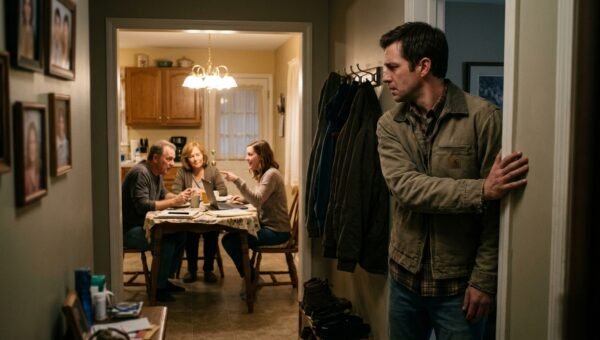
I’d grown up in a family where my mother was expected to remember birthdays, send thank-you notes, keep the holiday meals going, and make sure nobody felt left out. She was good at it. I thought she liked it. When she disappeared during Thanksgiving or Christmas, I took it personally.
I was old enough to know better, but not old enough, apparently, to ask her why.
The next morning, I called the hotel.
The St. Jude was a few blocks from the old bus station in our Hudson River city. I remembered it from when Dad had been sick. The lobby had a narrow desk and a bowl of peppermints nobody seemed to take. The manager, a man named Lou, studied the key tag and said the hotel had changed hands twice since those receipts were printed.
“I can check the old books,” he said. “It may take a while.”
I almost said not to bother. I’d already spent a lot of time sorting my mother’s things, and there were more important things to do. But I watched him carry a thick ledger out from a back room, so I stayed.
Lou ran his finger down the page, then stopped at the Tuesday entries.
He turned the ledger toward me. Evelyn’s name was there, but Clara’s was listed as the primary contact. My aunt had signed beside it. The dates kept going, month after month.
“Clara was the one who booked it,” Lou said.
I looked at that signature. Clara’s handwriting had always been neat, even on grocery lists. I felt a small, stupid relief. My mother wasn’t having an affair. My father had been gone for years. I don’t know why my brain went there first, except maybe the room and the secrecy made it easy to imagine something I could understand.
I called Clara from the hotel courtyard. I could hear a bus pulling away while the phone rang.
She answered on the second try. “You found the key.”
“I found a lot of receipts. Why did you rent a room for Mom every Tuesday?”
Clara didn’t ask me what I meant. She was quiet for a moment, then said, “Did you find the envelope taped under the bed?”
I thought she meant a hotel envelope, maybe something left behind. I looked back at the building through the glass doors.
“What envelope?”
“Go to Room 314,” she said. “Lou will let you in.”
She was so calm that I nearly got mad. I was standing there with my mother in hospice and a key from a life I hadn’t known about, and Clara sounded like she was asking me to pick up milk.
“Why was Mom there every Tuesday?”
“It was the one day she had to herself,” Clara said. “And when the family got to be too much.”
“Which family?”
She didn’t answer right away. Then she said, “You know which one.”
I did, in a way. Dad’s brothers and sisters could turn any holiday into a long list of things my mother had done wrong. The turkey was dry. The rolls were late. She hadn’t called somebody back fast enough. The complaints were always small enough to sound harmless if you only heard one. But they came one after another, and my mother would keep smiling like her face was part of the job.
I had thought she went upstairs to change, or that Clara needed help in the kitchen. I remember standing in the hall at Thanksgiving, waiting for her to come back with a pie, while everybody kept eating. I was seventeen. I was embarrassed by how much I wanted her to sit beside me.
I’d never asked if she was all right. I’d asked why she was making a fuss.
Room 314 was still there, though the lease had ended. Lou walked me down the hall and unlocked it. The room looked smaller than the key tag had made it in my mind. The bed was made. There was a chair by the window and a narrow table with a scratch down the side. No suitcase, no clothes, no obvious sign that my mother had ever been there.
Then I got down on one knee and looked beneath the bed.
A thick envelope was taped under the iron frame. The tape had gone yellow at the edges. The seal was dark red wax, pressed with my father’s old signet. I knew the mark from the ring he used to wear when he went to church or a wedding. Mom had never had that ring.
I reached for it, then stopped. I could see Clara’s hand putting it there, but I couldn’t know that yet. I didn’t know if the envelope was a warning, a secret, or something I had no right to read.
Lou had left the door open. I heard footsteps and then Clara came in, carrying a paper cup of coffee. She didn’t look surprised to see me on the floor.
“You put it there,” I said.
“I did.”
“Why?”
She sat in the chair and held the cup in both hands. Her fingers looked older than I remembered. I was angry with her for about ten seconds, then ashamed of myself for being angry at all.
“Your father asked me to,” she said. “When he was dying.”
She told me Arthur had worked out what was happening before I did. His family had leaned on Evelyn for years. They wanted her time, her attention, and her help with money. They called it family duty. If she said no, they called her selfish. If she said yes, they found another thing she could do.
I knew some of it. I’d seen my mother hand an envelope of cash to one of Dad’s brothers after he said he was short on rent. I had heard an aunt complain that Mom only called when she needed something, even though Mom had made three calls that week. I just hadn’t put it together. My father did.
“He knew he wouldn’t be here to shut it down,” Clara said. “He knew they’d keep coming to her.”
“So you booked her a hotel room.”
“Every Tuesday. It was close enough she could walk there if she wanted. She could sit down and not have to serve anyone.”
I looked at the envelope beneath the bed. “And the holidays?”
Clara set her coffee down. She told me the family got worse after Arthur died. People came to the house, ate what Evelyn cooked, and then criticized her for not doing enough. A few relatives asked for loans. One told her a widow shouldn’t be so careful with money when family was struggling. Clara had gone to the bathroom once and found Evelyn sitting on the closed toilet lid, trying to make her hands stop shaking.
I wanted to say I would have helped. But I was a kid for some of those years, and later I had my own life. I’d been around. I just hadn’t been paying attention.
“Why didn’t she tell me?” I asked.
Clara looked at me, not unkindly. “She thought you needed to love your family.”
That bothered me because I could see how much she loved me, and also because she hadn’t trusted me with the truth. Both things could be true. I wanted to be the person she came to. Instead, I was one more person she thought she had to keep comfortable.
Arthur had arranged the room while he was sick, Clara said. He gave her enough money to keep the Tuesday bookings going and asked her to hold onto the envelope. After he died, Evelyn went there to read his letters, write in a notebook, or sit without anyone asking for something. Sometimes she went on Tuesdays. Sometimes she went during a holiday and came back before anyone noticed.
“She’d come home and put the pie out,” Clara said. “That was the point. She got to come back because she chose to.”
The envelope had stayed under the bed for thirteen years. Clara had kept it there because Arthur wanted Evelyn to have it when she couldn’t keep carrying everything. At first Evelyn could bend down and touch it. Later, when her knees got bad, Clara taped it to the iron rail so it wouldn’t slide away.
“I put it there last year,” she said. “She couldn’t reach it anymore.”
That was the part I couldn’t make myself answer. The room had not been proof that my mother had chosen a life away from us. It was proof that she had found one small place where she could return to herself.
Clara helped me peel the tape away. The envelope came loose with a dry little crackle. We didn’t open it there. I tucked it under my coat, paid the last hotel bill of $184.60, and handed the brass key back to Lou. I asked him to keep the old receipts with the ledger instead of throwing them out.
The hospice center smelled like clean sheets and the lemon soap they used in the bathrooms. Clara drove separately and met me there. Mom was awake, though she’d been sleeping more each day. Her hands were resting over the blanket. The little fingernail on her right hand had a chipped corner from the last time I helped her with her phone.
I sat beside her and set the envelope on the bed.
“I found Room 314,” I said.
She looked at the wax seal. She didn’t ask how. Clara took a chair on the other side and put her hand over Mom’s.
“I’m sorry I thought you left because you didn’t want us,” I said.
Mom closed her eyes for a moment. Then she opened them and turned her hand so her fingers touched mine. I didn’t ask her to explain every holiday. I didn’t ask why she’d kept the room from me. I could feel those questions waiting, but I could also see how tired she was, and the room had finally told me what I needed to know.
She nodded toward the seal.
I broke it carefully. Inside was a letter in Dad’s handwriting, folded around a small group of photographs. I recognized the ones from our first house: Dad holding me on the front step, Mom laughing with flour on her cheek, the three of us at a picnic table before family gatherings became work for her.
The letter wasn’t long. Arthur wrote that he knew his family had asked too much of Evelyn and that he was sorry he wouldn’t be there to stand between her and their demands. He told her she didn’t owe anyone her strength just because they had grown used to it. He wrote that she could leave the table, let the phone ring, and keep the day for herself. He wanted her to live for her own sake, not just to make everyone else feel cared for.
At the bottom he had written: “You don’t have to go back until you’re ready.”
Mom held the paper against her chest. Clara squeezed her hand. I reached for the old brass key, which I’d brought back in my pocket before returning it to Lou, then remembered I’d already handed it over.
For once, there was nothing I could fix or carry for her. So I stayed.
The afternoon sun reached her hands where they rested on the open letter. She looked quiet, not like the mother at the head of every crowded holiday table, but like someone who’d finally come home.