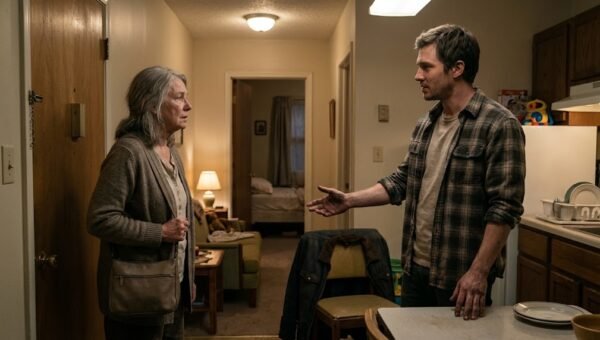
The damp edge of the deed stuck to my thumb while Galen tried to take it from me. He’d brought Ray and a contractor to my porch, along with papers saying I had to leave the house. The contractor had a survey map open on the hood of his truck. Galen was already talking about clearing timber. I kept my hand on the deed.
“You don’t own this house,” he said.
I told him he was wrong. I was trying to keep my voice level, but I could feel my pulse in my fingertips.
The contractor looked from Galen to the paper in my hand, then back at the map. He hadn’t yet seen the county stamp that was about to end the argument.
Three days earlier, Attorney Miller had read Mama’s will in his small office. I remember the stale coffee smell and how the chair arms dug into my elbows. Galen and Ray sat together across from me. I had Mama’s butter churn in my lap because I’d carried it in from the car and didn’t want to leave it outside.
The will read out plain. My two brothers split the farm and the bank accounts. I got “Mama’s butter churn.”
Galen laughed. “Don’t spend it all in one place, sis.”
Ray didn’t laugh exactly. He made a little sound through his nose and looked down at his hands. That was pretty much his part in the family. Galen said the thing, Ray went along with it, and I was left to decide if speaking up would make me sound difficult.
Attorney Miller said the land was worth maybe $300,000, depending on what could be done with it. Galen tapped the papers and said he and Ray would handle the farm. I wanted to ask which part of “handle” included coming when Mama couldn’t get out of bed, but the question got stuck. I’ve never been good at making a clean argument while somebody is smiling at me.
For six years, I’d been the one there. I bathed Mama, spoon-fed her when her hands got too shaky, kept track of her medicine and helped with the exercises the physical therapist showed me. Some days she could stand with my arm under hers. Some days she couldn’t.
My brothers sent cards from the city at Christmas and on birthdays. I’m not saying they never called. They did. A call doesn’t change a damp nightgown or get a pill down when your mother’s jaw is clenched.
I knew that sounded mean even as I thought it. I was tired, and I was jealous of the fact that they could hang up.
After the reading, Galen asked if I wanted help carrying the churn. I said no. I took it home because it was Mama’s, and because I couldn’t stand the thought of the brothers deciding it was junk and putting it beside the road.
That evening, the house felt different without her in it. Not tragic, just wrong in the practical ways. Her medicine cup was still beside the sink. I had to move it before I could wash dishes, and then I felt foolish for standing there with it in my hand.
I set the churn near the hearth and decided I’d clean it. It had been in the kitchen for years, mostly used to hold tea towels after Mama stopped making butter. I wiped the outside, then tried to fit the dasher back through the top. It wouldn’t seat right.
I turned it over. The bottom had a cedar panel screwed in tight, one I’d never noticed. I don’t know why I picked up a butter knife instead of finding a screwdriver. Maybe I was still mad enough to want to get at it immediately. The knife slipped once and scratched the wood. I almost stopped, then wedged the blade under the edge again.
The panel came loose.
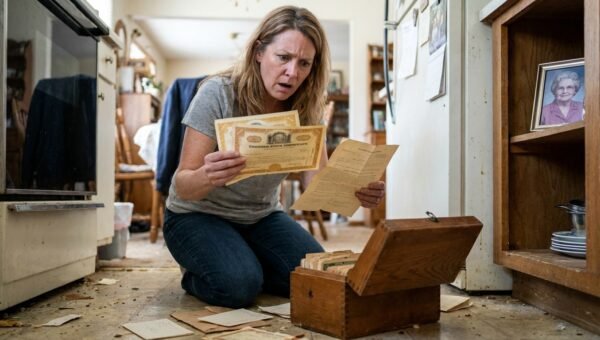
Inside was a roll of bills thick as my wrist, a folded deed, and a letter in Mama’s shaky hand. I sat on the floor. The first line read, “For the one who actually showed up. The land they’re fighting over was already…”
I stopped there, which was silly. The sentence wasn’t going anywhere. But I had to take a breath before I could keep reading.
Mama had written that three years earlier, Galen and Ray came out to the farm with a land appraiser. I remembered that visit. Galen said the appraiser was there to “get a better idea of things.” He spent more time looking at the tax papers than asking Mama how she felt. Ray wandered around behind him, quiet as ever.
Mama wrote that she heard them talking about selling the place after she died. They wanted to auction it to a timber and gravel company. They thought the old farm was worth more cleared than lived on.
The letter didn’t call them monsters. Mama never talked that way. She wrote that she was tired of being treated like a property problem while she was still sitting in the house. Then she wrote, “I knew what they planned, and I knew what you had done for me.”
I had to put the letter down for a minute.
There was more. The back eighty acres, she wrote, had been placed under a conservation easement that barred clearing and building for thirty years. She’d made sure the county had the right papers. The house, barn, spring, and twenty-five acres along the road had been deeded to me outright and recorded in the county registry the previous November. The land Galen and Ray were fighting over was already stripped of its commercial rights and subdivided.
Then I read the number at the bottom of the deed. Mama had included the recording stamp number in the letter. She’d also written, “Take this to Mr. Miller before you say a word to your brothers.”
I did that the next morning.
I brought the deed and letter to Attorney Miller’s office. He read the stamp number and checked it against his file. While he did that, I sat with my hands folded on my knees. I was worried the paper had some flaw, some condition I’d missed. I didn’t want to get excited and then have Galen laugh again.
Mr. Miller said the deed had been recorded twenty-six months earlier. It was legal and complete. He showed me the signed conservation easement covering the back acreage and explained that Mama’s will could only pass the land she still owned when she died.
“What about the rest?” I asked.
“The eighty acres are theirs,” he said. “But they can’t clear it or develop it. There are maintenance and tax obligations.”
I asked if the house was mine. He said yes. He checked the recording one more time, as if he understood I needed to hear it twice.
I’d thought the churn might be all she left me. It was the only thing Galen let me carry out of the will reading without making me feel I was taking something that belonged to him.
The money in it totaled $42,000. Mama had withdrawn it bit by bit over twenty months and kept it hidden. She wrote that she wanted me to have enough to pay the taxes and fix what needed fixing, so I wouldn’t have to sell the house just to keep it.
It wasn’t a fortune. The roof was old, and the spring needed work. Still, $42,000 meant I could make a plan instead of waiting for the next thing to break. I deposited it after I confirmed the deed, and set aside money for the roof and the property taxes.
I didn’t call Galen. I wanted to. I wanted to hear him explain why he’d thought he could bring a contractor onto Mama’s land before the funeral flowers had wilted. But Mr. Miller told me to keep the papers safe and let the record speak for itself.
The following morning, Galen arrived with Ray and the contractor. That was the scene I started with.
The contractor unfolded his map on the truck hood and asked Galen where the access road crossed the property line. Galen pointed toward the house. The contractor said the road and the twenty-five acres were not in Galen’s name.
Galen told him the will gave them the farm. The contractor asked to see the title search. Ray passed him a folder. The contractor looked at the plat numbers, then at the deed I was holding.
“That’s not what you told me,” he said.
Galen’s voice got louder. He said Mama couldn’t have transferred the house without telling him. He said the will proved the farm belonged to the two of them. I told him the house and home acreage never went through the will. Mama had deeded them to me while she was alive.
He held out his hand. I gave the certified copy to the contractor instead.
The contractor read the recording stamp and checked it against his papers. Then he folded the map. He said he wasn’t clearing anything, and he wasn’t taking the job. He’d been brought out to survey land Galen didn’t own, and without access or commercial clearing rights, there was no deal.
Galen asked if the contractor was seriously leaving. The man said he wasn’t going to risk his equipment on a bad title. He walked back to his truck, got in, and drove down the gravel road.
Ray watched the truck go. Galen didn’t move for a few seconds. Then he started swearing about the easement and the money they’d spent lining up the deal. They’d inherited eighty acres of protected wetland and agricultural backland with annual taxes and no way to turn it into the development money Galen had counted on.
Then he turned on me.
He said he’d sue to overturn the will. I told him the deed wasn’t part of the will. It had been recorded more than two years before Mama died. Mr. Miller had confirmed it. Galen could sue if he wanted, but he wasn’t going to make the house his by shouting from my porch.
Ray asked if we could sit down and work out some kind of family arrangement. His voice was soft, like the whole problem was a misunderstanding we could tidy up before supper.
I said no.
Galen tried a different voice then. He called me his sister. He said Mama wouldn’t have wanted us to cut each other off. He said they’d always meant to do right by me, though he didn’t say when or how.
I went inside and got the stack of greeting cards Mama had kept in the kitchen drawer. The cards were from Galen and Ray, mostly holiday ones. A few had short notes inside. I brought them back to the porch and set them on the rail.
“You sent her these,” I said. “I was there when she couldn’t lift her head.”
Galen said I was making it ugly. Maybe I was. I’d been swallowing things for years because I didn’t want to make a hard day harder. That morning I was done with that.
He said, “We’re family.”
“I spent six years learning what that means,” I said.
Then I told them they were not welcome at my home again. I said the same to Ray, who looked down at the cards. They left without another word. I watched their truck turn past the mailbox and disappear down the road.
The roof was replaced that fall. I paid the property taxes and had the spring checked. There’s still work to do. A farm doesn’t stop needing things because the deed is settled.
The churn sits cleaned beside the fireplace. I fixed the dasher so it rests straight now. Some mornings I carry black coffee out to the porch and sit where I can see the road. I don’t wonder whether Galen will come back. I know what I’ll do if he does.
For the first time in years, the house is quiet because nobody needs me to hurry. I have the deed in the drawer, the churn by the hearth, and my own key in my pocket.