I was holding the brass key in my palm when I understood that my marriage had already ended. I just didn’t know the reason yet.
The key had 418 stamped into it. Clara Vance had put it in my hand outside conference room 2B at the courthouse, while Thomas stood beside her and watched me try to make sense of the afternoon.
She said, “You should be the one to decide.”
I’ll get to what the key opened. I’ve tried to write this without making myself sound smarter than I was. I wasn’t. I was bringing Thomas lunch.
At 12:15, I walked into the courthouse with his metal lunch tin. It had a dent near the clasp from when he dropped it by our back steps. I’d put a ham sandwich and an apple inside. He’d forgotten it on the counter, which happened often enough that I didn’t think twice.
Denise, the receptionist, knew me by sight. She smiled at the tin.
“Thomas forget his lunch again?”
“Apparently.”
“He’s in a meeting with his ex-wife,” she said, then glanced down at the papers in front of her. “Conference room 2B.”
I laughed. Not because it was funny. I thought she’d mixed him up with someone else.
“Thomas doesn’t have an ex-wife.”
Denise looked up then. “Oh. I’m sorry. I thought you knew.”
I didn’t ask her to explain. I couldn’t quite make my mouth work. Thomas had never mentioned being married before me.
Not once. For seven years, he’d let me believe he’d been single until we met and that he’d simply never found the right person.
I knew his childhood dog’s name. I knew he hated cooked carrots and kept extra batteries in the kitchen drawer. I didn’t know he’d had a wife.
I sat on a wooden bench with the lunch tin between my shoes. I kept checking the clock. At 12:35, the door opened.
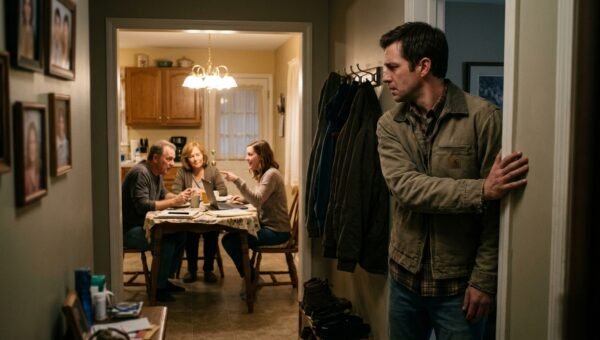
Thomas came out with a woman who looked tired but put together. She had a cane tucked under one arm. The other person was a younger woman carrying a thin folder. Thomas saw me and stopped walking.
The woman with the cane looked at me first.
“I’m Clara,” she said.
Thomas started to speak. “This isn’t, “
Clara held out the key. “You should be the one to decide.”
I took it because I couldn’t think of anything else to do.
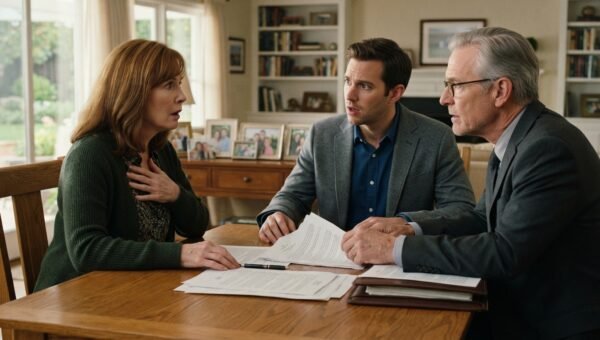
The other woman introduced herself as Maeve Donnelly, an attorney with the county legal aid clinic.
She said Clara had come in to clear up a deed issue involving her house. Thomas had been handling the last paperwork, or meant to be, at least.
I looked at him. “Your ex-wife?”
He rubbed his thumb against the side of his index finger. He does that when he’s trying to keep his voice even.
“I can explain,” he said.
“Not here,” Maeve said quietly.
Thomas looked at me. “Let’s go home and talk.”
I didn’t move. I could hear a copier running behind Denise’s desk. That’s the kind of detail I remember. Not what anyone wore. The copier, and the key pressing into the soft part of my hand.
“No,” I said. “I’m going to ask her.”
Thomas gave me a look I knew well, the one he used when he thought I was making something harder than it needed to be.
“Please,” he said. “Not now.”
That was enough to make me stay.
Outside, Maeve waited with Clara near the courthouse steps while Thomas walked a few paces away to take a call.
He kept looking back at us. He wasn’t really listening to whoever was on the phone.
Maeve explained that Clara had a home on Elm Street. The title still had a clerical lien that needed a release. Thomas’s signature was needed because the property had been bought during their marriage, and he’d signed away his claim when they divorced.
“So why is he involved now?” I asked.
“He never finished the final release,” Maeve said. “Clara’s trying to get the title cleared before a medical procedure.”
Clara shifted her cane from one hand to the other. Her fingers were thin, but her voice didn’t wobble.
“I asked him more than once,” she said. “He kept putting it off.”
Thomas ended the call and came back. “I didn’t put it off. The forms got complicated.”
“That’s not what you told me,” Maeve said.
He looked at her, then at me. “We can discuss this without an audience.”
I heard how he said it. He didn’t say without Clara. He said without an audience.
I asked Maeve what the key opened.
“The side entrance and the basement storage room at 418 Elm,” she said. “Clara asked me to bring it. She still has things in the house that belong to Thomas.”
Clara added, “I don’t want to decide what to do with them for him.”
Then she looked at me. Not angry. Not begging. Just worn out.
“I thought you should know what you’re being asked to trust,” she said.
I wanted to tell her she didn’t get to hand me a marriage problem like a box. I wanted to say Thomas had the right to tell me himself. But I also knew I was standing there with seven years of marriage in my head and no answer for what kind of man I’d married.
Thomas stepped closer. “There’s nothing in that house you need to see.”
I looked at the key.
“Then it won’t hurt if I do.”
He said my name. I didn’t answer.
Maeve gave me the address. I drove to Elm Street by myself. Thomas called three times before I got there, and I let each call ring out. I was angry at him. I was angry at Clara for knowing more about my husband than I did. Mostly, I was angry at myself for still wanting to go home and have him explain it neatly.
The house was small, with a front porch and hydrangeas that had grown too big for their patch. I’d never seen it before. I know that sounds strange, because it was the house where my husband had lived with another woman, but I didn’t feel like I was looking at a stranger’s home. I felt like I’d arrived late to something I should have known about.
The side door had a deadbolt. The brass key turned after I pushed the door in with my shoulder.
Inside, the house was mostly empty. There was a smell like old paper and closed-up rooms. A couple of boxes sat near the basement steps. Nothing dramatic. Nothing that would have made a good story if I hadn’t already been given a reason to look.
The basement storage door was locked too. The same key opened it.
I don’t know why I expected a single box. There were several. Some were taped shut. Others had been packed but never moved. I found wedding albums, insurance forms with both their names, and a stack of medical bills. Thomas’s handwriting was on the envelopes. I knew the shape of it before I read his name.
The hospital statements were from ten years earlier. There were copays, lab charges, and notes in his writing about dates and amounts due. The diagnosis on one form was chronic kidney disease. Early stage, at the time.
I sat down on the bottom stair.
This was the part I kept trying to make smaller. He’d been scared. He’d been young. Maybe they’d been having trouble already. Maybe he’d been trying to help and couldn’t manage it. All of that could be true.
But he’d also left her with the house payments and medical bills. Then he’d let me believe he’d never been married.
I found the divorce paperwork in a box marked HOUSE. His name and Clara’s were on the first page. The docket number was printed in the corner. In the back was a county notice about the unfinished release. It had been sent years before. There were more notices. They’d never been opened.
That is what the key opened. Not just a room. The part of Thomas’s life he’d packed away so thoroughly that he thought he could make it disappear.
He came in while I was still downstairs. I heard the side door close, then his shoes on the steps.
“Are you down there?”
I held one of the bills by the corner. “Yes.”
He came to the bottom stair and stopped when he saw the papers laid out beside me.
“Why did you keep these?” I asked.
“I didn’t know what to do with them.”
“You knew what to do with the house. You left.”
He sat on the step above me. He didn’t reach for the bills.
“Clara got sick,” he said. “I couldn’t handle it.”
“Then you could’ve told me you were married.”
“I was ashamed.”
“You let me think you’d never had a wife.”
“I know.”
“Did you tell me you’d been single because you thought it sounded better?”
He looked down at his hands. “Yes.”
It wasn’t a good answer. It was just the first honest one.
He said he’d been afraid of becoming responsible for her care. He was afraid of the bills, the appointments, the possibility that her health would get worse. He told me he’d felt trapped and ashamed of feeling trapped, and when he left, he thought it would be temporary.
“How long was temporary?” I asked.
He didn’t answer.
I put the bill down. “You left her with all of it.”
“I signed over my claim to the house.”
“That isn’t the same thing.”
“No,” he said. “It isn’t.”
He sounded small, not because I wanted him to suffer, but because I’d never heard him talk without smoothing the edges off first. Thomas was good at being dependable in ordinary ways. He took my car in for oil changes. He remembered my sister’s birthday. He packed leftovers for me when I worked late.
I had treated those things as proof of character. Maybe they were proof of habit. I still don’t know.
He started to say it was a mistake from when he was young. I cut him off.
“Don’t call it a mistake.”
He looked at me.
“You made a choice. Then you hid it from me for seven years.”
“I didn’t want it to be who I was.”
“But it was.”
He put both hands over his face. I let him sit there for a minute. Then I stood up.
“I wasn’t strong enough,” he said.
He said it like it explained everything.
I said, “You didn’t tell me because you wanted to keep looking like someone who wouldn’t leave.”
He nodded once. “I think that’s true.”
The lunch tin was on the mantel. I’d brought it all the way from the courthouse and forgotten I was still carrying it. I set it beside the papers.
Thomas looked at it. “You brought my lunch.”
“I did.”
That was all. I didn’t scream. I didn’t throw anything. There wasn’t a version of the day where I could say the right sentence and have the past become less true.
He tried again. He said he loved me. He said he’d do anything to fix this. He said he’d sign whatever Clara needed and go to counseling with me.
“Would you have told me if Denise hadn’t?” I asked.
He looked down.
I already knew the answer.
Maeve came by later to pick up the release paperwork. Thomas signed it in front of us. This time there was no story about a form getting complicated, no reason it couldn’t be done today. Maeve checked the signature, thanked him, and put the pages in her folder.
Clara wasn’t there. She’d gone home to rest before her procedure. I didn’t blame her for leaving. She’d already waited long enough for one signature.
Thomas asked me if we could go home together. I said no.
I went back to our house, packed a bag, and took enough clothes for several days. I called a residential hotel downtown and booked a room. I didn’t want to sleep in the same bed and listen to Thomas explain the difference between fear and cruelty until I got tired enough to accept whichever version hurt less.
At 418 Elm, before I left, I took off my wedding ring. I placed it beside the lunch tin on the worn kitchen counter. I could hear Thomas behind me, saying my name, but I didn’t turn around.
The gate made a hard little click when I closed it. Through the front window, the autumn light fell across the counter, catching the silver band beside the lunch tin. I left it there.