The porch at my house was where I watched my son leave with two lawyers and no explanation. Twenty-five days later, I found him sitting on those same steps beside two beat-up suitcases and a banker’s box.
I was halfway across town when Martha called. “Arthur, you need to come home right now.” Her voice had that tight, breathless sound people get when they’re trying not to scare you and doing it anyway. “There’s someone standing at your front door, and I don’t think you were expecting this.”
I didn’t ask who. I just turned the car around.
For the whole drive, I kept seeing Julian at 18, walking away from me on his birthday.
I’d told myself I could accept whatever he chose. That was before 25 days passed without a call, a text, or even a two-word message.
I’d tried to act like a person with sense. I went to work. I put food in the fridge. I answered Martha when she asked if I’d heard from him. But every evening I still checked my phone before bed, then set it face down like that would help.
The road bent near our block. I came around the corner and saw the faded denim jacket first. Julian was slumped against the doorframe, his head down. His sneakers were dusty, and the suitcases beside him looked like they’d been dragged a long way. The box sat by his feet.
I hit the brakes too hard. The seat belt caught me across the chest.
Martha stood on her porch, one hand lifted toward him as if she’d been trying to decide whether to touch his shoulder. Julian looked up when I got out of the car.
“Dad,” he said.
I had been carrying plenty of anger around. It went quiet then. Not gone. Just not the first thing I felt.
I walked up the steps. “Are you hurt?”
“No.” He rubbed one hand over his face. “I’m just tired.”
He looked like he hadn’t slept properly in a week. Maybe longer. I wanted to grab him and shake him at the same time, which isn’t a fine way to feel about your kid. So I stood there with my hands at my sides until he moved toward me.
“I’m sorry,” Julian said.
I put my arms around him. He folded into me, and I could feel the stiff edge of the banker’s box between us. Martha let out a breath from across the yard. I told her we were all right, though I didn’t know that yet.
“Come inside,” I said.
I remember his shoes on the hall mat. I bought that mat when Julian was small, after he tracked mud across the whole kitchen. He’d made a face when I told him to clean it up, then spent ten minutes scrubbing one spot with an old toothbrush. I don’t know why that came back to me right then. Maybe because the shoes were still dusty.
I got him a glass of water. He drank half of it without stopping. Then I sat across from him at the kitchen table, the same table where we’d eaten his birthday cake 25 days earlier.
That day, two people from the Sterling trust had shown up before we’d finished the cake. One was a woman named Evelyn Sterling, Vance Sterling’s widow. Vance was Julian’s biological father, a man I’d never met. The other two were lawyers from Sterling Trust Partners.
They had a folder and a careful way of speaking. Julian had just turned 18. Vance had died years before, and his will had left Julian a multimillion-dollar trust.
I can still picture the frosting on the paper plates. Julian had blue icing on one thumb. He’d been smiling until Evelyn placed the folder beside the cake.
I didn’t know what to say. “That’s a lot to take in.”
Julian looked at me, then at the lawyers. “I need to read it.”
“Of course,” Evelyn said. “There are some conditions.”
The lawyers explained that the trust had to be accepted by a certain date. They said there were documents for Julian to review and sign. They didn’t say, in front of me, what those documents required. Julian stopped smiling. His shoulders went stiff.
I thought maybe he needed time alone. I was wrong about that, but I didn’t know it yet.
When the visitors left, I followed Julian to the front door. He hugged me hard enough to make my ribs ache. Then he stepped away and walked down the porch steps without looking back.
“Jules,” I called.
He kept going.
I didn’t chase him. I’ve replayed that choice more than once. I thought giving him room was the decent thing to do. I also didn’t want him to see how scared I was that the money would make me less important to him.
The fear didn’t come from nowhere. When Julian was 8, I found out I wasn’t his biological father. His mother had already drifted out of our lives by then. I’d been raising him since he was a baby, and it had never occurred to me to count the years or compare our faces.
The truth came out during a medical appointment. A blood test raised a question, and his mother finally told me about Vance. I remember sitting in my truck outside the clinic with a folded appointment slip on the passenger seat. I had to read the same line three times.
I was hurt. I was embarrassed that I’d been the last to know. But when I went inside and saw Julian building a crooked tower out of paper cups, none of that changed what I was going to do.
That night, I told him, “You’re my kid. That’s not changing.”
He looked up from the cups. “Okay.”
That was it. He went back to building his tower. I went back to being his dad.
So when he left on his 18th birthday, I tried to tell myself blood didn’t matter, not even now. But I also knew what kind of money was involved. I wondered whether Vance’s family had made Julian feel that he belonged with them in a way he didn’t belong with me.
For 25 days, I didn’t know what had happened. The first few days, I checked my phone every few minutes. After that, I checked less often, but I still checked. I called once. The call went to voicemail. I didn’t leave a message because I couldn’t figure out how to say, “I miss you,” without sounding like I was asking him to come back for my sake.
Martha asked once if I wanted her to check with people in town. I said no. It wasn’t true that I didn’t want to know. I just didn’t want to make Julian feel hunted.
Now he sat across from me at the kitchen table, back from wherever he’d been, with a legal box at his feet.
“Tell me what happened,” I said.
He rubbed both hands on his jeans. “They wanted me to sign something before I could get the trust.”
“What kind of something?”
“A severance agreement.” He glanced up to see if I understood. “They called it the Severance of Prior Guardian Ties and Repudiation Agreement.”
I didn’t answer right away. The phrase sounded like it had been built to make a person feel small.
“What does it say?”
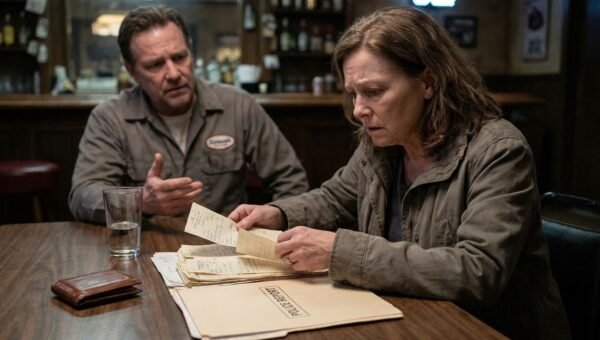
Julian opened the box. He took out a thick manila dossier, worn at the corners, and set it on the table. There were letters with the Sterling Trust Partners name at the top. There were copies of forms and notes in his handwriting. His handwriting had always slanted uphill when he was in a hurry.
“They wanted me to publicly say you weren’t my father,” he said. “And cut you off. No contact. No money to you. Nothing.”
I read the first page slowly. Then I read it again. The words were plain enough. They just didn’t seem like something any family should put in front of an 18-year-old.
“They said I had to sign this to get the inheritance?”
“Every part of it.”
“And if you didn’t?”
“I got nothing.”
I looked at him. “They wanted you to give me up for money.”
Julian nodded once. He kept his eyes on the papers.
The trust also came with a place on a corporate board and an internship overseas, all arranged by Vance’s family. The lawyers had talked about opportunity. Julian said they talked about discipline and keeping the Sterling name clean. He was expected to live where they told him, work where they told him, and stay away from me.
I ran my finger along the edge of the page. The paper had a rough cut, like it had been torn from a stack.
“Why didn’t you call me?”
“I thought I could find a way around it,” he said. “I thought I could keep the money and not sign the part about you.”
He’d spent 25 days in offices with lawyers and people from Vance’s family. There were depositions, meetings, and pressure to accept their terms. Julian thought he could negotiate. He thought that if he kept his mouth shut about me, no one could use me to force his hand.
“They said I couldn’t talk about the negotiations,” he said. “And I believed them. I thought if I called you, they’d find some way to drag you into it.”
“Jules, I could’ve helped.”
“I know.” He pinched the bridge of his nose. “That’s why I didn’t want to tell you. I didn’t want you paying for a lawyer or getting pulled into their mess. I figured I had to handle it myself.”
I got mad then, though not in the clean, simple way I expected. I was mad at the lawyers. I was mad at the Sterling family. I was mad at Julian for leaving me to sit with no word. I was mad at myself for thinking the worst.
“I thought you’d decided you didn’t need me anymore,” I said.
He looked up. “I didn’t.”
“Twenty-five days is a long time.”
“I know.” His voice cracked. “I know.”
He pulled another page from the folder. It had an official stamp near the bottom and signatures beside it. He didn’t push it toward me yet.
“I tried to make both things fit,” he said. “The money and you. I kept thinking I was missing a way to do it. But every version they offered came back to the same thing. They wanted me to be theirs, and they wanted me to say you weren’t.”
The room was quiet. I could hear the fridge humming. I didn’t say anything because I wanted him to finish.
“So I stopped trying to find a loophole,” he said. “I signed this.”
He put the page down between us.
The title read “Irrevocable Renunciation and Disclaimer of Trust Assets.” The stamp was clear. There were witnesses listed below it. I looked from the page to Julian.
“You gave it all up?”
“Every cent.”
“You know how much it was?”
“More than I can picture.” He let out a short breath. “It doesn’t matter now.”
It mattered. Of course it mattered. It was a fortune. But there was his name on that paper, and beneath it the words saying he had refused the trust. No lawyer could say he’d only been thinking about it. No relative could tell me he’d taken the money and forgotten where home was.
“You didn’t have to prove anything to me,” I said.
“I wasn’t trying to prove it.” Julian looked down at his hands. “I just wanted to come back without them having a claim on you. I didn’t want to call until it was done.”
I wanted to tell him I’d rather have been there for every bad meeting. I also knew he’d made the choice he thought would protect me. Maybe that wasn’t the choice I would have made. It was still his to make.
I reached across the table. “You’re my son with or without that paper.”
“I know.” He started crying then, and tried to cover it by looking down. “I wanted you to know I chose you.”
I took his hand. “You don’t have to choose me. You already came home.”
He shook his head, still crying. I’m not good at speeches. I’m not sure I’ve ever been good at saying the right thing on the first try. So I held on to his hand and let the quiet sit there between us.
Martha knocked a little later. I opened the door and told her Julian was all right. She gave him a careful hug and said she’d kept an eye on the porch because she didn’t know if he might fall asleep sitting up. Julian thanked her. She told him to eat something.
He went upstairs to his old room. I heard the floorboard by the closet creak in the same spot it had when he was 10. He came back down with his sleeves pushed up and his face washed.
The next week, Julian found an apprenticeship at a repair shop in town. It wasn’t grand, and he didn’t pretend it was. He said he wanted work he could do honestly and pay he could earn himself. The Sterling trust passed to the next people named in its documents. Julian didn’t ask me what that might mean for the family. He was done with them.
That evening, I warmed the stew I’d made before he came home. He hung his faded work jacket on the brass peg by the front door, the one he’d used since he was a teenager. Then we sat across from each other at the chipped kitchen table.
The stamped disclaimer lay on the counter, out of the way.
Julian reached for another piece of bread. I passed it to him. His jacket was back on its peg, and he was home.