A black car stopped beside my mailbox, and a man I hadn’t seen in thirty years put a pair of small wool gloves in my hand.
I knew the gloves before I knew him. Red and grey, with my black thread across one thumb where I’d mended a hole. I was standing on my front walk in my old house shoes. The cold had got through them, but I could not look down at my feet.
“You kept me warm when no one else did,” the man said.
Then he opened the back door of the car.
The woman who stepped out was old and thin. She had one hand on the door, like the ground might move under her. I knew her eyes. I had seen them once through the windshield of my school bus, at the bend by the feed store, in the winter of 1986.
I was seventy-three years old by then. My husband, Arthur, had been gone since October. The bank had sent me another red envelope that week. I was $9,000 behind, and I had started to think of my home as a place I was about to lose.
The boy on Route 6 had been seven.
I drove that route for thirty years. The mornings could be mean in winter, and that year was worse than most. Julian Vance climbed onto my bus wearing a thin shirt and no coat.
His lips had turned blue. He held the rail with both hands, and his shoulders were up around his ears.
“Sit up front by the heater,” I told him.
He looked at me like he expected to be sent back down the steps. “I’m okay.”
“You’re not,” I said. “Come on.”
I had a pair of spare wool gloves in my bag. They were red and grey, left over from a school winter drive. I gave them to him, then pushed my lunch crackers into his hands. He tried to give one back.
“Eat them,” I said. “I’ve got more.”
I didn’t have more. I had half a cheese sandwich and a thermos of coffee. But a seven-year-old shouldn’t have to learn how to make a little food last while he was shivering beside a bus heater.
That became our morning habit. Julian sat up front. I kept the heater turned his way, even when the rest of the bus complained it was too hot.
I put crackers aside for him, and he wore those gloves. I didn’t ask questions. I knew better than to make a child explain what the grown-ups around him had failed to do.
By spring, he was gone. His family moved, or that was what I thought. I never got a goodbye. I never got his address.
I did get one look at his mother.
I was turning at the bend near the feed store when I saw a woman standing outside a house with the porch light on. Her face looked tired in a way I couldn’t quite name. There was a bruise along her cheek, and she had one arm wrapped around herself. The bus rolled past before I could do more than glance. I had children behind me and a schedule to keep. That’s the part I wish I’d done differently. I told myself it wasn’t my business.
Back on my front walk, thirty years later, the woman from the bend stood beside a black car.
The man held out the gloves. He looked about thirty-eight, tall, with a little grey at his temples. I searched his face for the child I remembered. His eyes were the same. I wasn’t certain until he said, “It’s Julian.”
I tightened my fingers around the gloves. “You’re the boy from Route 6.”
“Yes, ma’am.”
The woman took a small step toward me. Her hand shook. A faint silver scar crossed the skin near her thumb.
I knew that scar, too. I had seen it through the windshield, just for a second, when she stood at the road bend.
“Evelyn,” I said.
She covered her mouth. “You remember me.”
I did. And I remembered the story I’d made up about her without knowing a thing.
I had thought she was a mother who sent her child into the cold because she didn’t care. For years, when I thought of Julian, I worried that he’d gone home to people who didn’t see him. I suppose I needed that explanation. It was easier than thinking I’d seen something wrong and driven on.
“Come inside,” I said. “It’s cold out here.”
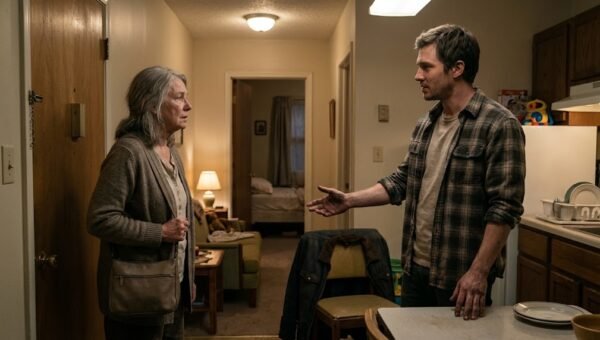
They followed me into the kitchen. I put the kettle on, though my hands kept fumbling with the switch. Julian sat at the table. Evelyn sat beside him, both hands wrapped around a mug of tea I hadn’t poured yet.
I looked at the gloves again. One thumb had a black line of thread, uneven because I’d been in a hurry. “You kept these?”
“My mother kept them,” Julian said. “She gave them to me when we got out.”
Evelyn reached into her coat pocket and took out a folded piece of yellow paper. It had been creased so many times that the edges were soft.
“I brought something,” she said. “I thought I should show you.”
The paper was a receipt from a women’s shelter in the next county. It was dated in the spring of 1986. A little hand-drawn map was tucked behind it. One line marked Route 6. Another marked the bend by the feed store.
“I drew it so I could find the bus,” Evelyn said. “I wanted to see who you were. I wanted to thank you.”
I leaned closer to the map. The pencil had faded, but I could still see my route.
“Why didn’t you come?” I asked.
Evelyn lowered her eyes. “I was ashamed.”
She spoke slowly, stopping once to sip her tea. She’d been working graveyard shifts at a packing plant, then picking up extra hours at a canning plant when she could. Her husband, Julian’s father, took the money she earned. He kept the heat low, hid Julian’s coat, and locked them out when he was angry.
“It was my husband,” she said. “He controlled the money. The clothes. Everything.”
I held my mug with both hands. I had pictured a careless mother for three decades. Not because I knew. Because I didn’t.
“He’d lock me out after my shift,” Evelyn said. “Sometimes Julian was inside. Sometimes he was with me.”
She looked at the glove in my hand.
“That morning he came on the bus with frost on his ears,” she said. “I’d been locked out all night. I had no coat for him. I couldn’t get to him until later.”
The tea smelled faintly of the lemon soap I used on the cups. I can still remember that. I wish I remembered every word she said, but I don’t. I remember how she kept rubbing the scar on her thumb, and I remember looking at Julian and trying to see the seven-year-old who’d watched me hand him crackers. I had been proud of myself for keeping a child warm, which is not the same as knowing what was happening to him. I had been angry at his mother without asking her name. It’s a hard thing to admit, especially after all these years, but I did it. I was wrong about her. I was wrong, and I had carried that wrong thought around like it was proof I’d cared.
“I got enough bus fare together,” Evelyn said. “I took Julian and one suitcase. We left at night.”
“What about the gloves?” I asked.
“He took them with him. He wouldn’t let them go.”
Julian looked down at the pair between us. “I didn’t know why she kept them until I was older.”
Evelyn pressed her fingers to her mouth again. “I kept them because they showed me someone had seen him.”
I wanted to say it was nothing. A spare pair of gloves. A few crackers. But it wasn’t nothing to her, and saying that would have been another way to make the story smaller than it was.
“You did what you could,” I said.
“I should’ve protected him.”
“You were trying to get both of you out.”
Her face crumpled, and Julian reached over to hold her hand. I let them sit there a while. I had spent years thinking about the boy, but I had never thought to wonder what it cost his mother to get him away.
Then Julian noticed the red envelopes on my credenza.
“You’ve got bank mail there,” he said.
I didn’t like the way I pulled the latest one closer to me. It was a childish move, as if hiding it could change the number inside.
“It’s nothing,” I said.
Evelyn glanced at Julian. “Martha.”
I was embarrassed, and I was tired of being embarrassed. Arthur had been sick for a long time. We used what we had for doctors and medicine, and I never regretted that. After he died, I fell behind on the mortgage. The bank’s notices got more serious each month. The last one said foreclosure. The number was $9,000.
“I can handle it,” I said.
Julian looked at the envelope, not at me. “You shouldn’t have to handle it alone.”
“I’m not taking charity.”
He nodded. “I understand.”
I appreciated that he didn’t argue. He didn’t tell me I was being foolish. He asked if I would go with him to First County Bank so we could find out what could be done before the deadline.
“I’ll talk to Mr. Campbell myself,” I said.
“Of course,” Julian said.
So we went. Not because I’d agreed to let him pay, but because I wanted to know what the bank would do. Mr. Wayne Campbell met us in his office with the account papers already out. Julian had called ahead, but he hadn’t asked Mr. Campbell to do anything without me.
Mr. Campbell turned the papers toward me. “The arrears are $9,000. There’s also the remaining principal.”
“I know,” I said.
Julian set a bank draft on the desk. “I’d like to pay both in full.”
I looked at the amount. It covered the $9,000 and the rest of the loan. It was more money than I had ever seen on one piece of paper.
“No,” I said. “Julian, no.”
“I’m not doing this to make you owe me,” he said. “You helped me when I was a kid. I’ve wanted to find you for years.”
“That was my job.”
“You gave me your gloves.”
“You were freezing.”
He let that sit. Then he said, “Let me do this.”
I looked at Evelyn. She had both hands folded in her lap. She wasn’t pushing me. She wasn’t asking me to make her feel better. She just met my eyes.
“I kept those gloves because I thought I’d failed him,” she said. “I’d like to see you keep your home.”
That was what broke through. Not the money, though the money mattered. I could see that she wasn’t trying to buy forgiveness. She was asking me to let her set down a piece of guilt she’d carried too long.
I nodded once. “All right.”
Mr. Campbell checked the draft, called the bank’s main office, and asked me to sign the payment authorization. I read it twice. My name looked strange there, written with my hand shaking a little. Then I signed.
Mr. Campbell said the foreclosure would be stopped. The mortgage would be paid in full, and he’d send the release to the county courthouse for recording. He printed the receipt and gave it to me.
I took it myself.
The next few days involved forms, phone calls, and one more trip into town. I signed what needed signing. The release was recorded, and Mr. Campbell called to tell me the lien was cleared. The house was mine, free of the mortgage.
Julian and Evelyn came back with the final papers. I put them in the drawer where Arthur kept the tax records. It seemed right to put them there, beside the papers for the home we’d paid for together.
I didn’t feel as if everything had gone back to normal. Arthur was still gone. His chair was still empty. But I could wake up without looking at the mail and wondering how many days I had left in my house.
Before Julian and Evelyn left, I took one glove from the pair.
“Keep this one,” Julian said.
“I’m keeping one,” I told him. “You keep the other.”
He smiled, though his eyes were wet. Evelyn reached for my hand and held it between both of hers.
“I’m sorry it took me so long,” she said.
“I know,” I told her.
I set my glove on the mantel beside Arthur’s photograph. Julian put its mate in his coat pocket before he drove down the snowy lane.