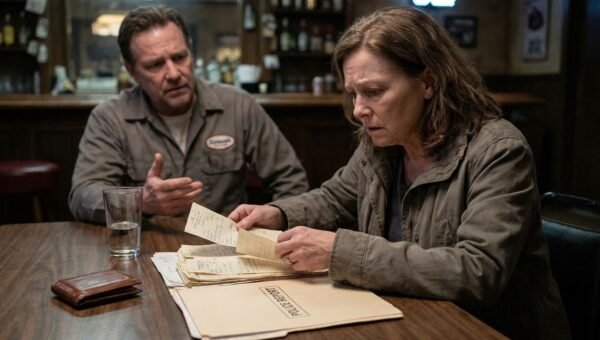
I was wrong about the mice in our basement, and I learned it with my mother’s chipped dinner plate in my hands.
I came home early from the grocery store and found Greg loading boxes into his car. The trunk was open. One box sat on the passenger seat, and yellow price stickers were lined up beside it. Not storage labels. Price stickers from Vance Antiques.
Then I saw the blue towels.
My mother used those towels to wrap the china when I was a kid.
My sister and I used to fight over who got the chipped plate at Sunday dinner because neither of us wanted it, and Mom would say, “Fine, it’s mine now.” She always said it like she’d won something.
I stepped closer. Greg put one hand on the box.
“Those are going to storage,” he said.
“Why are there price stickers in your car?”
He looked at the stickers, then at me. “I’m dealing with it.”
“Open the box.”
He gave me a tired little smile, like I was making a scene over nothing. “Only if you’re ready to see what’s underneath.”
I didn’t move away. I reached past him and pulled the towel back myself.
The top layer was my mother’s china. The chipped plate was right there, its blue flowers worn thin in the middle. I lifted it, and the bottom of the box didn’t feel like packing paper.
It felt stiff. Flat. I pushed the plate aside and saw manila folders tucked under the towels, plus two empty velvet jewelry cases.
I looked at Greg.
“What is this?”
He rubbed the side of his face. “Can we not do this in the driveway?”
That was when I knew he wasn’t taking those boxes to storage.
Three weeks earlier, Greg told me there were mice in the basement. He said he’d seen droppings by the shelves and heard something moving behind the old trunks. I didn’t like the sound of it, but he’d already started shifting boxes around, so I let him handle it. He said he’d take the family things to a storage unit while we got the basement cleaned.
I remember saying, “Just don’t mix up Mom’s things.”
“I know,” he said. “I’m not an idiot.”
I should have gone down and looked. I didn’t. I trusted him, and I was tired of being the person who held on to every old dish and towel.
That’s the plain truth. Greg knew I felt a little silly about keeping all of it downstairs, and I think he used that.
My mother had been gone four years by then. I had inherited the china, some silver, a few quilts, and the jewelry she wore when she went to church. Nothing a museum would want. But I could still picture her hands smoothing those towels over the dishes. That was enough for me.
Greg called the china “dead weight” once, months before. He said it while we were clearing a closet, not even in an argument. I told him it wasn’t dead weight to me. He shrugged and changed the subject.
At the time, I thought that was just Greg being practical.
In the driveway, I took the papers out of the box. The first sheet had Vance Antiques printed at the top. Under that was an itemized list of my mother’s things, written in neat rows.
The sterling silver tea set. A gold locket. Two jewelry boxes. Three quilts. A set of serving spoons.
My mouth went dry, which is not how I’d usually describe myself. I was mad. I was confused. Mostly I kept trying to make the words on the page mean something else.
“This is a consignment form,” I said.
Greg reached for it. “Give me that.”
I pulled it back. “You signed this?”
“It’s not what you think.”
There was another page. A receipt. Then another. The payout amounts had been made out to Greg alone. One was for $1,280. Another for $3,640. Beside each was his signature.
I stood there holding my mother’s plate in one hand and the receipt in the other. The plate was cold and heavier than I expected.
“How long?”
He looked toward the house. “I was going to tell you.”
“When?”
“I don’t know. When I had it sorted out.”
“Sorted out what?”
He made a quick motion with his hand, like the answer should be obvious. “The bills. The credit line. It got away from me.”
“So you sold my mother’s things.”
“I was trying to keep us afloat.”
I hated that part of me wanted to ask whether we were in trouble. I hated that I still wanted the marriage to be something I could fix by asking the right question.
Instead I said, “How much have you sold?”
He didn’t answer.
I looked down at the empty jewelry cases. “What was in these?”
“Some pieces.”
“Which pieces?”
“Your mother’s locket. A couple of things from the boxes.”
He said it in the same voice he used when telling me the furnace filter needed changing. I heard that flat little tone and felt something in me go still. Not calm. Just finished asking him to care.
I took the car keys from the hood.
“Hey,” he said. “Give those back.”
“No.”
“We need to talk first.”
“We are talking. We’re going to Vance’s.”
He stepped toward me, then stopped. I kept the keys in my fist. There was a small nick in the plastic fob from when I dropped it on the garage floor last winter. I pressed my thumb into it hard enough to feel the edge.
“I’m not driving over there to have you humiliate me,” Greg said.
“You did that yourself.”
He got into the passenger seat because he knew I wasn’t going to change my mind. I left the china box in the car and drove to Vance Antiques with the paperwork on my lap. At the first red light, Greg tried to take the pages from me.
I moved them out of reach.
“Stop,” I said.
“I didn’t steal anything.”
“You had no right to sell it.”
“It was just sitting in the basement.”
“It was mine.”
“It was your mother’s.”
I looked at him then. “That’s why it mattered.”
He turned toward the window. We drove the rest of the way without speaking.
Arthur Vance was behind the counter when we walked in. I’d been there once before with my mother, years ago, when she sold a small set of glass dishes she didn’t use. He recognized me, or maybe he recognized the papers in my hand.
“Can I help you?” he asked.
“I’m here about a consignment under Greg’s name. These items belonged to my mother.”
Arthur took the form and read it. He looked at Greg.
“You told me you had permission,” he said.
“I said we were married,” Greg answered.
“That isn’t permission,” I said.
Arthur set the paper down. He didn’t raise his voice. “I can stop the pieces I still have.”
“Stop the silver,” I said. “All of it. And anything else that hasn’t been sold.”
Greg leaned toward the counter. “This is between us.”
“No,” I said. “You brought my family’s things here.”
Arthur checked the list against a ledger behind the counter. He had the silver tea set and two quilts. The jewelry was gone. The locket had been sold to a buyer he’d have to contact. He said he’d give me the sale records and copies of every payout receipt. I asked him to write down the buyer information for the locket and mark the unsold pieces as disputed.
He did.
I didn’t cry in the store. I kept asking practical questions because I could do that. What had been sold? On what date? Which pieces were still there? What would he need to release them to me?
Greg stood beside me, hands in his jacket pockets.
At one point he said, “This is getting out of hand.”
I looked at him. “It was out of hand when you signed my name into your plans.”
He’d signed his own name, of course. I didn’t mean the paperwork. I meant the marriage. I meant the way he had decided I could be kept out of the truth as long as he had a good enough excuse.
Arthur put the tea set and the quilts aside. I showed him the estate papers I kept in a folder at home, and he made copies. He agreed to hold everything until I could arrange pickup. The locket was already gone. He couldn’t get it back that afternoon, but he said he’d call the buyer and tell them the sale was disputed.
I thanked him. My voice sounded normal. That bothered me more than it should have.
On the way home, Greg tried again.
“I was going to replace the money.”
“With what?”
“I’ve got a plan.”
“What plan?”
He stared down at his hands. “I made some bad investments. I thought I could get ahead of it before you noticed.”
There it was. Not the bills, not keeping us afloat. His investments. His private credit line. His choices.
“You used Mom’s things to cover your debts.”
“I didn’t think you’d want to sell them.”
“So you sold them without asking.”
“I knew you’d say no.”
He said it like that settled the matter. Maybe it did for him. I had spent years believing that if I explained why something mattered, Greg would understand. He understood. He just didn’t think my answer had to count.
When we got home, I made him go down to the basement with me. The shelves were mostly bare. The two trunks that had held my mother’s quilts were gone. So was the small wooden box where she kept her jewelry. Dust had left clean rectangles on the shelves where the boxes used to sit.
I stood there longer than I meant to.
“You’ve been down here more than once,” I said.
He didn’t answer.
“How many trips?”
“I don’t know.”
“Try.”
“Four, maybe.”
I looked at the empty shelf. “You told me the mice were in the boxes.”
“I saw droppings.”
“No, you didn’t.”
He looked away.
I still don’t know what I expected. Maybe that he’d say he was sorry in a way that showed he understood what he’d done. Instead he said, “Those things were collecting dust. You didn’t even use them.”
I could smell the basement, that dry cardboard smell mixed with the lemon cleaner I’d spilled down there once and never fully got out of the concrete. I remember it because I had to keep holding on to small details to stop myself from asking the same thing over and over.
“You sold the locket,” I said.
“It was a small piece.”
“It was hers.”
“Dead people don’t need dishes.”
I didn’t answer. He seemed to think he’d made a point. I walked past him and took the remaining boxes upstairs.
The next few days were plain in the way bad days can be plain. I called the shop. I gave Arthur copies of the estate papers. I filed a report about the jewelry Greg had sold without permission. I made a list of what was returned and what was gone. I called my sister and told her about the blue towels, and she was quiet for a while before she said, “Mom would’ve been so mad.”
That made me laugh, a little. Then I cried in the laundry room where Greg couldn’t see me.
I wish I could say I had been completely clear-headed from the start. I wasn’t. I asked Greg if counseling could help. I asked whether there was some way to pay back what he’d taken. I asked questions that gave him openings to explain, because part of me was still trying to save the version of him I’d lived with.
He said he was sorry. He said he’d been scared. He said the debt had grown faster than he expected. He also said I’d been “impossible to talk to” about money and that he knew I’d never agree to sell anything.
“I knew you’d say no,” he said again.
That was the whole problem. He knew. He just thought he could do it anyway.
I told him to pack a bag and stay somewhere else. He said I was making a permanent decision over things that could be replaced. I told him the china wasn’t the only thing he’d taken from me.
He packed two suitcases. I didn’t help. When he was done, he stood by the front door with one hand on the handle.
“I can fix this,” he said.
“No,” I said. “You can’t put it back.”
He left the keys on the hall table. I changed the locks the next morning and made a new folder for the estate papers. The house felt too quiet, but at least the quiet belonged to me.
The silver and quilts came home from Vance’s. The locket didn’t. I still have the sale receipt and the buyer’s name. I don’t know if I’ll get it back. I know the report is filed, and I know where the rest of my mother’s things are now.
I stopped keeping them all in the basement. I washed the chipped Sunday plate by hand and set it in the center of the kitchen table. Then I put bread and salt on it, the way my mother did when we came in from outside and dinner wasn’t ready yet.
I used to think that plate was just the one with the chip. Now it’s the one I refused to hand over.