The orange in Dad’s lunch tin was still firm when I found it in the garage. The crackers were soft around the edges, but the orange looked like he’d packed it that morning.
Dad had been dead six weeks. My brother, Dennis, and I were clearing the garage because Mom couldn’t make herself go in there. Dennis had a trailer borrowed from a neighbor and a list of things to keep, donate, or toss. He was trying to be useful. He was also moving fast.
“That’s junk,” he said, lifting the dented tin by its handle. He tossed it toward the trash bin.
I caught it before it fell. I don’t know why I reached so fast. Dad had carried that tin to every job site for as long as I could remember. It had a dent near the latch from the time it fell off the back of his truck, and he’d kept using it anyway.
Dennis shrugged. “You want it, take it.”
I set it on the workbench. The lid opened with a little metal pop. Inside were the crackers and the orange. There was also a folded paper tucked beneath the waxed-paper liner, which didn’t seem right. Dad never folded things that neatly.
The bottom plate lifted when I pressed one corner. Under it sat a tiny brass key and a slip of paper with a name written in Dad’s carpenter’s pencil: Clara Vance. Beneath the name was “Mill Creek” and a faded phone number.
I knew the name. I hadn’t heard it since I was a kid.
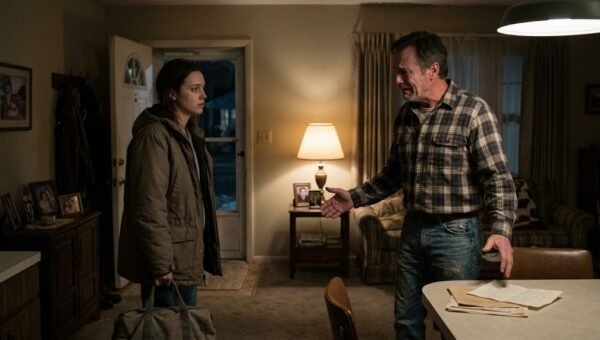
I took the slip inside. Mom was at the kitchen sink, drying one of Dad’s white ceramic dishes with a towel. I read the name aloud because I wanted to see if it meant anything to her.
The dish slipped from her hands and broke on the linoleum.
For a few seconds, none of us moved. Then Mom put the towel down.
“Where did you get that?” she asked.
“Dad’s lunch tin.”
She looked at the paper again. “Put it away.”
Dennis had followed me in. He leaned on the counter and glanced at the key in my palm.
“It’s probably nothing,” he said. “Dad kept all kinds of scraps.”
Mom was still looking at the name. I’d seen her tired, sick, annoyed, and furious. I’d never seen her look at a piece of paper like she was waiting for it to speak.
“Who’s Clara?” I asked.
“I said put it away.”
I could have done that. I wish I’d thought more about the way she was holding herself before I pushed. But there it was, the same name in my hand and her face telling me there was a story she’d carried alone.
“Mom, you know her.”
She picked up the dish towel. “I knew the name.”
That was all. She wiped the counter where the broken pieces had been, though I’d already swept them up. Dennis took the key from me and read the tag.
“FCU 114,” he said. “First County, maybe. We should finish the garage.”
I took it back. “I’m going to find out.”
Dennis looked at me like I’d just announced I was going to dig up the driveway. “Dad’s gone. There’s no point stirring things up.”
The phone number on the slip was too faded to call, so I searched the name and Mill Creek.
I found a Clara Vance in the county directory, with an address on Mill Creek Road. I didn’t call. I had no idea what I’d say. I did know that I couldn’t leave the name there like a loose nail and pretend I hadn’t seen it.
The key tag led me to the old First County Trades Credit Union. It had merged with another credit union years ago, but a woman at the front desk checked the old records and told me Box 114 was still in Dad’s name.
“Do you know what’s in it?” I asked.
“No,” she said. “But I can bring you the file.”
I needed proof I was his daughter, so I came back the next day with the paperwork. The manager took me into a small room with a table and unlocked the box while I watched. The brass key turned stiffly. It took both hands.
Inside were three bundles. A thick ledger. An old newspaper clipping, folded into quarters. And a sealed envelope with Mom’s name written on it.
The ledger had dates going back to 1994. Beside each date were small deposits, sometimes $40, sometimes $75, once $118. The numbers were written in Dad’s careful hand. There were more than I could count without making a list. They continued for years, with breaks here and there, then picked up again.
The clipping was from a local paper. A framing accident on an uninsured private build. Ray Vance, killed when an unsupported truss gave way. Dad was named as the other worker at the site. The article said he’d walked away without a physical injury.
I sat there and read that line more than once.
The next paper was a recorded deed release, stamped and signed. It showed the mortgage on Clara Vance’s house had been paid off two years earlier. Another set of deposit slips showed that Dad had been adding to a trust for Ray’s daughter.
I knew then that the key wasn’t connected to a secret life in the way my mother had feared. I still didn’t know what Dad had told Clara, or what he’d promised. The envelope was for Mom, and opening it without her didn’t feel right.
The credit union copied the papers and noted that the box would be closed once I signed the release. I put everything back except the envelope and a copy of the ledger. I wanted to speak to Clara before I brought this home. I needed to know what had actually happened, not just what a stack of papers seemed to say.
The address on Mill Creek Road led to a small clapboard house across the county line. Clara answered after I knocked twice. She was older than Mom, with short gray hair and a cardigan buttoned wrong at the top. I introduced myself and showed her the slip from Dad’s tin.
She looked at the name, then at me.
“Frank kept it?” she said.
“His whole life, as far as I know.”
She let me in. The front room was neat but lived in. A pair of reading glasses rested on a folded newspaper, and there was a basket of sewing beside her chair. I sat on the edge of the couch, still holding the paper.
“Ray would’ve liked that,” she said.
I didn’t know what to say, so I asked about the accident.
She told me Ray and Dad had worked together for years. They took a private framing job outside their regular work because they were both short on money. It wasn’t bonded or insured. Ray went up first to brace a beam. The truss shifted, and the whole section came down.
“Frank was right there,” Clara said. “He couldn’t get Ray out.”
She kept her hands folded on her lap. She didn’t make Dad into a saint. She said he was quiet and stubborn, and that for a long time he couldn’t talk about the job without getting angry at himself.
“He kept saying Ray should’ve let him take the beam,” she said. “He believed it was his fault.”
“Was it?”
“Not the way he thought. They both made a bad choice. But Frank carried it like he’d put that truss up himself.”
After Ray died, Clara had a baby and a mortgage. There was no big insurance payment, no family money waiting to help. Dad came by with groceries. Then he came by to fix a loose step. Once he showed up with cash and left before she could say no.
“He told me he’d promised Ray I wouldn’t lose the house,” she said. “I told him I didn’t want him hurting his own family over a promise.”
She said he answered, “I won’t take from them.”
The extra work was his own. Weekends, side jobs, repairs people paid him for in cash. He kept the amounts in the ledger and brought money to the credit union. He helped pay down the mortgage, then kept putting money into a trust for Clara’s daughter.
“He didn’t want anything from us,” Clara said. “Not even thanks.”
She showed me the porch. Dad had built it years ago, after the mortgage was already down to a manageable amount. She said he’d insisted on doing it right and wouldn’t take payment for the work.
Her daughter finished college. The house was paid off. The last deposit into the trust had been years before the final note on the mortgage was burned.
“I thought he stopped coming around,” I said.
“He came less when your mother had you kids,” Clara said. “But he never stopped keeping his promise.”
That was the part I couldn’t fit in my head right away. Dad had gone to work early for years. Mom thought some of those mornings meant he was leaving us out of something. The truth was that he had been putting in another shift before his regular one, then coming home smelling like sawdust and coffee.
I drove home with the papers buckled into the passenger seat. I was afraid to tell Mom. I was also afraid not to.
She was sitting at the kitchen table when I got in. Dennis was there too, sorting through Dad’s tool inventory. I put the deed release, the clipping, the copied ledger, and the envelope on the table.
Mom looked first at the envelope.
“You opened it?” she asked.
“No. It’s yours.”
Dennis stopped writing. “What did you find?”
I told them about Ray, the collapse, and Clara’s house. I told them about the side jobs and the deposits. I told them what Clara said about Dad never taking money from us. I kept getting details mixed up, so I stopped and started again. Mom didn’t interrupt.
When I finished, she touched the old clipping.
“I thought he’d stopped seeing her,” she said.
“He wasn’t seeing her like that,” I said. “He was trying to keep his promise to Ray.”
Mom stared at the folded article. “I know that now.”
I didn’t ask what she’d thought all those years. I knew enough from the name and the broken dish. When bills were tight in the early nineties, Dad had started leaving before dawn. They fought about money. She had heard Clara’s name in a low argument and carried the worst version of it forward, even after Dad said he’d handle things.
“I was so sure he’d promised me there was nothing,” she said. “I thought he meant nothing was still going on.”
She picked up the letter and eased it open. The paper made a dry little sound. Dad’s handwriting slanted down the page, just as it did on the notes he left on the fridge.
The letter was short. He apologized for keeping the burden from her. He said the money came from work he’d taken on himself, and he hadn’t used our household money. He wrote that he’d known she had enough to worry about when we were young. He also wrote that he wanted her to know the promise was finally kept.
Then came the line Mom read twice: “I’m sorry I made you carry a question I could have answered.”
Mom pressed the paper flat with both hands. Her eyes filled. She didn’t make a sound at first. Dennis came around the table and put his hand on her shoulder.
“I thought he was hiding something bad,” she said.
“I know,” I said.
“No. I mean, I really thought it. For years.”
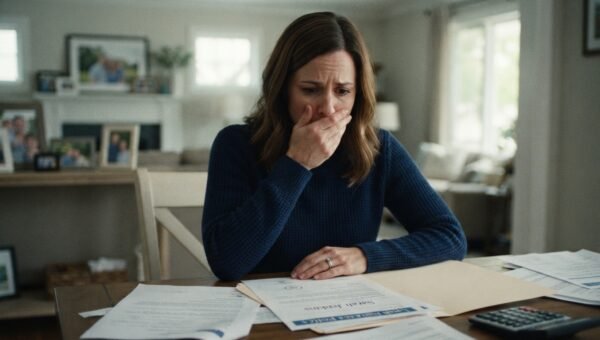
She started crying then. I moved my chair closer. I wanted to tell her she had no reason to feel guilty, but that wasn’t quite true. She’d doubted him. She’d also lived with the doubt, because he’d left her no good way to ask again.
“I should’ve asked him once more,” she said.
“I wish he’d told you,” I said.
That was all I could give her.
Dennis picked up the deed release. He read the stamped date and checked it against the ledger. For once, he didn’t hurry.
“I was going to send the tools to auction,” he said. “Not all of them. But some.”
“Keep the ones that matter,” Mom said.
He nodded. “I will.”
We closed the credit union box the next week and put the copies in Dad’s family records. The original letter stayed with Mom. We kept the clipping and the deed release together in a folder. Dennis stopped sorting the garage into trash and donation piles like he was racing a clock.
Mom and I called Clara. We’re planning to visit in the spring, when the roads are better. Mom said she wanted to see the porch Dad built. Clara said she’d put on coffee.
The broken dish was gone by then. Dad’s tools were still in the garage, though they’d been cleaned and put away. Mom didn’t ask me to explain the key again.
I wiped the lunch tin clean of garage dust and set it on the dining room sideboard beside our family pictures. I put the brass key inside with an unpeeled orange.