“I’ll bring the donation boxes Monday,” Julian said. “It’s easier if I get it over with.”
He was taping one shut in the guest room at his house while I sat beside Mom’s bed. She was twisting the end of a piece of blue yarn around her finger. I’d been there maybe ten minutes. I was 32, and Mom had lived in her duplex for 34 years, longer than I’d been alive.
Two months earlier she’d fallen in her kitchen. Not badly, but badly enough that Julian moved her into his guest room before I could help her decide what she wanted.
He kept saying she was happier there.
I visited twice a week. Usually Mom had something to tell me about the downstairs neighbor, or the woman who ran the corner shop, or a package that had gone to the wrong door. Lately she stopped talking when Julian came in. I told myself it was because she was tired. I wanted that to be true.
I reached for the loose yarn, and something hard slid out of the knitting bag. It was her duplex key, wrapped in a bus ticket. The ticket was dated for the following Monday.
Mom looked at the doorway. Julian was still in the hall, folding the cardboard flaps of another box. She pressed the key into my palm.
“Don’t let him pack the blue room.”
Her hand felt dry and light. I turned the ticket over. The crosstown bus still went past her building. I knew the route because I’d ridden it with her as a kid, though I was too young to remember much beyond her waving from the front window.
“I can still get there by bus,” she whispered.
I started to ask why Monday, but Julian walked in carrying two taped boxes marked DONATION. His eyes went to my hand.
“What’s that?”
“Her knitting needles,” I said. The lie came out too fast.
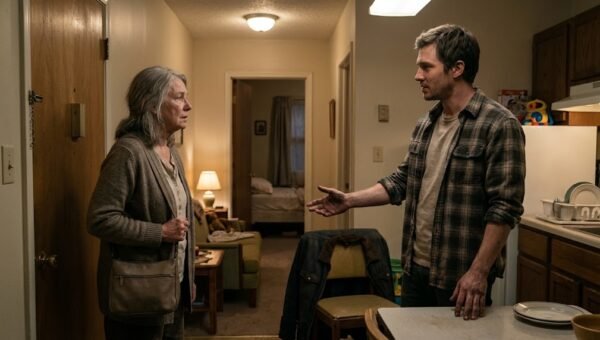
He put the boxes down. “We need to sort this stuff. She can’t manage that apartment anymore.”
“I’m right here,” Mom said.
“I know, Mom. I’m trying to help.”
He said it in the same voice he used when correcting a cashier about a coupon. Maybe he did think he was helping.
He’d always been the one who made calls and filled out forms. Once he took charge, the rest of us tended to let him. I had let him do it with Mom, too.
I tucked the key into my coat pocket. Julian watched me do it.
“I’ll bring the boxes back Sunday,” he said.
That was why I didn’t tell him I was going to the duplex.
I took the crosstown bus that evening. The ticket in my pocket had a soft crease through Monday, and I kept rubbing it with my thumb. Julian had offered to drive Mom back to the duplex “when she was stronger,” but I’d never heard him say when that would be. The same bus passed her front window, though that evening the glass was dark.
I got off one stop early. I don’t know why. Maybe I wanted a few minutes to think. The key stuck once in the lock, then turned.
There were boxes in the hallway.
Some had DUMP written across the top in black marker. Others said THRIFT. Mom’s small radio was sitting in one, tangled in its own cord. I’d heard that radio every Sunday morning when I was growing up. She’d played the same local station while she made toast and read the paper.
I stood there with my coat still on. The place smelled like old books and the lemon cleaner Mom used on the kitchen table. It was the same smell as always, except for the cardboard.
A door opened downstairs. Mrs. Gable came up in slippers with a dish towel over one shoulder. She’d lived below Mom nearly as long as I could remember.
“I thought Julian said she was gone for good,” she said.
“Gone where?”
“He told me your mother had advanced dementia. Said the apartment would be empty by Monday at noon.”
I asked if Julian had been there.
“Twice with a dolly. He said he was taking care of the paperwork.”
Mrs. Gable lowered her voice. “Martha didn’t look confused to me.”
That should have been enough for me to call Julian and demand an explanation. Instead, I asked her to stay downstairs while I checked the blue room. I didn’t want him to know I’d found anything before I knew what it was.
The blue room was at the front corner of the duplex. It had been my nursery, then Mom’s place to read and keep the neighborhood papers she collected. She saved things other people would throw away: notices about street work, names and numbers for the block association, copies of letters from the landlord. I used to make fun of her for it.
“I like knowing where things are,” she’d say.
The room was quiet except for the bus brakes hissing at the corner outside. The light was fading, so I turned on the small lamp by her chair. The roll-top desk stood against the wall, still locked.
Mom had given me the key to that desk years ago, when I was in high school. I’d forgotten I had it until I checked the little envelope in my wallet where I keep old keys. It took a minute to find the right one.
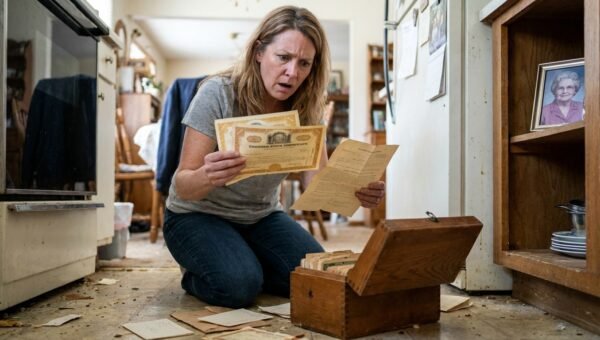
Inside were folders, a small journal, and a set of savings bonds. There was also an envelope from the housing office. I opened that first.
The lease was active. The renewal notice was signed and dated. It had protections that kept Mom’s rent at an amount she could afford, as long as she chose to stay. Julian had told me the lease was old and had expired years ago. I’d believed him because I hadn’t bothered to check.
The next paper was a surrender request dated for Monday morning. It said Mom was no longer able to make decisions about her home. Her name was typed at the bottom. The signature line was blank.
There was a second folder with her health papers and a signed letter from her longtime doctor saying she was fully able to make her own choices. Then I found the journal.
I won’t pretend I read every page. I read enough. Mom had written down dates, calls, and things Julian said to her. She’d noted that he took her phone after she called Mrs. Gable. She wrote that he told her an assisted-living place would lock the doors if she “kept making trouble.” She wrote that he’d called her confused in front of the landlord, then asked her to sign papers she couldn’t see without her glasses.
The handwriting was neat. The dates weren’t.
At the end of one entry she’d written, “I don’t want my children fighting. I also don’t want to disappear.”
That line hurt in a plain, ordinary way. Like hearing a cupboard close in the next room when you thought you were alone.
I called Mrs. Gable from the hall and asked her to tell me exactly what Julian had said about the apartment. Then I called Mom’s doctor’s office. The doctor was gone for the day, but the answering service took my number. I left a message saying there was a Monday deadline and I needed confirmation about Mom’s ability to manage her own affairs.
I called Julian next. He didn’t answer. I left no message.
Then I carried the papers to his house.
When I got there, Mom was sitting in the guest room with her hands folded in her lap. Julian was in the dining room with another box. I set the lease and the surrender request on the table.
“What is this?” I asked.
He stared at the papers. “You went into her desk?”
“I went into her home.”
“You don’t understand what’s going on.”
“Then explain why you told the landlord she couldn’t make decisions.”
He rubbed his forehead. “She fell. She’s not safe alone.”
“She can have help without losing her apartment.”
“That place is too much for her.”
“It’s hers.”
He looked toward the guest room. “Mom, don’t get upset.”
Mom came to the dining room doorway. I’d never seen her walk so slowly, but she didn’t ask for help. She looked at Julian.
“Give me my purse and my phone.”
He sighed. “You don’t need to make this harder.”
“I said give them to me.”
For a second I saw him as the brother who’d driven me to school when Mom worked late, not just the man standing between her and her own things. He looked tired. He looked irritated. He looked like someone who had talked himself into believing that being the one who handled everything meant he got to decide everything.
“I was trying to keep her safe,” he said.
“You told people she had dementia.”
“I said she wasn’t doing well.”
“You started giving away her things.”
“I was clearing space. It’s a lot to deal with.”
That was his reason. Not a grand plan. A lot to deal with. A small, selfish shortcut that could take away the home Mom had held onto for 34 years.
I called the doctor again and put the phone on speaker. By then the doctor had heard my message and called back. She confirmed Mom was mentally capable of making decisions. She said she’d put that in writing in the morning.
Julian sat down. I told him Mrs. Gable had seen the dolly, and I had the housing office papers. I said I was ready to call adult protective services about the pressure and the false claim, and that I’d do it if he kept trying to surrender the lease.
He looked at the open papers, then at Mom.
“I didn’t forge anything,” he said. “I didn’t sign her name.”
“You told them she couldn’t decide for herself,” I said.
He had no answer for that.
Mom asked for her purse again. This time Julian brought it to her. He handed over her phone, too. She checked the screen and put it in her pocket.
“Monday,” she said. “I’m going home Monday.”
The next morning, Julian called the property manager and withdrew the surrender request. I stayed on the phone while he did it. The manager said nobody had accepted it yet, and the lease was still in Mom’s name. I got the confirmation number and wrote it on the back of the bus ticket.
Julian stopped the donation pickup. Not every box had been packed, but the radio and the things in the DUMP boxes came back. I didn’t thank him. I’m not proud of that, but I was still mad, and I didn’t want to make his apology easier than it was.
It wasn’t much of an apology anyway. “I thought I was doing the right thing,” he said.
Mom didn’t answer.
On Monday morning, I rode with her on the bus. She held the rail when she stepped up, and I stayed close without grabbing her arm. At the duplex, Mrs. Gable was waiting by the door. Two neighbors came out when they saw Mom. One carried a grocery bag she’d set aside for her.
We arranged two hours of daily mobility help with a local aide Mom already knew. I set up grocery delivery and showed her how to change the schedule herself. The lease stayed in her name. Julian wasn’t allowed to handle calls or papers for her unless she asked him to. He could visit, but not alone for now.
I know it sounds strict. It is. I’d helped him take over by deciding it was simpler not to argue. I couldn’t fix that by pretending none of it had happened.
Before I left, I went to the blue room. Mom was sitting in her chair by the front window with a cup of tea. The bus rumbled past the corner, and she lifted her hand to wave.
Her duplex key rested on the windowsill beside the cup.