Four years after Clara told me she’d quit Apex, Leo slid her company card out from under my teacup.
I was standing at the kitchen counter with the kettle still ticking as it cooled. He held the card up like he’d found a prize. The company name was printed across the top, and Clara’s direct extension was underneath it.
I knew that name. I’d heard her say she was done with Apex years ago.
“Look what I found, Grandma,” Leo said.
Maya was already tugging at the cup, wanting to know if there was another clue. They were five, and every object in my house could become part of a game if I let them stay long enough.
I took the card from Leo. It was crisp, not some old thing that had been left in a drawer. Before I could ask him where he’d found it, I heard Clara’s key in the front door.
She’d dropped the twins off that morning so she could go to a job interview. An hour later, she called and said she’d canceled it. She sounded embarrassed, so I didn’t push.
Now she came into the kitchen to collect the kids and saw the card in my hand.
“You weren’t meant to find out until Friday.”
That was all she said.
I waited for an explanation. Clara looked down at Leo, asked him to find his coat, and started packing the kids’ snack cups.
She didn’t seem angry. She seemed caught, which was worse, because it told me there was more to the card than I knew.
I let her take them home.
I didn’t let the question go.
The twins had left cracker crumbs on my rug, and the tea had gone lukewarm. I sat with the card beside the cup. That same week, I’d turned down two interviews for local jobs because Clara needed help with childcare.
I hadn’t told her I was looking. I’d also never told her I’d been worried about money. I’d spent years telling myself I was doing fine, and after a while I think I started saying it mostly to keep other people from asking.
Clara didn’t know I’d turned down the interviews. I hadn’t wanted to make her feel she owed me. That sounds noble, I know. The truth is, I didn’t want to hear her say she could manage without me.
The first interview had been for an office temp job on Monday. I’d found the listing at the library and taken notes in my old organizer. The second was for a retail job near the grocery store. I called to cancel when Clara asked if I could watch the kids. Both places had emailed me after to say they’d moved on.
I’d kept those messages in my inbox. Not because I planned to do anything with them. I guess I wanted proof that I’d tried.
The card made me pick up my phone.
I looked up Apex’s website first. The company had changed since I’d last paid attention. Its main regional office had moved, and I found a staff page with Clara listed as a Senior Compliance Advisor on contract. Not a former employee. An active one.
Then I saw an open posting for a Senior Client Liaison. The duties sounded familiar in a way that made me uncomfortable.
Years ago, I’d spent close to thirty years in office and operations work, helping people keep accounts, schedules, and client records from turning into a mess. I knew the systems. I knew how to talk to customers who were mad and managers who were in a hurry.
The job listed flexible hours and remote options. It was more than I’d expected to see.
I called the number on Clara’s card. I nearly hung up when a woman answered, but I said I was trying to understand how the company was connected to Clara.
The woman was polite. She asked if Clara had sent me.
“No,” I said. “I’m her mother.”
“Oh, Elena,” she said, like my name had already come up. “Clara was here this morning with David Vance, going over the portfolio packets.”
I gripped the edge of the counter.
“Was she interviewing for a job?”
There was a pause. “I’m sorry, I probably shouldn’t get into the details. David will be able to explain it.”
I thanked her and hung up. That wasn’t an answer, exactly. But Clara had been at Apex that morning, and somebody there knew me by name.
I spent the rest of Tuesday trying to decide whether I was angry. I wasn’t, not really. I felt foolish for asking a stranger about my daughter. I also felt like Clara had taken a door I thought was closed and quietly opened it behind my back.
Wednesday went by with a load of towels, two calls from Clara about the twins, and me not mentioning the card. She didn’t mention it either.
By Thursday afternoon, I was tired of pretending I wasn’t waiting for Friday.
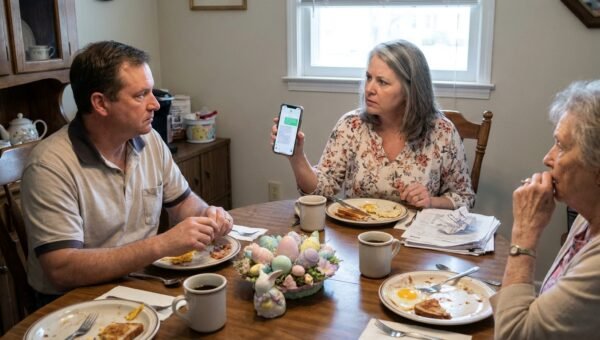
Clara came by with the kids after picking them up from preschool. She sat at my table while Maya colored, and Leo built a tower out of my coasters. Clara had her laptop open to a spreadsheet. I recognized the look on her face. She was trying to get work done while keeping one eye on each child.
I’d seen her do that for years. She’d stepped back from full-time work after the twins were born, though she’d kept contract work going from home. I thought she’d left Apex because she’d talked about leaving. I hadn’t understood that she was still connected to them.
I waited until the twins were busy in the other room, then set the card and a printout of the job listing on the table.
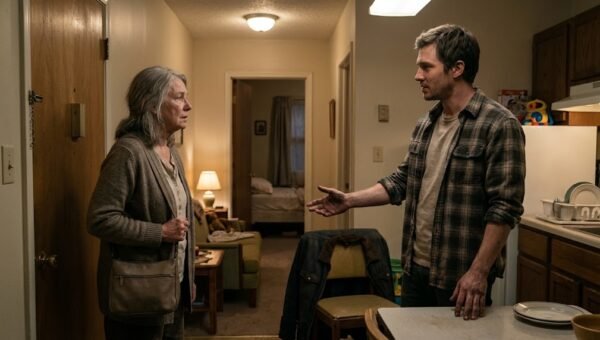
“Why does Apex have you down as active?” I asked.
Clara shut her laptop. “I can explain.”
“Then please do.”
She rubbed both hands over her face. “I didn’t quit. Not exactly.”
I tried to keep my voice even. “You told me you left.”
“I said I left the full-time job. That was true.” She looked at the card. “When they changed the office and restructured everything, I took contract work. Remote audits. I kept it small.”
“Why didn’t you tell me?”
“Because you were already doing so much.”
It sounded too easy. I waited.
Clara glanced toward the living room, where Leo had started making a road out of the coasters. She lowered her voice.
“I knew you were trying to stretch your savings,” she said. “I saw you start checking every price at the store. I didn’t want to make you feel watched.”
I didn’t like hearing that she’d noticed. I liked it even less that she’d been right.
She went on. She’d seen my interview notes when she came over a couple of weeks earlier. She’d asked David Vance if Apex had any work that might fit my background. David remembered the kind of work I’d done, and the company had a need for a regional liaison. They’d worked out a role that used my experience, with flexible hours, benefits, and remote days.
“You asked them to make a job for me?” I said.
“Not a fake job,” she said quickly. “They needed someone. I told David what you’d done. He looked at your old resume, and he agreed to meet with you.”
“You have my old resume?”
“I kept a copy. You gave it to me when I was looking for my first office job.”
I remembered that. I’d printed it on the computer at work, back when paper copies still seemed important. I’d forgotten she had it.
“Tuesday wasn’t your interview,” I said.
“No. It was supposed to be a meeting with David. I wanted to get the final approval and bring it to you on Friday.” She looked down at her hands. “He got pulled into a client emergency. They pushed the sign-off to Friday, and I was trying to work out the rest of the meeting when you called.”
“So you canceled because it wasn’t for you.”
“I canceled because there wasn’t a meeting anymore. And because I’d made it sound like I was interviewing for myself.”
Her cheeks reddened. She wasn’t trying to trick me. She’d just kept adding small pieces to a story because she was afraid I’d say no to the whole thing.
“You could’ve asked me,” I said.
“I know.”
“You could’ve told me what you were doing.”
“I know.”
I took the two emails from my organizer and put them beside the card. I’d printed them that morning. The paper was already getting soft at the fold.
Clara read the subject lines. “What are these?”
“The jobs I didn’t go to.”
Her eyes moved up to me. “You had interviews?”
“Two. This week.”
“You didn’t tell me.”
“No.” I picked at the paper edge. “I didn’t want you to think I was asking you for help. And I didn’t want you to stop asking me to watch the kids.”
Clara pushed her chair back a little. “Mom, I would never, ”
“I know you wouldn’t. That doesn’t mean I don’t worry.”
She didn’t answer right away. In the living room, Maya asked Leo to move his coaster road. Leo told her it was a bridge. The whole ordinary sound of them made me feel worse, somehow. We’d both been working around each other like the other one might break.
Clara’s voice got small. “I thought I was helping you without making you feel like I was helping you.”
“I thought I was helping you without making you feel like I was in the way.”
Neither of us had done a very good job.
She reached across the table and put her hand over mine. Her thumb had a faint ink mark on it from the spreadsheet, or maybe from one of the kids. I don’t know why I remember that part.
“I should’ve told you,” she said.
“I should’ve told you about the interviews.”
We sat there for a minute with the emails and the business card between us. Then Clara explained what Friday would be. David wanted me to come in, review the role, and meet with the people who would work with me. If it fit, there’d be a contract to sign.
“I’m not going because you arranged charity,” I said.
“It isn’t charity.”
“I need to hear that from him.”
“You will.”
That was the first time I felt like I could say yes without losing something. I told her I’d go, but I wanted to read everything myself. She said that was fair. We agreed she’d ask before assuming I could watch the twins, and I’d tell her when I had work or an interview. We could make a schedule instead of doing this by guesswork.
Friday morning, Clara drove me to Apex. I brought my worn leather organizer because I didn’t know what else to bring. The old card was tucked inside the pocket where I kept appointment slips.
David Vance met us in a small conference room. I’d expected a man who’d talk at me like he was doing a favor. He didn’t. He asked what kind of work I’d done, what tools I’d used, and which parts I liked best. He listened while I answered.
He told me Clara had brought him my resume and made a strong case for my experience. He also said the liaison opening was real. The company needed someone who could handle clients and keep regional records in order, and they could build the schedule around remote work and office days.
Then he slid the contract over.
I read every page. The pay was better than the retail jobs I’d applied for. The health coverage was there in writing. So were the hours and the remote options. I asked two questions about travel and one about how the benefits worked. David answered each without rushing me.
Clara sat beside me, quiet. She didn’t fill in my answers or try to make me take the job.
I signed.
My hand shook a little, which annoyed me. I’d signed plenty of papers in my life. But this one felt different because I hadn’t expected anyone to look at my old work and see something useful still sitting there.
Afterward, David handed me a visitor badge to use while the permanent one was being made. Clara smiled at me, but she didn’t say she’d told me so. I was grateful for that.
We talked through the practical parts before leaving. I’d start with a few remote days. Clara and I would put the twins’ schedule on the calendar, and she’d arrange childcare for the times I was working. No favors kept secret. No pretending I had nothing going on.
Outside, Clara bought us coffee. We sat in the car before driving off. My organizer was open on the passenger seat, and the new badge rested beside Clara’s business card.
A few months earlier, the card would have looked like proof she’d kept a secret from me. Now it was just the thing that got me to Friday.