My front porch was where my family asked me to sell my dead son’s story.
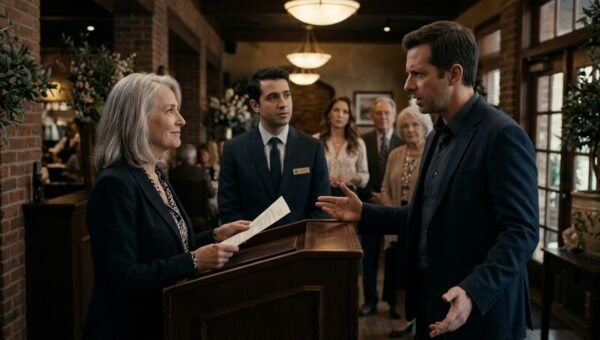
They came one week after Leo’s funeral. My mother held grocery-store flowers with the plastic still around the stems. My father stood behind her, and my ex-husband, Daniel, came with his wife, Celeste, and a leather folder. They were all dressed like somebody had told them a photographer might be there.
I was still wearing the same soft gray sweatshirt I’d slept in.
There was a bowl with dried oatmeal on the coffee table, and I hadn’t brushed my hair. I opened the door only partway. I didn’t invite them in.
My mother’s eyes moved over my face and then down to the boys’ shoes by the wall. “We’ve been thinking,” she said. “We want to make things right. We’re family.”
I didn’t answer. My father stepped around her, just enough to be seen. He said they needed a favor.
That was the first thing that told me the flowers weren’t an apology.
A month before that Saturday, Leo was still alive. He’d been sick for months, though I can’t put every day in order now. Some days were hospital days. Some were home days where I checked his temperature, changed the sheets, and tried to make the younger boys feel like their whole life hadn’t turned into waiting rooms.
My parents said they couldn’t help with Nate and Owen. My mother had her own appointments, and my father didn’t drive after dark.
There was always a reason that sounded almost fair if I didn’t look at it too long.
I asked them anyway. I asked my mother to take the boys for one afternoon so I could sit with Leo without watching the clock. She said, “I’m sorry, honey. This week is impossible.”
The next week was impossible too.
I called Daniel once. I didn’t ask for money. I asked if he could pick up the boys and keep them overnight because I needed to be at the hospital. I remember a cart squeaking somewhere behind me and the dry taste from the vending machine coffee.
Daniel said, “You’re just a poor writer. Deal with it.”
I didn’t tell him what I wanted to say back. I just hung up and went to Leo’s room. I was ashamed that I’d called. That part is mine. I kept thinking if I asked in the right way, if I sounded calm enough, somebody would help.
Nobody did.
Leo died. I won’t write down what the room sounded like, because there wasn’t much sound. I held his hand and kept telling him I was there. I was there. The boys had been with a neighbor for the last part. I’d called my parents earlier, but they didn’t come.
I came home with the boys, and I kept making food because they still needed to eat. I put out cereal. I packed lunches. I made sure they had clean socks. I don’t know how I did those things. They weren’t brave things. They were just the next thing in front of me.
The funeral came and went. I answered messages, though I didn’t know what to say to most of them. A few people had shared an essay I wrote about Leo’s last weeks. I’d written it at night, in pieces, when I couldn’t sleep. I never thought of it as anything but mine, and his.
By the Saturday my family arrived, I knew Daniel’s name was in the news. His children’s cancer charity had been accused of moving donations into accounts that had nothing to do with care or research. The story had broken two days earlier. I saw it on my phone while I was trying to find Nate’s library book.
Daniel had been on the charity’s board. The article said the board was reviewing financial records. A reporter had asked for comment. I didn’t know what was true beyond what had been printed, but I knew Daniel had been part of that world. I also knew his new wife had posted pictures from the charity events for years.
That afternoon, my father kept the folder tucked against his side. My mother was still holding the flowers. The plastic crackled whenever she shifted her grip.
I asked, “What favor?”
My father looked at Daniel first. Celeste opened the folder, took out several pages, and held them toward me. She had a neat, practiced smile that didn’t reach her eyes.
Daniel said they were trying to “get ahead of a misunderstanding.” He said the foundation needed people to remember the good it had done. Celeste said a gala was coming up, and a profile was being prepared about families who had been helped.
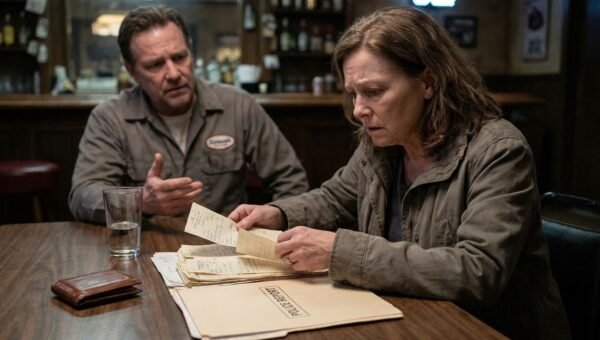
I looked at the top page. There was language about exclusive rights to my essay and permission to use my words and photographs. A second page asked me to approve a public statement about Daniel’s support during Leo’s illness.
I read that line twice. Daniel had not been there.
My mother reached for my arm. “It would mean so much if we could show everyone we’re together.”
I moved my arm away. I asked her if she remembered calling me back when I asked her to watch the boys. She pressed her lips together. My father said this wasn’t the time to go over old complaints.
That’s what he called it. Complaints.
I could hear Owen in the hall, dragging his socked feet on the floor. Nate came up behind him and stopped when he saw the people at the door. Neither boy said anything. They’d learned how to read a room too young.
I looked back at the papers. Celeste started explaining that the rights language was standard. The public statement was supposed to be short. They wanted me to say Daniel had supported our family, and that his work with the foundation had brought comfort to families like ours.
I asked if they wanted me to say he helped us when he didn’t.
Daniel rubbed his thumb along the edge of the folder. “It’s not about every detail,” he said. “It’s about the bigger picture.”
I had heard that kind of answer from him before. It always meant the truth was inconvenient.
My father said the charity was under pressure and Daniel’s career could be ruined by a story that didn’t show the whole picture. Celeste said their friends had started asking questions. She didn’t sound sad about the families who had donated. She sounded worried about what people at the gala would think.
Then Daniel stopped trying to sound kind.
He said the reporter was asking about the money, and that a statement from me could show the foundation had done real good. He said if people saw a grieving mother standing with them, they might stop assuming the worst. His voice got tight. He looked at the boys in the hallway, then back at me.
He said, “We need this before Monday. My name is already taking a beating.”
I had to hold the doorframe for a second. Not because I was about to fall. I just wanted something solid under my hand.
There it was. They didn’t come because they missed Leo. They didn’t come because they had finally understood what they left me to carry. They came because his death could help them clean up a mess, and because my essay already had readers.
My mother still had the flowers. Their stems were bent inside the plastic.
I said, “You want my words, and you want me to lie.”
Celeste told me it wasn’t a lie if I believed Daniel had cared in his own way. My father said I was making it harder than it had to be. Daniel said he had been under pressure too.
I looked at him and said, “You told me to deal with it.”
He glanced at the boys. “That was a long time ago.”
It had been weeks. Leo was still alive when he said it. My parents were still alive and well enough to come here now. They had all found time for this.
I said the boys didn’t belong in a charity profile. I said they weren’t proof of anybody’s good heart. I told my mother I’d asked for one afternoon of help, and she gave me excuses. I told Daniel I’d asked him to take his own sons for one night, and he called me poor.
My voice didn’t get loud. I thought it might. It didn’t.
Daniel reached for the papers, maybe to take them back, maybe to put the folder between us again. I took the pages from Celeste’s hand. The top sheet had a blank line for my signature. I tore it down the middle.
The paper made a small, ordinary ripping sound. Nate was watching my hands. Owen had one hand on his brother’s shoulder.
My mother said my name. I don’t remember if she said it once or more than once.
I tore the next page too. I gave the pieces back to Celeste. She looked down at them like she couldn’t work out how a person had ruined something so useful.
Daniel said I was being emotional. I told him I was being clear. Then I pointed toward the walk and told them to leave.
For a few seconds, nobody moved. Then my father took my mother by the elbow. Daniel started saying that I’d regret making this public. Celeste gathered the folder against her chest and kept looking at the ripped pages in her hand.
I shut the door before they could finish. I turned the lock, then the second lock. My hands were shaking by then. I let them shake.
The next morning I wrote down what had happened while I could still remember the exact words. I didn’t post the pages from the contract. I didn’t claim I knew where the money went. I wrote that Daniel had asked me to sign away exclusive rights to my essay and endorse his foundation after leaving me alone during Leo’s illness.
I said my parents had stood beside him. I said their flowers didn’t change that.
I posted it on my own page. It was not clever. It was not polished. I wrote it the way I could say it, and I left it there.
By Monday, the gala profile had been put on hold. A local reporter contacted me. I sent her the papers I had kept, with the account and rights language, and answered what I knew. I didn’t know what would happen to Daniel’s job or the charity. I only knew I wasn’t going to help them pretend.
The charity faced more questions after that. Daniel’s name stayed in the news. My parents stopped calling. I didn’t ask them to start again.
I went back to writing. At first I could only manage a few paragraphs at a time. Then I wrote more. People read the work, and some paid for it. It helped with groceries and the electric bill. It also felt good to have something that belonged to me, even if I had to make it out of the worst year of my life.
Nate and Owen still ask about Leo. I answer them. I tell them the stories that make us laugh, too. The boys don’t have to carry my anger for me. They only have to know they’re safe in this house.
I sometimes think about my mother standing there with those flowers. They were cheap ones from a grocery store, probably picked up on the way. I’m not saying that to be cruel. I keep thinking she could have brought them when Leo was still here.
The flowers stayed outside after I shut the door. I saw them through the little window by the stairs, plastic sleeve turned sideways on the mat. I left them there until the next morning.
The door stayed locked. The flowers withered outside.