PART 1
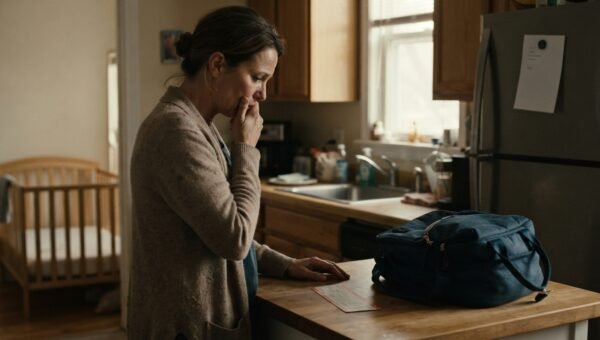
I found the card on a Tuesday morning in late November while I was pairing clean socks.
It was tucked into the very back corner of Greg’s drawer, pushed beneath a roll of heavy wool hiking socks he only wore a couple of times a year. It wasn’t in an envelope. It was just a thick, cream-colored card with gold foil edging, folded shut.
I picked it up thinking it was an old keepsake from our early years, or maybe something our daughter Megan had made years ago that he couldn’t bring himself to throw away.
But when I opened it, the handwriting was fresh. The blue ink was sharp and clear, written in Greg’s distinct, slightly slanted cursive.
Across the top, he had written: “To the love of my life.”
Inside, printed by the card company, was a generic verse about holding hands through every season. Beneath that, Greg had added his own note.
“Happy Birthday, December 12. Every year with you makes the waiting easier. Soon we won’t have to hide anything. I promise.”
At the bottom corner, jotted down quickly, was a street address: 742 Willow Creek Lane.
I stood in our quiet bedroom with the laundry basket resting against my hip, staring at the words until my eyes burned. My birthday is March 14th. We had been married for twenty-eight years, and Greg had never once forgotten that date. Which meant this card was not for me.
My hands began to shake, but a strange, icy calm took over almost immediately.
It was the kind of cold focus that hits you when you realize the floor you have walked on for nearly three decades was never solid wood, just thin ice.
My first instinct was to march downstairs to his home office, slam the card onto his desk, and demand an explanation. But twenty-eight years of marriage teach you how a person operates when they get cornered. If I confronted him with just a piece of paper, Greg would lie. He was an accountant by trade; he knew how to pivot, explain away anomalies, and turn things back on the person asking questions. He would claim it was a bad joke, or a coworker’s card he held onto, or a scrap from someone else. He would snatch the card, tear it up, and scrub whatever tracks he had left behind.
I did not want an argument. I wanted the truth, and I wanted proof.
So, I folded the card carefully, smoothed the edges, and tucked it back beneath the wool hiking socks exactly where I found it. I closed the drawer with a gentle push, carried the empty laundry basket downstairs, and made myself a cup of tea that sat on the counter until it went stone cold.
For the next two weeks, I watched him.
It is a terrible thing to sit across the dinner table from a man you have loved since you were twenty-two years old and realize you do not know him at all. Greg ate his pot roast. He talked about his firm’s end-of-year audit schedules. He kissed my forehead when he got up from the table, asked if Megan had called from college, and complained about the draft coming off the living room windows. He was normal. He was comfortable. That terrified me more than anything else, because it meant he was completely practiced at living two lives.
Every day, I looked at the calendar on our refrigerator. The days ticked down toward December 12th. I didn’t search his phone. I didn’t hire an investigator. I simply waited.
On the morning of December 12th, Greg woke up earlier than usual. He showered, shaved carefully, and put on a dark merino wool sweater I had bought him the previous Christmas.
At the breakfast table, he poured his coffee and avoided looking directly at me for longer than a few seconds.
“I’ve got quite a few errands to run today,” he said casually, buttering a piece of toast. “A couple of client drop-offs across town, and then I need to stop by the hardware store and pick up some air filters for the furnace.”
“Will you be back for lunch?” I asked, keeping my voice entirely level.
“Probably not,” he replied, taking a quick sip of coffee. “Traffic on the south bypass is always a mess this time of week. Don’t wait on me. I’ll probably be out until mid-afternoon.”
He left at exactly ten in the morning. I heard the garage door rumble open, the hum of his sedan backing down the driveway, and then the quiet click of the door sealing shut again.
I stood by the front window until his car turned the corner at the end of our street. Then I went straight up the stairs, walked into our bedroom, and opened his sock drawer.
The back corner was empty. The card was gone.
PART 2
I didn’t immediately run out the door. I knew that if he was meeting someone, he had places to go first, or a lunch planned. I needed time, and more importantly, I needed records.
I walked downstairs into his office. For years, Greg had handled our primary finances. I managed the household checking account, bought the groceries, paid the utility bills, and handled our daily expenses. But our long-term investments, the retirement portfolios, and our primary savings had always been his domain. He had a degree in finance; it just seemed natural to let him manage the heavy lifting.
I sat down in his desk chair. The bottom drawer of his file cabinet was locked, but Greg kept the spare key in a magnetic box stuck beneath the metal frame of his desk lamp. I found it within thirty seconds.
Inside the drawer, neatly alphabetized in green hanging folders, were our tax returns, our insurance policies, and our bank statements. But behind the folder labeled “Vanguard Retirement,” there was a manila envelope without a label.
I pulled it out and spilled the contents onto the blotter.
Inside were settlement sheets from a title company dated three years earlier. The property was 742 Willow Creek Lane, a four-bedroom colonial in an upscale subdivision about twenty miles south of our home.
The buyer listed on the deed was an LLC called “WCL Properties.” But attached to the back of the deed was the personal guarantee, signed in Greg’s unmistakable hand.
Worse than the deed was the financing breakdown. The down payment had been eighty-five thousand dollars, drawn directly by cashier’s check from our joint money market savings account, an account I rarely checked because it was meant to be our safety net. Every month for the last thirty-six months, a wire transfer of two thousand four hundred dollars had gone out to cover the mortgage, taxes, and insurance on that house.
Over three years, he had drained more than one hundred and seventy thousand dollars of our marital money into that property.
I copied every single paper on our desktop printer, took clear photographs of the signatures and bank routing numbers with my phone, and slipped the originals back into the manila envelope. I locked the drawer and returned the key to its magnetic box.
At eleven o’clock, I grabbed my coat and car keys, walked out to my car, and typed 742 Willow Creek Lane into the GPS.
The drive took thirty-five minutes. The neighborhood was quiet, lined with tall maples that had lost their leaves for the winter. Number 742 was a beautiful brick home with a large front porch and a landscaped yard.
Parked in the driveway was a small white SUV with a child’s booster seat visible in the back. But Greg’s car was not there.
I parked two doors down and watched. At eleven-forty, an older sedan pulled up. A woman in her late thirties got out, carrying grocery bags. A little girl, no more than four or five years old, hopped out of the passenger side and ran toward the front steps. The woman looked tired, her hair pulled back in a quick clip, wearing a winter coat with the zipper stuck halfway.
She didn’t look like an expensive mistress. She looked like a woman trying to get groceries into her kitchen before it started raining.
I didn’t get out of my car. I didn’t scream, and I didn’t knock on the door. I sat there with my hands resting on the steering wheel, taking in every detail. Then, at twelve-fifteen, Greg’s sedan pulled into the driveway.
He got out holding a wrapped gift and a boutique bakery box tied with a red ribbon. He walked up the porch steps without knocking, used a key, and let himself inside.
I watched the front door shut behind him. I took one deep, steady breath, started my engine, and drove back home.
PART 3
I spent the afternoon cleaning the kitchen. I wiped down the counters, organized the pantry, and put a kettle on to boil around three-thirty. I wanted everything in our house to look entirely normal, orderly, and calm.
At four o’clock sharp, the back door opened. Greg walked into the kitchen, unwinding his woolen scarf.
He was empty-handed. No hardware bags. No furnace filters. No receipts sitting on the counter.
“Hey,” he said, hanging his coat on the hook by the entryway. “Cold out there today.”
“Did you get everything taken care of?” I asked, turning to face him from the stove.
“Yeah,” he said, rubbing his hands together. “Traffic was an absolute nightmare down near the junction, but I got the client folders dropped off.”
“How were the errands?” I asked, keeping my voice gentle, conversational.
“Fine,” he said, walking to the refrigerator to grab a bottle of water. “Just a long day of driving around.”
“Did you get everything you needed?”
“Yes,” he answered, twisting the cap off the bottle and taking a long swig. “Got it all done.”
I leaned back against the counter, crossed my arms, and looked directly into his eyes.
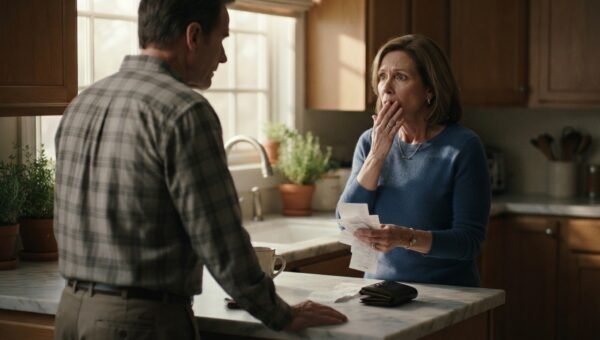
“Good,” I said quietly. “Because while you were gone, I found the card. And I found the address you wrote inside it. And I drove there.”
The water bottle froze halfway to his mouth. The casual, tired expression on his face collapsed in an instant. The color drained from his cheeks until he looked gray, like damp paper.
“What are you talking about?” he stammered, his voice dropping an octave. “What card?”
“The birthday card in your sock drawer,” I said. “The one addressed to the love of your life for December 12th. The one you delivered with a bakery box at twelve-fifteen this afternoon.”
He took a step back, gripping the edge of the kitchen counter. His breathing turned shallow. “Eileen, listen to me. It’s… it’s not what you think. You went to her house?”
I shook my head slowly.
“No,” I said. “I went to our house. The one you bought with eighty-five thousand dollars taken directly from our joint savings. The one you’ve been paying a twenty-four-hundred-dollar mortgage on every single month for three years. The one I didn’t know existed until today.”
He opened his mouth, but no sound came out. For the first time in twenty-eight years, Greg had no ledger to balance, no spreadsheet to manipulate, and no clever explanation to offer.
“Her name is Sarah,” he whispered finally, his voice cracking. “She was an intern at the firm six years ago. The little girl… she’s mine, Eileen. Her name is Clara. I couldn’t just abandon them.”
“You didn’t abandon them,” I replied, my voice steady and cold. “You abandoned me. You used my name, our life, and our retirement to build an entire second family twenty miles down the road.”
ENDING
He tried to plead. He fell into a chair at the kitchen table, put his head in his hands, and wept. He told me he never meant for it to go this far, that he was trapped, that he was trying to protect everyone. He offered to sign the Willow Creek house over to me, promised to sell it, swore he would end contact with Sarah and only pay court-ordered child support.
I didn’t cry. The tears simply didn’t come, because the man crying at my table was a stranger who had stolen three years of my life and nearly two hundred thousand dollars of our shared future.
“You don’t get to decide what happens next, Greg,” I told him quietly. “You gave up that right the day you signed that LLC paperwork.”
The next morning, while Greg was staying at a nearby hotel at my insistence, I sat down with a forensic divorce attorney recommended by an old friend.
We filed the following week.
Because Greg had used marital funds from a joint account without my consent to purchase and maintain real estate under an LLC, my attorney filed an immediate injunction freezing the accounts to prevent any further dissipation of assets. In our state, using joint marital funds for an extramarital relationship constitutes clear financial dissipation.
During discovery, every dollar Greg had diverted was laid bare on court exhibits. Every wire transfer, every utility bill for the Willow Creek house, and every secret withdrawal was tallied up.
The final settlement took fourteen months of hard, exhausting legal work. In the end, the judge awarded me our primary home completely free and clear of any mortgage, along with seventy-five percent of his firm’s retirement portfolio to offset the funds he had funneled into the other house.
Greg was left with the Willow Creek property, its full mortgage debt, and an order to pay a substantial portion of my legal fees. From what Megan tells me, Sarah broke things off with him entirely once the court proceedings dragged her into depositions and exposed how much he had lied to both of us. He ended up having to sell the Willow Creek house at a loss to settle his debts and rent a two-bedroom apartment near his office.
Last week, my daughter Megan came over to help me paint the living room. We chose a bright, warm linen white, covering up the dark gray Greg had always insisted on.
As we were packing up the roller pans, Megan looked at me across the sunny room. “Are you going to be okay here by yourself, Mom?”
I looked around the house. It was quiet, peaceful, and entirely mine. Not a single drawer held a secret, and not a single dollar was being spent on a lie.
“I’m not by myself, sweetie,” I told her, smiling for the first time in a very long time. “I’m finally home.”