At 9:14 on Leo’s twelfth birthday, a text from my father lit up my phone while I was trying to pull a candle out of its plastic sleeve. “I’m bringing Leo something,” Arthur wrote. I read it twice, then looked at the kitchen clock as if the time mattered. Dad had missed every Saturday chess lesson for a year. Now he was coming with a present, and I had no idea whether I wanted him to.
The promise had come thirteen months earlier, when Leo was turning eleven. Dad brought an old chessboard to the party and told him, “We’ll start Saturday. I’ll teach you the right way.”
Leo looked at me as if he’d just been handed a key to something important. Arthur had been a strong club player when I was growing up. He used to keep a chessboard beside his recliner, and he’d taught me enough to know he wasn’t making an idle promise.
The first Saturday, Leo set up his own board on the porch. Dad called to say his car was acting up. The next week it was yard work. After that came a headache, a long errand, a bad night’s sleep. Each excuse sounded possible on its own. That was what made them hard to challenge.
Leo started watching the driveway around ten. I’d tell him breakfast was ready, and he’d say, “I’m waiting for Grandpa.” The toast would go cold. I kept making it anyway.
By the third month, I started texting Dad before the weekend. “Are you still coming tomorrow?” He’d write, “I’ll see how I feel,” or, “Probably not this week.” I got mad at him, then mad at myself for asking. I didn’t want Leo to see me begging a grown man to keep his word.
The first six months were a series of small letdowns, which is how a child gets taught not to expect much. Leo would put the board away after lunch, careful to keep the pieces in their little box. Some Saturdays he didn’t bother setting it up. Then he’d hear a car slow near the house and look toward the window anyway.
I know that look because I saw it in the mirror once. I was carrying a laundry basket when a truck rolled past, and Leo’s face lifted before he caught himself.
He turned back to his game and said, “It’s not him.” I put the basket down and sat beside him. I didn’t know what to say that wouldn’t make it worse.
In month eight, I found him on the porch with his shoes on, though it was already past noon. The board was still open beside him. I sat on the step and told him the truth I could tell at the time.
“Stop waiting at the curb,” I said. “If he comes, he comes, but your Saturdays belong to you.”
Leo picked up the pieces one by one. “So I shouldn’t wait?”
“No,” I said. “I don’t think you should.”
He carried the board inside and put it in his closet. I was relieved he’d stopped watching the driveway. I was also angry that it had taken me that long to say it. I could keep a patient’s family updated through a hard shift, but I couldn’t find a clean way to explain to my own kid that his grandfather might not show up.
The next four months were quieter. Not better. Dad still called now and then to ask about school or whether Leo had outgrown his shoes. I answered, and I didn’t mention chess. It felt like a kindness at first. Then it felt like we were all letting him off the hook because confronting him would make the family uncomfortable.
That birthday morning, I set out the cake I’d ordered, a plain chocolate one with blue icing. Dad arrived just before noon with a bakery box under one arm and a long wooden case under the other. He hadn’t called ahead. He looked tired, which was almost funny by then.
“I brought something for the birthday boy,” he said.
The cake inside the box was shaped like a chessboard. The squares were neat, and little chocolate pieces sat along the edges. The wooden case held a new chess set, far nicer than the old one beside his recliner. Leo stood by the table, looking at both. He didn’t touch either.
Dad smiled, but it didn’t last. “I thought we could start again.”
Leo looked him in the eyes. “I’m not waiting anymore.”
Then he walked upstairs. I heard his bedroom door close, not slam. That small difference stayed with me.
Dad set the chess set on the table. He didn’t tell Leo to come back down. He didn’t ask me to make him. He just stood there while I tried to think of something that wouldn’t sound cruel or fake.
“I wanted to make it right,” he said.
I looked at the untouched cake. “You can’t do it with a cake.”
“I know.”
He left a few minutes later. The cake went into the fridge. Nobody ate it. The next day I threw it away, squares and chocolate pieces and all. I hated wasting food, but I hated looking at it more.
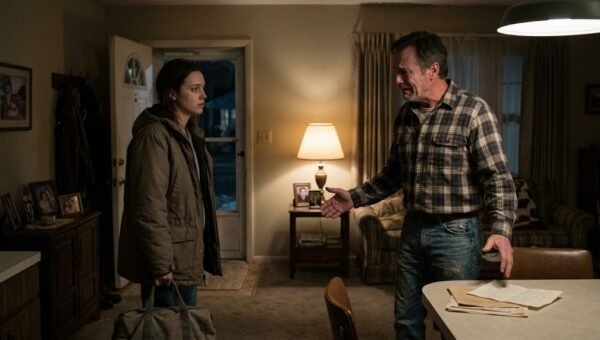
I waited three days before going to Dad’s house. I didn’t want to bring Leo along as proof of what his absence had done. I wanted to talk to Arthur alone, and I wanted to hear something more than another excuse.
Dad was in his den beside the old recliner. The chessboard was already set up on a small table. The pieces were oddly placed, one knight turned sideways, two pawns pushed out of line. I noticed a notebook under a chess journal. The writing on the open page was jagged, with numbers crossed out and rewritten. Behind the journals, I could see prescription bottles.
Dad glanced at me. “I’m too tired for another Saturday game.”
“It’s Wednesday,” I said.
He shrugged. “I mean, you know what I mean.”
I sat on the arm of the couch. “No, I don’t. You kept promising him. Then you kept making him wait.”
“I was tired.”
I wanted to believe that was all it was, because the alternative was worse. I also knew the way he said it. I’d heard the same flat answer on the phone, over and over, while Leo sat near the window. So I told him what I’d come to say.
“Were you tired of him, or were you terrified he’d see you lose your mind?”
Dad looked at me before answering. That was the question I’d come to ask, and his face told me I’d finally hit the thing he’d been hiding.
He reached for a carved wooden bishop. His right hand started shaking so hard the piece slipped free and hit the carpet. He stared down at it. I bent to pick it up, but he lifted one hand, asking me to stop.
“I can’t make it behave,” he said.
He told me the first symptoms had started about a year before Leo’s birthday. His hand would shake when he tried to place a piece. Some days he’d look at a board and lose track of where he’d moved things. He went to a neurologist ten months earlier and was diagnosed with early-stage Parkinson’s and vascular cognitive problems that could make hard spatial tasks suddenly confusing.
He’d been practicing alone before that first lesson. One afternoon, he couldn’t get through a simple opening. He kept losing his place. He told me he sat in the kitchen afterward and cried, then spent Saturday making up a reason not to come.
“I didn’t want him to see me like this,” he said.
I picked up the bishop. The worn base was warm from the room. “So you let him think you didn’t want to see him.”
Dad rubbed his thumb against his palm. “I thought I could get it under control.”
“You didn’t tell me.”
“I was ashamed.”
That answer made sense. It didn’t make me less angry. I was his daughter, and I knew how much he’d built his life around being capable. He’d fixed his own roof, kept his bills in neat folders, and taught me to check my work twice. But he had made a child carry the cost of his pride.
“I’m not telling you it’s fine,” I said. “It wasn’t fine.”
“I know.”
“No, Dad. Leo thought he wasn’t worth showing up for.”
He looked down at the board. I didn’t soften it. I wanted to, because he was sick and scared and still my father. But Leo had spent a year watching the driveway. I couldn’t let Arthur’s fear erase what Leo had lived through.
Dad told me he’d brought the cake because he couldn’t face showing up empty-handed. The new board was meant to say he still wanted to teach Leo, even if he couldn’t do it the old way. He’d thought a gift might bridge the gap without making him explain why he’d left it there.
“It was easier than saying I was sorry,” he said.
I told him the cake hadn’t helped. I told him Leo didn’t need a replacement board or a grand gesture. He needed the truth, and he needed his grandfather to understand that showing up imperfectly was better than disappearing neatly.
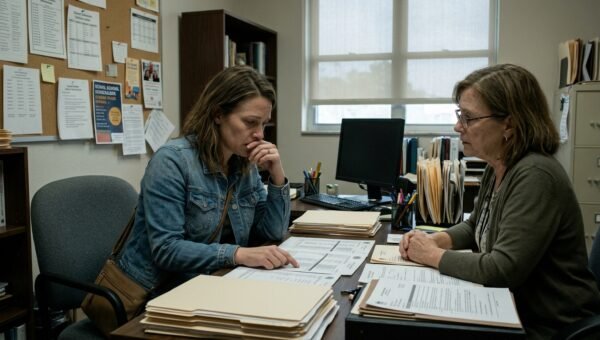
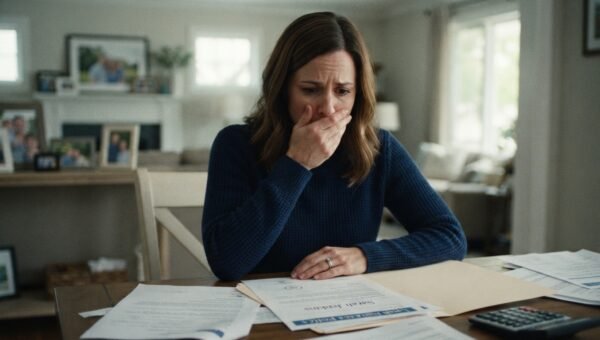
Dad nodded, but I didn’t take that as a promise. I’d heard enough of those. I asked for the neurologist’s papers, and he showed them to me. I took over making appointments after that and started checking in most days. He hated the extra help. I let him hate it.
Before I left, I said, “You need to talk to Leo without the board.”
Dad pressed his lips together. “What if he doesn’t want to hear it?”
“Then you tell him anyway. He gets to decide what to do with it.”
We went to my house the following Sunday. Dad brought no cake and no chess set. Leo sat on the porch with his knees pulled up, and I stayed close enough to hear but far enough not to make it a family meeting.
Arthur sat on the step below him. His hands rested together.
“I’m sorry I didn’t come,” he said. “I got sick, and I was scared you’d see me make mistakes.”
Leo didn’t answer right away.
“Were you really sick?” he asked.
“Yes.”
“Why didn’t you tell me?”
“I was ashamed. That wasn’t fair to you.”
Leo looked at his shoes. “I thought you didn’t like being with me.”
“I do. I love being with you.”
I saw Leo’s shoulders loosen, but not all at once. He didn’t hug his grandfather or ask to play chess. He asked if Dad wanted to watch the afternoon baseball game with him. Arthur said yes.
That’s how it started again. Not with lessons. Not with a promise to make up fifty-two Saturdays. We began with baseball on the television and short visits that ended before Dad got worn out. I helped him keep track of his appointments and safety checks. Leo kept the chessboard in his closet.
A few weeks later, on a Sunday afternoon, I found them sitting side by side on the porch with a paper carton of cider donuts between them. They were talking about a bad call in the game. Arthur’s hands rested loosely in his lap.
The chessboard stayed inside.