Greg called from his office at 10:16 and said he’d left his lunch on the counter. “Could you bring it by?” he asked. I put the canvas tote in the passenger seat and drove to the courthouse, thinking I’d be back before the laundry finished.
I’d done little errands like that for him for five years. He was a courthouse clerk, the kind of man who kept a lint roller in his desk and remembered which judge took coffee with no sugar.
I used to think his carefulness meant he was steady. That afternoon, I found out it also helped him hide things.
The receptionist took the tote from me, then glanced toward the hall. “He’s in Conference Room C with his ex-wife,” she said, in the same voice she might have used to tell me he was at lunch.
I didn’t answer. I honestly thought I’d heard her wrong. Greg had told me he’d never been married before me. Not once in five years had I heard a name, seen a picture, or come across some old box of keepsakes. I knew his parents, his work friends, even the names of two kids he used to babysit. No ex-wife.
“His ex-wife?” I said.
The receptionist looked at me properly then. “Meredith. I’m sorry. I thought you knew.”
I set the tote on the counter. My fingers were still curled around the handles.
I could feel the thin paper bag inside, damp where his apple had started to sweat.
I waited in the lobby because I couldn’t make myself walk back out. I kept telling myself there could be an explanation. Maybe there was a mix-up. Maybe “ex-wife” meant something else, though I knew perfectly well it didn’t.
Greg came out first. His eyes went straight to me, then to the lunch tote. His face did a small, quick change. Not surprise exactly. More like he’d seen a bill he’d hoped had gone to the wrong address.
“What are you doing here?” he asked.
“You left your lunch.”
He looked past me toward the reception desk. “I’ll explain.”
A woman came out behind him with a folder tucked under her arm. She was about my age, maybe a little older, and looked tired in a way that didn’t come from one bad night.
An attorney or advocate walked beside her. The woman glanced at my wedding ring, then at Greg.
“Meredith,” Greg said, too quickly. “This is, ”
“I know who she is,” Meredith said.
She held a small brass key out to me. A paper tag was tied through the ring, marked L-14 in faded ink. I stared at it. Meredith’s hand stayed steady.
“You should be the One to decide,” she said.
I took it because she had put it in my hand, and because Greg had already started toward me.
“Give me that,” he said. “It’s not what you think.”
“I don’t know what I think.”
“You shouldn’t be involved in this.”
That was the first honest thing he’d said, though not in the way he meant it. Meredith and her advocate headed down the hall. Greg reached for the key. I closed my hand around it.
“I need to see what it opens,” I said.
His voice dropped. “Please don’t do this here.”
He was looking over his shoulder at the clerks coming out of the work area.
I noticed that. I noticed he was more worried about who might hear him than about what I’d just learned.
There was a records annex downstairs. I knew the building well enough from holiday events and the times I’d waited for Greg after work, but not the lower level. A security officer named Frank saw me heading for the stairs.
“You need the records room?” he asked.
“I think so. I have this key.”
He looked at the tag. He didn’t take it from me. “L-14 is in the secured archive. If your name isn’t on the access sheet, I can’t let you in alone.”
Greg had caught up by then. “Frank, it’s fine. I’ll handle it.”
Frank looked at me, not him. “Do you want me to check the access record?”
“Yes,” I said.
Greg rubbed the bridge of his nose. “This is a family matter.”
“Then you can explain it to her,” Frank said. “I still have to follow the sign-in rules.”
It wasn’t much. But it was the first person in the building who treated me like I had a right to ask what was happening. Frank checked the cabinet log, called someone in records, then walked us down a narrow hall to the archive room. Greg kept asking me to wait.
“Just give me the key,” he said. “There’s no reason for you to see it.”
That made me want to see it more.
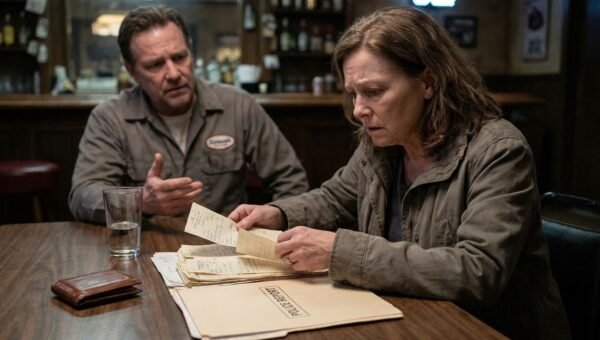
The box was a metal tin inside a locked drawer. The key turned with a sticky little scrape. Inside were court papers, a deed to a rural cottage held in trust for a child, medical logs, and a petition Greg had signed. I read the name on the first page twice.
Lily. Nine years old.
Her mother was Meredith. Her father was Greg.
I sat down at the small table because the page was moving in my hands, or seemed to be. It said Greg and Meredith had married ten years earlier. It showed a divorce filed in another county seven years ago, with child support reduced to a small monthly amount. There were custody terms, old court dates, and medical notes about Lily’s care needs.
The deed was for a cottage outside town. The trust was meant to help pay for Lily’s care and keep a stable place available to her. Greg’s petition asked to end his remaining legal ties to the property. He wanted Meredith to release him from future responsibility in exchange for a clean liability release. The cottage could then be sold.
Two weeks earlier, he’d started the process. He’d never mentioned Lily to me. He’d never mentioned Meredith. I had thought I knew the shape of his life before I met him. He’d let me think he’d had no life at all.
At the bottom of the tin was a second envelope with papers Meredith had brought for the meeting. One was a trust release Greg had signed, surrendering his claim to the cottage. The other papers made it clear the transfer wasn’t complete. Meredith had not signed her part.
I heard Greg say my name behind me. I closed the folder.
“Let’s go upstairs,” he said.
I didn’t move right away. I was trying to understand how someone could make a whole child into a blank spot. I was also trying not to wonder if he had lied about anything else. That was too big to take in all at once.
When I came back into the hall, Meredith was gone from the room. I saw her at the far end with her advocate. A little girl sat on a bench nearby, a worn sketchbook open across her knees. She was drawing small squares in a row, stopping every few marks to press her pencil against the paper.
She looked up when Greg stepped into the hall.
“Dad?” she said.
Greg stopped. Just for a second. He didn’t go to her.
I saw his face in hers. It was there in the eyebrows, the same slight lift at the outside. I’d seen that expression on Greg when he was trying to look calm at a dinner party. Lily looked back down at her sketchbook.
Meredith’s advocate was standing close enough to help her, but didn’t interrupt. No one asked me to do anything. Still, I understood why Meredith had given me the key. She knew Greg had lied to both of us. She was tired of carrying his secret while he stood nearby pretending it was only paperwork.
Greg led me into the stairwell. He shut the door behind us, then kept his voice low.
“You had no right to open that box.”
“You signed the petition.”
“It’s a legal issue.”
“It’s your daughter.”
He dragged one hand over his hair. “I was trying to settle things with Meredith.”
“You never told me you were married.”
“I didn’t know how to bring it up.”
“You told me you’d never been married.”
He looked down at the steps. “I thought I could keep the past separate.”
The words were so small next to what they meant. I asked him why he’d left. He said Lily’s needs had gotten bigger than he knew how to manage, that money was tight, and that he’d felt like a failure all the time. He and Meredith had fought. He said he’d started sleeping in a spare room, then staying away longer, then filed for divorce out of county.
“I couldn’t be that flawed father anymore,” he said. “I thought I could start over.”
He said it as if the hard part had been other people seeing him fail. As if Lily’s needs were a story about his own embarrassment. His voice broke, and I could see there was real shame there. But even then, he was asking me to take care of his shame for him.
“I did it for our fresh start,” he said.
“No,” I said. “You did it so you wouldn’t have to be a father.”
He told me the cottage wasn’t the only thing at stake. He was afraid the old support agreement could catch up with him, afraid people at work would find out, afraid our life would be pulled into it. He said he’d planned to handle it quietly.
“Give me the papers,” he said. “We can talk at home.”
I kept the folder against my chest. “You told me you had no past. You have a daughter.”
“I made a mistake.”
“Seven years isn’t one mistake.”
He put his hand out again, then lowered it. “Please.”
I wanted to be kind to him. That was the worst part. I wanted to believe there had been a version of him who was better than this, and that maybe if I let him explain long enough, I could get back to that version. But Lily was still down the hall, waiting with her sketchbook while her father tried to make sure no one at work heard.
I walked past him.
Meredith was in the lobby with her advocate. I handed her the key, the deed, and the signed trust release. My hands shook enough that the pages tapped together.
“Is this everything?” she asked.
“It’s everything I found in the box.”
She looked at me, then down at the papers. “Thank you.”
“I’m sorry,” I said. “I didn’t know.”
“I know.” She held the folder against her side. “I’m not asking you to fix what he did.”
I nodded. That was fair. The key was warm from my hand when she closed her fingers around it.
Greg had come back into the lobby. He saw the papers and stopped. A clerk he knew was near the security desk. Frank was there too. No one said anything, but Greg couldn’t make the moment private again.
“Can we not do this here?” he said.
“You did it here,” I said. “You filed it here.”
Meredith’s advocate told her the signed release and deed would let them stop the petition and secure the cottage for Lily. The transfer still needed to be filed, but Greg’s attempt to sell it was done. He could not use the property to buy himself a clean exit.
He didn’t yell. He didn’t have to. His jaw tightened as he watched Meredith leave with the papers. People at the courthouse had seen enough to understand there was a story. I knew the truth would travel through that building. It was his workplace, the place where he’d spent years looking respectable. He’d brought the lie into the one place where records had a way of staying put.
I left by myself. Greg called once before I reached my car. I didn’t answer. He called again when I was on the road, then sent a message saying we needed to talk before I made a decision I couldn’t take back.
I went home and started with the hall closet. His shoes, his work jackets, the framed picture from our wedding. I put the things in boxes, not because I felt calm, but because I needed something I could finish. I called an attorney the next morning and asked for a separation agreement and an audit of our joint accounts. I wasn’t going to learn a year from now that there was another piece of his life I had helped pay for without knowing.
Greg stayed with a coworker while we worked out the next steps. He sent long messages about his shame, his fear, and how he’d wanted to protect the life we had. I read them. I didn’t reply to most of them. He had been afraid of looking like a bad father, so he’d made sure no one could see him being one.
Meredith later told me she’d secured the cottage trust for Lily’s care. She didn’t ask me for anything else. I didn’t ask to meet Lily. I wasn’t owed that, and I didn’t want my need to feel better to become another thing Lily had to carry.
The day I signed the separation agreement, I set the canvas lunch tote on the kitchen island. I’d washed it, though the paper bag inside had left a faint apple smell in the seams. Beside it lay the agreement and the new house keys. I’d changed the locks while Greg was away.
The tote stood upright in the afternoon light, still waiting for the man I thought I’d married.