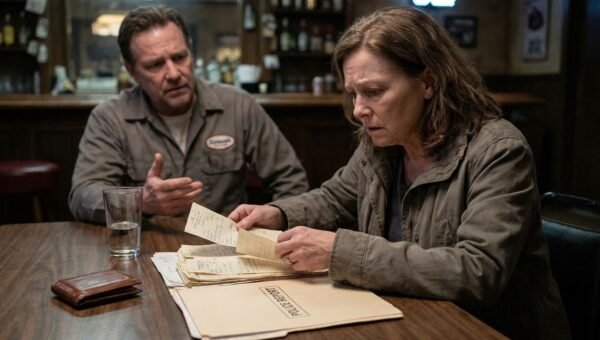
My fingers were still trying to grip the bedrail when Greg handed me the divorce papers. I was in a hospital gown with a plastic bracelet around my wrist, and the room kept tipping sideways even though I was lying down. Greg laughed as he told me he’d filed and planned to take the house and the car. Then he walked out as if I were a debt he’d finally cleared.
I remember the paper edge against my thumb. That part, for some reason. Not what the nurse had said ten minutes earlier, or which doctor had been whispering outside my curtain. Just Greg’s laugh and the paper.
My dizziness had started that morning while I was working from home. I’d stood up from my desk and grabbed the wall because the whole room seemed to slide left. By the time the ambulance got me to the hospital, I couldn’t keep water down. The doctors were worried enough to order scans and talk quietly where I could hear bits of it.
I was scared they were talking about a stroke. I was also embarrassed that I kept asking them to turn off the little monitor because its beeping made the room feel like it was moving faster.
Greg arrived that afternoon. I thought he’d brought my charger or clean clothes. Instead, he set the papers on my blanket and said, “I’m done carrying you.”
I couldn’t make my mouth work right away. My head still spun when I turned it.
“You’re taking the house?” I asked.
“I’m keeping it,” he said. “And the car. You don’t have anything to fight me with.”
Then he laughed. Not loudly. More like he’d told himself a joke and was pleased with it.
I didn’t plead. I didn’t ask him to stay. I’m not saying that because I was brave. I was too dizzy to sit up, and I knew if I started crying, I might throw up again. So I watched him put his hand on the door and leave.
That was the humiliating part. Not the papers. I’d been married to Greg for eleven years, and he still thought I was too helpless to understand what he was doing.
He’d always called my technical work a hobby. I started as a freelancer, fixing systems and writing documentation for small companies.
Three years ago, I got hired as an enterprise systems analyst. I kept getting promotions. My salary eventually reached $130,000.
Greg never asked what I made. He’d ask if I’d “made a little pocket change” that month, or say he was glad I had something to keep me busy. He worked in equipment sales and liked to say he was the one keeping our household afloat. I corrected him a few times. Then I stopped.
I kept my pay in an account at a different bank. That wasn’t a trick. I’d watched money disappear from our joint account whenever Greg decided he needed new equipment, a better truck, or a weekend that was supposed to be “good for business.” I didn’t want to spend my whole life asking where my own paycheck went. I should have been more direct. I know that. But keeping my account separate felt safer than another argument that ended with him telling me I didn’t understand money.
The first night in the hospital, I barely slept. Every time I closed my eyes, the bed seemed to roll under me. I kept thinking about the forms and the house and whether Greg could really make me leave. Then I’d remember that I couldn’t stand without help and feel foolish for worrying about a car.
The next morning, Dr. Chen came back with my test results. She pulled the chair close and spoke plainly.
“It’s severe labyrinthitis,” she said. “Your inner ear is inflamed. We don’t see signs of a stroke.”
I asked if it would go away.
“It should improve,” she said. “You’ll need rest. It can take a while.”
I cried a little, which I hadn’t meant to do. I was relieved enough that my hands started shaking. Dr. Chen handed me a tissue, and I remember the thin paper tearing when I tried to open it.
The answer wasn’t a miracle. I still needed fluids and help walking to the bathroom. But I could think again. Once Dr. Chen left, I called a family-law attorney whose number I’d saved months earlier after a friend mentioned her. Her name was Eleanor Vance.
“I’m in the hospital,” I told her. “My husband served me papers.”
“Don’t sign anything,” she said. “Send me a photo of every page you have.”
I sent them from my phone. That was the first thing I did that felt like mine.
By the time I was discharged the next afternoon, the dizziness had eased enough for me to get into a car, slowly. I was still wearing the hospital bracelet when I walked into my house. Greg wasn’t there. The kitchen was quiet, and his coffee cup was still on the counter from the day before I went to the hospital.
The house looked the same, which felt almost rude. My shoes were by the back door. The mail was stacked where I’d left it. I stood there for a minute, holding the discharge papers, trying to connect that ordinary room to Greg saying he was taking it from me.
Then I went to my office and opened the folder in my private cloud account. I keep copies of important paperwork because I work with systems all day and don’t trust one copy of anything. I found the deed, the mortgage records, the vehicle title, and our tax returns.
The house and the car weren’t in Greg’s name. The mortgage and the primary vehicle loan were tied to my credit and my income. I’d had the credit and income to qualify when we bought them. Greg had signed some household papers over the years, but he had never bothered to read the actual loan statements. He assumed I’d been freelancing for pocket change because that was easier than asking.
I won’t pretend I felt triumphant. I felt sick. I had a stack of papers proving I was not the woman Greg had just described, but those same papers meant I’d have to let the situation get uglier before it got better.
Eleanor met with me the next morning. She looked through Greg’s filing, then looked at the documents I’d brought.
“He’s filed an emergency request to control the accounts and take the property,” she said. “He’s made some claims he can’t support.”
“Can he make me leave?”
“Not based on what I’m seeing.”
She explained that Greg’s filings had opened the door to full financial disclosure. His paperwork claimed he was the sole provider and that I had no real income. He’d also tried to freeze credit and push through title changes before anyone had reviewed the records. That move brought the lenders into it. The house lender sent notice that the attempted transfer and related filings had triggered a review, including an acceleration notice. It wasn’t a judge handing him the house. It was a problem he’d created by acting like the house belonged to him.
Eleanor also found debts Greg hadn’t told me about. Some were credit cards and personal loans. A separate account he’d kept hidden had grown into more than he could manage on his own. His emergency statements had brought those debts into the open.
“He thought the filing would make you look dependent,” she said. “Instead, he’s put his own numbers under a light.”
I should say I felt bad for him. I did feel bad, in a distant way. I knew what it was like to worry about bills. But I had also spent years asking Greg not to run up balances for things we didn’t need. He’d call me cheap, then make a payment from our joint account and tell me not to fuss.
Eleanor asked whether I wanted to send the certified records right away or wait until Greg’s lawyer asked for them. I knew sending them would cut off the idea that I might help cover his debt just to keep things calm.
“Send everything,” I said. “I’m not covering it.”
She warned me that this could make Greg angry. I told her I understood. I didn’t, not really. I just knew I was tired of making his choices easier for him.
For two days, I let myself believe the worst was behind me. I rested. I took the medicine Dr. Chen had prescribed and kept a glass of water by the bed. I went through the house slowly, one room at a time, and tried not to look at Greg’s side of the closet.
I also signed the papers Eleanor prepared. The house and car records were clear. My salary records were clear. It felt good to see the facts lined up in black and white.
Then, at 11:23 p.m. on the third night after Greg served me, my phone lit up with his name. I almost let it ring. I picked up because I wanted to hear what he’d say when he couldn’t laugh.
His voice was shaking.
“My lawyer says you own the house.”
“I’m on the mortgage,” I said. “And the title.”
“You never told me you were making that much.”
“You never asked.”
He went quiet for a second. I could hear a TV in the background, or maybe a radio. I don’t know why that’s the detail I remember.
“Can we stop this?” he said. “I was under stress. I didn’t mean what I said at the hospital.”
“You served me divorce papers in a hospital bed.”
“I thought you had nothing.”
That was the part he couldn’t take back. He said it like it explained him.
I had to sit up slowly because my head still felt tender when I moved too fast. I looked at the bracelet on my wrist. It had my name and the date printed on it. It made me feel like a chart, but it also reminded me that I’d been there alone when he chose to do this.
“You don’t get to take it back because the numbers changed,” I said.
“I need you to help me with the lender. I can’t pay all this by myself.”
“I’m not taking on your debts.”
“I’m still your husband.”
“Not for long.”
He kept talking. He said he could withdraw the emergency request. He said we could settle things quietly. He said he was sorry, but each apology came with a request attached. I could hear him trying to get back to the old arrangement, where I did the work of calming him down and he got to call it being a team.
I told him Eleanor would speak with his lawyer. Then I ended the call.
The next morning, Eleanor confirmed that Greg’s lawyer had pulled back the emergency motions. The ownership records were not in dispute after she sent the certified copies. Greg had to deal with his own debt, and he had to make arrangements to move. I kept the house and the car. He couldn’t force me to pay the balances he’d hidden from me.
We still had to sit across from each other at a legal conference. Greg looked like he hadn’t slept. He brought no joke with him this time.
“I’m sorry about the hospital,” he said.
I held the records on my lap. “You laughed.”
“I was angry.”
“I was sick.”
He pressed his hands together. “I didn’t know your salary. I didn’t know the loan was all in your name.”
“That’s because you didn’t ask.”
“I thought we were doing this together.”
I wanted to tell him that I’d thought that too, for a long time. Instead, I let Eleanor go through the terms. The home and vehicle remained mine. Greg’s separate debts remained his. We signed an uncontested settlement and ended the marriage without another fight about who had earned what.
I used to think keeping the peace meant leaving some things unsaid. I can see now how convenient that was for Greg, and how convenient it was for me not to have one more argument. I wasn’t blameless in how quiet I stayed. But I didn’t owe him my money, my house, or another chance to laugh at me when I was down.
The next morning, I sat on the front porch in the sun with the hospital bracelet still on my wrist. My head was steady. I took a pair of shears and cut through the plastic.
Greg’s old house keys were already in the trash.