PART 1
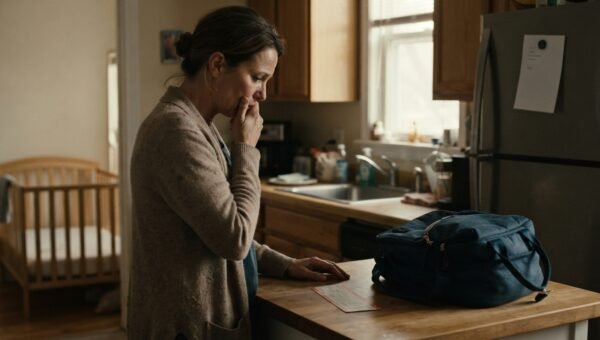
Ellen held both of my hands across her kitchen table back in March, looked right into my face, and told me the sewer line had backed up during the heavy spring rains. She said the water rose nearly four feet in her finished basement before the sump pump tripped the breaker. She told me the cedar chest had been sitting directly on the concrete floor, right where she stored her extra winter linens.
“Sarah, I am so sick about it,” she whispered. Her eyes were red, and her voice shook just enough to make me feel guilty for even asking. “The water sat down there for two whole days while I was out of town caring for my sister. By the time I came back, the mold had eaten straight through the batting. The smell was unbearable. The restoration crew hauled the whole chest out to the roll-off dumpster before I could even try to save it.”
That quilt was stitched by my grandmother, Clara, in 1948. She made it in the mountains outside Boone, North Carolina, using feedsacks, worn wool trousers, and faded cotton calico from dresses she had outgrown during the war. It was not a decorative showpiece meant to be folded over a guest bed. Grandma had wrapped me in it whenever I had a fever as a child. When Ellen asked to borrow it three months earlier for a regional heritage display at our county historical society, I agreed because Ellen had been my closest friend for fourteen years.
We walked three miles together every Tuesday morning, shared holiday dinners, and traded spare house keys. I trusted her with my life, so I trusted her with Grandma’s quilt.
When she told me it was gone, I cried in her kitchen. I told her it was just cloth, that accidents happen, and that our friendship mattered far more than any old blanket. I spent the next five months mourning it in silence, feeling a hollow ache every time I walked past the empty cedar rack at the foot of my bed.
Then, on a rainy Thursday in August, a glossy quarterly catalog arrived in my mailbox from Miller & Croft Fine Antiques in Asheville. I flipped through the pages while drinking my morning coffee, glancing idly at early pine cupboards and stoneware crocks. On page twenty-four, my eyes snagged on a full-color photograph.
There was the faded navy feed sack square with the tiny white anchors.
There was the butter-yellow star in the center, pieced with the uneven, tight backstitches Grandma always made with her arthritic left thumb.
The catalog description read: “Rare Appalachian Heirloom Quilt, dated 1948. Double wedding ring variant with pieced star medallion. Pristine condition, professionally cleaned and conserved. Consigned from a private estate. Estimated value: $7,500.”
I did not call Ellen. I got into my car with the catalog on the passenger seat and drove straight to her house.
When she opened the front door, she was holding a pair of garden shears, wearing her bright floral gardening apron. I held the catalog open to page twenty-four and put it right in front of her face.
“Look at this, Ellen,” I said. My voice was completely flat. “Tell me what that is.”
She did not gasp. She did not drop the shears. She pulled her glasses down off the top of her head, peered at the glossy page for perhaps three seconds, and then looked right back at me.
Her expression hardened into a cold, flat stare I had never seen on her face in fourteen years.
She folded her arms across her chest.
“You can’t prove that one is yours,” she said.
PART 2
The sentence hung between us on the porch. She did not say the auction house made a mistake. She did not say she had been duped or that someone had stolen it from her trash. She went straight to legal ownership and proof.
“I gave you that quilt in February,” I told her. “You sat on my sofa and promised you would keep it in a locked display case at the library.”
“And I told you it was ruined in the flood,” Ellen said, not blinking. “Appalachian star quilts aren’t unique, Sarah. Women made thousands of them in the forties. If you go barging into Miller and Croft making accusations, you’re only going to embarrass yourself. Now, I have work to do in the yard.”
She stepped back inside and closed the heavy oak door. The latch clicked firmly into place.
I stood on her welcome mat for a minute, looking at the brass knocker shaped like a pinecone that I had given her for her sixtieth birthday. Then I walked back to my car, backed out of her driveway, and pulled over two blocks away to breathe.
My grandmother had not left behind formal appraisals or insurance riders. She died in 1982 in a wood-frame house that heated with an oil stove. But Grandma was a practical woman who lived through the Depression, and she had an intense sense of family pride. In the bottom left corner, underneath the calico backing, she had stitched something with dark red embroidery floss. When I was eight years old, she held my finger against the thick stitches and told me that if the quilt ever got mixed up at a church bee, everyone would know who it belonged to.
The catalog stated that preview hours for the weekend auction began at ten o’clock the following morning.
I was waiting outside Miller & Croft’s gallery on Biltmore Avenue twenty minutes before the doors unlocked. The gallery was quiet, smelling of floor wax and old paper. A young woman in a tailored jacket directed me to the textile racks at the rear of the main showroom.
The quilt was hanging from a padded wooden bar suspended against a cream-colored display wall. Seeing it under bright gallery track lights made my chest tighten. Every patch was familiar: the pale green gingham from my mother’s grade-school pinafore, the brown homespun from my grandfather’s Sunday vest, and the yellow star at the center.
A silver-haired man with tortoiseshell spectacles approached with a clipboard. His nametag read Arthur Croft.
“Magnificent piece, isn’t it?” he said softly. “The stitching tension is remarkable for mid-century mountain work. We have two museum curators bidding by phone tomorrow.”
“I need to inspect the backing,” I said. “Specifically the reverse side of the lower left corner.”
Mr. Croft hesitated, but my voice must have carried enough quiet authority that he nodded. He slipped on a pair of white cotton handling gloves and gently eased the heavy textile forward so I could examine the reverse.
The original cream muslin backing was intact across ninety percent of the surface. But in the lower left corner, a neat, rectangular patch of newer unbleached cotton had been set into the seam with modern machine stitching. It covered an area roughly four inches wide by six inches long.
Someone had cut the original fabric out and replaced it.
My stomach dropped. Ellen had inspected the quilt before taking it to the consignor. She had found the embroidery and removed it so I could never identify it.
“Is something wrong, ma’am?” Mr. Croft asked, watching my face carefully.
“The corner was altered,” I said. My voice was shaking now, and I couldn’t stop it. “My grandmother embroidered her identification in red thread right under this hem seventy-six years ago. Someone cut it out to hide where it came from. This quilt was stolen from me.”
Mr. Croft did not call security or dismiss me. He adjusted his glasses, looked at the modern repair on the backing, and then looked at the despair on my face.
“Wait here just a moment,” he said.
He disappeared into an office behind the showroom floor. Three minutes later, he returned carrying a clear plastic sleeve containing the intake documentation file.
“When an item of this value is brought in for consignment, our intake protocol requires high-resolution documentation before any conservation or stabilization work is approved,” Mr. Croft explained quietly. “The consignor claimed this corner had suffered minor dry rot and paid our textile restorer fifty dollars to patch it before cataloging.”
He slid an eight-by-ten glossy color photograph out of the plastic sleeve and laid it flat on the glass display case between us.
“This is the intake photograph of the reverse corner before the patch was applied,” he said.
I looked down at the photograph. The red embroidery floss was unmistakable, worked in tiny, slanted cross-stitches into the original muslin: *S.E.M. 1948*. Those were my initials: Sarah Elizabeth Miller.
Right beneath my initials, worked in identical red thread and the exact same neat hand, was a second line of stitching that Grandma had never once mentioned to me.
It read: *For Martha Ellen, Keep Faith.*
Before I could process what the second name meant, a sharp clatter of heels sounded across the hardwood floor.
“Arthur, step away from that table,” a voice snapped.
Ellen was marching down the center aisle of the gallery, her purse clutched against her ribs like a shield, her face flushed dark red. She lunged forward, her fingers outstretched, grabbing violently for the glossy photograph on the glass.
PART 3
Mr. Croft was quicker. His hand came down flat on top of the print, pressing it firmly against the glass counter before her fingernails could reach the paper.
“Do not touch gallery records, Mrs. Vance,” Mr. Croft said. His tone was not loud, but it was like iron. “You are on private commercial property.”
Ellen froze. Her hand hovered in the air, trembling. Her gaze darted between Mr. Croft, the framed quilt on the wall, and me. The bravado she had shown on her porch twenty-four hours earlier had completely dissolved into frantic desperation.
“Sarah, please,” she whispered. Her voice cracked. “Don’t do this here. Let’s walk outside. Let’s go get coffee.”
“Who is Martha Ellen?” I asked. I didn’t yell. I kept my eyes locked on hers. “My grandmother made this in 1948. She embroidered my initials, and then she embroidered Martha Ellen. That’s your mother’s full name.”
Ellen’s shoulders dropped an inch, then two. The defensive glare went out of her eyes, replaced by a hollow, cornered exhaustion. She looked at the floor, unable to meet my gaze.
“My mother was Clara’s half-sister,” Ellen said, so quietly that the gallery assistant at the front desk couldn’t hear. “Clara’s father remarried in 1928 after his first wife died of influenza. My mother was the child from that second marriage.”
The family history I had known my entire life suddenly cracked open. Grandma Clara had always spoken of her childhood as an only child in Watauga County. She never spoke about her father after he left the farm during the Depression.
“They had a falling out that lasted thirty years,” Ellen continued, her words tumbling out now like water from a broken pipe. “When my mother was nineteen and had me out of wedlock in 1948, the family shut her out completely. But Clara came down off the mountain in secret. She brought that quilt. She stayed three nights in the boarding house, helped my mother nurse me through colic, and stitched our names into the lining together so my mother would remember she had family.”
“Then why did Grandma have it?” I asked.
“Because when my mother got married two years later, her new husband wouldn’t let her keep anything from her past,” Ellen said, a bitter edge returning to her voice. “He was a deacon at the Baptist church in Lenoir. He made her box up everything from that time. My mother drove that quilt back to Clara’s porch, left it on the glider, and never spoke to Clara again. My mother lived the rest of her life pretending she was an only child from a respectable family.”
“And you knew?” I said. “All these years we’ve been friends?”
“I didn’t know until three years ago,” Ellen whispered. “When my mother was in the nursing home in Hickory, right before she passed, she told me about the quilt. She said Clara kept it for Sarah, but that half of it rightfully belonged to our line of the family. She made me promise to find it.”
“So you didn’t borrow it for a heritage display,” I said, the truth finally settling like lead in my chest. “You hunted it down.”
“You didn’t even know what it was,” Ellen spat, her eyes flashing with sudden, ugly resentment. “You threw it across the foot of a twin bed in your guest room. My mother died with twelve hundred dollars in the bank, Sarah. I’m sixty-eight years old, my husband’s pension dried up when the furniture plant went bankrupt, and I have eleven thousand dollars in medical debt from my hip replacement. That quilt is family property. It was made for my mother, too. I had a right to sell it.”
“You stole it from my house,” I said. “You looked me in the eye and lied about a flooded basement while I held your hand and cried.”
Mr. Croft picked up the intake folder, slid the photograph back inside, and closed the cover with a deliberate, heavy thud.
“Mrs. Vance,” he said, looking squarely at Ellen. “This consignment contract was executed under false provenance warrants. You signed an affidavit affirming sole and unencumbered ownership of this artifact. That is fraud under North Carolina commercial law. I am withdrawing lot one-hundred-fourteen from tomorrow’s auction immediately.”
Ellen took a step toward him. “You can’t cancel the consignment! The catalog has already gone out to three hundred registered buyers! That quilt is valued at $7,500. I need that money to pay off the hospital!”
“The auction house will not facilitate the sale of disputed property,” Mr. Croft replied calmly. “Furthermore, if you do not leave the premises right now, I will dial the Asheville Police Department and file a formal report for commercial misrepresentation.”
Ellen turned back to me, her hands clasped together near her chin, pleading. “Sarah. Please. We’ve been friends for fourteen years. Don’t let him do this. Take half the hammer price. Three thousand dollars for each of us. We can walk away and nobody else ever has to know.”
I looked at the woman who had walked beside me through fourteen years of ordinary life, through my husband’s funeral and her daughter’s wedding. I saw the calculated desperation in her face, and I realized that every warm morning on the trail and every shared cup of tea had been secondary to the resentment she had harbored the moment she learned about that piece of cloth.
“The quilt belongs to me, Ellen,” I said. “Grandma kept it in her house for thirty-four years, and she handed it to me the summer before she died. You don’t get to steal my memories to pay your bills.”
ENDING
Mr. Croft required two weeks to complete the legal paperwork releasing the quilt from the gallery’s custody. I had to provide my birth certificate, Grandma Clara’s 1982 will showing I was the sole heir of her personal property, and a notarized statement detailing the original embroidery.
When the textile was finally cleared for release, I drove back to Asheville on a Tuesday morning. Mr. Croft had packed it carefully in acid-free tissue paper inside a sturdy archival box. He refused to charge me for the conservation patch his restorer had sewn into the corner. He also handed me the original intake photograph showing the red stitching with both names side by side.
I did not press criminal charges against Ellen. The county sheriff’s deputy told me I had enough evidence for a grand larceny warrant, but putting a sixty-eight-year-old woman in a county jail cell would not have healed anything.
Instead, I let the silence do the work.
I took back my spare house key from the hook inside her garage while she was at church. I blocked her phone number. When two women from our walking group asked why Ellen and I had stopped meeting at the park trailhead, I told them the truth in three sentences: Ellen took Grandma’s quilt under false pretenses, attempted to sell it at an antique auction in Asheville, and the auction house returned it to me after verifying my ownership. I did not embellish or raise my voice. The community is small, and by the end of September, Ellen had resigned from the historical society board and stopped attending the Tuesday morning gatherings.
Last week, I took the archival box out of the closet and carried it into my spare room.
I sat by the window with a seam ripper, a needle, and a spool of unbleached thread. Very slowly, stitch by stitch, I removed the modern patch the auction restorer had machine-sewn over the lower corner.
Underneath, the original muslin was slightly frayed where Ellen had tried to pick at the threads before giving up and asking for a patch, but the red floss had held fast. *S.E.M. 1948* was still there. And beneath it, slightly faded by seventy-six years of mountain air and dark cedar chests, remained the name of the girl Clara had slipped away to comfort: *For Martha Ellen, Keep Faith.*
Grandma had stitched that second line not out of pride or ownership, but out of secret mercy for a sister the world had told her to forget. Ellen had seen only a dollar amount and a score to settle with the past.
I smoothed the muslin flat with the palm of my hand. I decided not to cover it with a patch.
I folded the heavy quilt, carried it down the hallway into my own bedroom, and laid it across the foot of my bed, where the morning sun hits the yellow star every single day.