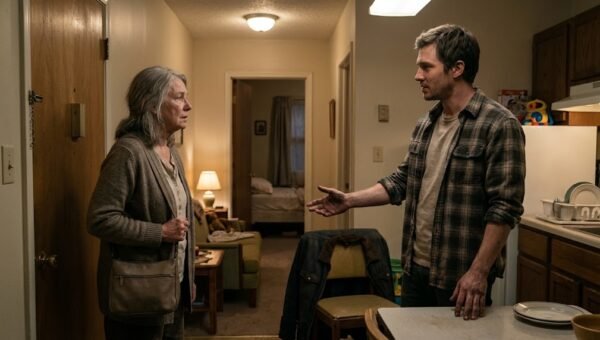
The spoon was still sitting in the sugar bowl when Maxine told me I had no business at Aunt Inez’s dining table. She had one hand on the back of her chair and the other on a ring of keys. I was holding a folder I’d carried across town, trying not to let my fingers shake.
“Get off this property,” she said. “You’re trespassing.”
That was the first time I knew she hadn’t understood what she’d taken.
To explain how I ended up at that table, I have to go back to the funeral, when the only thing Maxine thought I was worth was a chipped candy dish.
Aunt Inez’s funeral was on a Thursday. I remember because I’d taken the morning off from work and still had my name tag in my purse. After the service, a few of us went back to Inez’s house. Maxine was already sorting what she called “the practical things.”
She’d arranged it so she got the house, the Buick, and the $96,000 in Inez’s savings account. I got the candy dish that had sat beside Inez’s telephone for 28 years. It was the color of weak tea, with a small chip along the rim and green felt on the bottom.
Maxine put it in a Dollar General bag and pushed it toward me.
“Take the candy dish and quit whining,” she said.
I hadn’t actually been whining. I’d asked whether Inez had left anything in writing about the house.
Maxine laughed, and there were still people in the kitchen who could hear her.
“She knew what you were worth.”
I wish I could say I answered her. I didn’t. I took the bag because I didn’t want to make a scene at Inez’s house, which is the kind of thing I always tell myself when I’m afraid to make one.
The drive home was short. I kept the bag on the passenger seat, and every turn made the dish tap against the door. Inez and I had spoken on the phone every Sunday evening since I was a young woman. The dish had been beside that phone through all of it.
I’d call after dinner. She’d ask if I had eaten enough, then tell me something small about the week. A loose gate. A pie that didn’t set. Maxine needing money again. I don’t remember every conversation. I remember the sound of the dish being nudged when Inez reached for the phone.
At home, I set it on the kitchen counter and pulled it out of the bag. The rim had a fresh rough spot where the glass had cut my thumb. I wrapped it with a dish towel and sat there longer than I needed to.
I almost put it in a cupboard. Instead, I turned it over to see if the cut had chipped more of the bottom.
The green felt was peeling loose.
I lifted one corner with my thumbnail. Something flat was taped underneath. It was a brass key, no longer than my little finger, and a folded receipt with “Safe Deposit” stamped across the top. The annual fee was $11. The date was from the January before Inez died.
I read it twice. Then I read it again, as if the numbers might change.
The receipt had the name of First Farmers Bank, the town where Inez had lived.
I tucked the key and paper into my wallet, then called the bank. The person who answered said the box was still there, but I’d need identification and the key. I waited until July.
There wasn’t a good reason for waiting, except I was tired and angry and didn’t trust myself to walk into a bank without calling Maxine first. That would have been a mistake. I knew how she worked. She’d have told me it was probably junk, and I might have believed her just to avoid another fight.
Three weeks later, the heat broke the thermometer outside my kitchen window. I drove to First Farmers with the air conditioner struggling and the key in my purse. The lobby was cool enough that I felt the sweat drying on my neck.
The man who came out from the back introduced himself as Charles Henderson. He was older, with a silver tie clip and a little coffee stain on one cuff. When I showed him the receipt, he looked at it, then at me.
“Your aunt set this up carefully,” he said.
He checked my ID and asked for the brass key. I gave it to him. He brought me into a small room and returned with a long metal box. My birth date was printed on the file tag. Not just the month and day. The whole date.
Inez had set the access terms so the key and my identification were both needed. Mr. Henderson stayed while I opened the box. I remember my hands felt clammy against the cool metal.
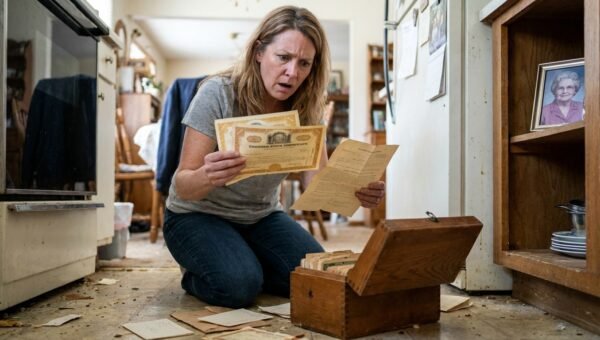
The first thing inside was a thick envelope. Under it was a certified county deed, a folded survey map, a small notebook, and several pages of bank records. The deed was for Inez’s 40-acre orchard parcel. It had been recorded four years earlier and transferred directly to me through a Transfer-on-Death deed.
I read the name on it carefully. Mine.
The map showed the parcel line running around and beneath the farmhouse. The house itself was on the land. I was still trying to understand that when I saw Inez’s handwriting on the envelope.
She’d written my name in the same sharp cursive she used on birthday cards.
I opened the letter in the bank room. The first line said she knew Maxine would take the visible things. It wasn’t a guess. In the last five years, Inez had watched Maxine push her way onto the bank accounts, take control of the Buick’s title, and press her to change what she’d planned to leave.
Inez wrote that she hadn’t wanted another family fight while she was alive. She said Maxine was good at making a demand sound like help. Inez had been lonely and had let too much go on because she was tired of arguing.
Then she wrote about the calls.
“Twenty-eight years of Sundays,” she wrote. “I knew you’d keep the dish.”
I had to put the letter down for a minute. Mr. Henderson offered me a glass of water. I said no, then changed my mind and drank it.
The notebook was a record of dates and amounts. The bank pages showed repeated withdrawals and transfers from Inez’s personal savings. Some had Maxine’s signature. Others had been made through the joint account Maxine had pushed Inez to open. The balance Maxine bragged about receiving had not all been Inez’s to leave.
There were teller records, withdrawal slips, and internal bank audit notes. Mr. Henderson explained that the bank had kept records after Inez raised concerns. She’d signed a directive asking them to preserve the transaction history if anyone challenged the account. Her affidavit was notarized and attached to the last pages.
Inez had made the directions plain. If Maxine tried to shut me out, I was to take the deed and the bank records to an independent probate attorney. I was not to settle for a quiet payment just to keep the peace.
That part stung, because I could see myself doing exactly that.
I took copies of everything and called an attorney the next morning. I chose someone Maxine had never used. The attorney, Ms. Bell, went through the deed, the transfer record, the lease papers, and the bank records over two meetings.
Maxine had been given the house structure in the probate papers, but she did not own the land under it. The old ground arrangement she relied on had never been properly recorded, and it did not give her the right to claim the parcel. The home was still Inez’s, and the deed had moved the land to me years before the probate rush.
“You need to deal with the account separately from the deed,” Ms. Bell said. “But the records give us a real basis to ask for a full audit.”
I asked if Maxine could simply say Inez had wanted her to have the money.
“She can say it,” Ms. Bell said. “The records are what matter.”
I could have kept the deed quiet and let Maxine live there. I thought about that. I also thought about the way she had laughed at the funeral, and then felt ashamed for using that as my reason. Inez had left instructions. Maxine had taken money from an older woman who trusted her. I couldn’t pretend the papers were only about hurt feelings.
Ms. Bell filed a request for a full estate accounting. That was how Maxine learned I had the deed and the bank records.
A few days later, I went to the farmhouse. I took the certified deed, survey map, and audit documents in a folder. Inez’s dining table was still where it had always been. The spoon was still in the sugar bowl, though I don’t know why that’s the thing I noticed.
Maxine stood up when I came in.
“You have no right to be here,” she said.
I put the folder on the table. She didn’t touch it.
“You can’t take this house from me,” she said.
I slid the survey map toward her. The red line crossed the spot where she was standing. Then I put down the recorded deed and the bank records.
“I own the land,” I said. “And these show where the money went.”
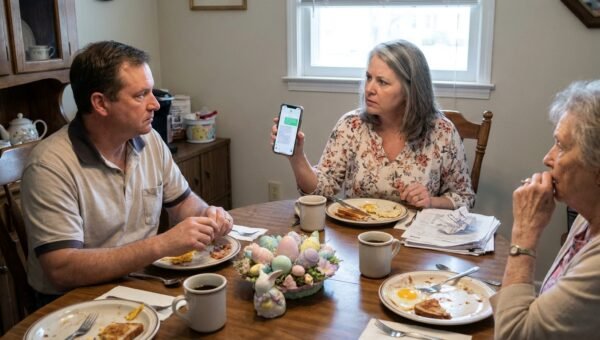
She looked at the map, then at the deed. Her mouth tightened when she saw her name on the withdrawal records. She picked up one page, put it down, and tried to tell me Inez had agreed to every transfer.
I didn’t argue about what Inez had said in private. I pointed to the signed directive and the audit trail.
Maxine pushed the papers away. “You’re trying to make me look like a thief.”
“I’m asking for the money to be accounted for.”
She said she’d call the police if I came back. I told her the estate attorney had already been in touch. That was when she stopped talking about trespassing.
The legal work took months. The audit backed up what Inez had written. Maxine had to account for the $96,000 she’d taken from the joint account, including money transferred out of Inez’s savings while Inez was paying her own household bills. The estate’s attorney gave her a choice: return the funds and relinquish her claim to the house, or face a court fight over the withdrawals and the deed.
Maxine signed the settlement. The money was repaid to the estate under the terms of the agreement, and her claim to the house was transferred. The land and farmhouse were formally retitled according to Inez’s recorded deed and the probate settlement.
She packed her belongings into the Buick. She didn’t look at me when she left. After that, she cut off contact with most of the family. Nobody asked me to fix things between us.
I moved into the farmhouse after the papers were done. I’ve made small repairs and cleared out the worst of the old orchard rows. It’s not a grand place. Some mornings, I still hear the phone ring in my head around supper time, the way it used to on Sundays.
I kept the candy dish. The chip is still there, and I didn’t try to glue the felt back down. It sits beside the telephone on my kitchen counter, catching the morning sun through the clean windowpanes.