Hank’s gravel lot is where my brother found out Dad had already made up his mind about the truck.
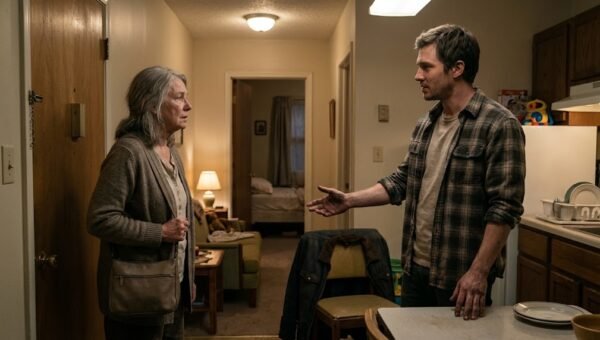
I was standing between Cal and the driver’s door, holding the keys so tight the little metal ring dug into my palm. Dad sat in the passenger seat. He’d been quiet since we pulled in, his coat folded beside him and the peppermint gum smell coming through the open window. Cal stood there saying the truck should go to the son.
He hadn’t visited Dad in almost a year. But he wanted the keys like they’d been waiting for him.
I wish I could say I felt only angry. Mostly, I felt tired in a way that had been building for months, and then ashamed for feeling tired while Dad was right there. I also knew I wasn’t going to hand Cal the keys.
The pickup was old, but it wasn’t just an old pickup to us. I’d used it to take Dad to dialysis every Thursday, and I knew the route without looking at a map. I knew which turn made him brace his hand against the dashboard, and which light always caught us even when there was no other traffic. Those details stick. Other things don’t.
For most of that year, Thursday had been our day. I’d get to Dad’s house a little before eight, check that he had his wallet and the clinic papers, and help him down the porch steps.
He could still do plenty for himself. I didn’t want to make him feel like I thought otherwise. But his legs were weaker, and the truck sat lower than my car, so we took it.
The starter needed a second try on cold mornings. Dad would tap the dash once, like that would help, and say, “She’s thinking.” I’d tell him the truck had been thinking for ten years. He’d grin and hand me a stick of peppermint gum from the glove compartment.
That was most of our talk on the drive. We weren’t a big feelings family. If Dad asked whether I’d eaten, that meant he was glad I came. If I brought him a thermos of coffee, he didn’t have to say thank you. That was how we did things, which worked fine until it didn’t.
Cal used to come around more. Then he got busy with work, then there were things he had to handle, then he stopped giving a reason.
I didn’t keep a calendar of his visits. I’m not proud of this, but I did notice when it had been months. I noticed each Thursday Dad asked whether Cal had called.
I’d say I didn’t know. Sometimes I’d add, “He’s got a lot going on,” because it was easier than saying I was mad too.
The truck belonged to Dad. He’d bought it years ago, and he kept it running himself until his hands started giving him trouble. It wasn’t a show truck, but it was worth enough that people had asked if he’d sell it. Cal knew that. I think he heard Dad was having it looked at and decided it was time to claim something before it disappeared.
At 8:00 that morning, Dad had taken the truck to Hank’s shop for a safety check. The front end had started pulling a little, and Hank said he’d look at the tie rods and brakes before winter.
I thought we’d be there half an hour. Dad had called Hank before we left, though. I didn’t know what he’d arranged.
At 10:30, Cal pulled into the lot.
He got out fast and came around the truck before I could ask what he was doing there. He looked at the pickup, then at me, then at Dad through the passenger window.
“I heard Dad was getting it serviced,” he said. “I’ll take it from here.”
I said, “Take what?”
“The truck.”
I told him Dad was right there, and Cal said he knew. He leaned toward the open window and asked Dad if he was ready to give him the keys. Dad looked at him for a moment, then looked back toward the shop.
I’d been doing that thing where I tried to keep the peace by making myself smaller. I’d done it at family dinners and over phone calls, too. I’d let Cal talk like his plans were already settled, hoping he’d stop if I didn’t challenge him. But I could see Dad’s dialysis bag on the floor by his feet, and I couldn’t pretend this was some old family argument over a lawn mower.
I said, “Dad needs the truck.”
Cal’s voice got sharper. “The truck should go to the son.”
I felt that land in the same place all those missed Thursdays had landed. He’d made the drive to Hank’s shop, but not to Dad’s house. He wanted the truck, not the Thursday mornings.
Still, I knew I had a choice. I could hand over the keys and avoid making a scene. Or I could hold on to them and let Cal be mad at me.
I kept the keys.
Cal stepped in front of the driver’s door. He didn’t touch me, and I’m not going to make it sound worse than it was. He just stood there, taking up the space, as if I’d need his permission to get in.
“Move, Cal,” I said.
He held out his hand. “Give me the keys.”
Dad could hear all of it. I knew that, and it made my face burn. I hated having him sit there while his kids argued over his property. I also hated that Cal seemed to think Dad’s quiet meant he wasn’t paying attention.
The shop door opened. Hank came out, wiping his hands on a rag and carrying a yellow carbon repair order on a clipboard. Hank had known Dad for years. He’d fixed the pickup, Dad’s mower, and, once, a kitchen chair Dad said was worth saving because it was “still good wood.”
Cal turned toward him. “Tell her the truck’s going to me.”
Hank didn’t answer right away. He looked at Cal, then past him to Dad in the passenger seat.
“Your dad asked me to handle this with him,” Hank said.
Cal gave a short laugh. “He asked you to fix the truck.”
Hank held out the clipboard, but not to Cal. He passed it to me.
There was a repair order, a safety inspection sheet, and a DMV title transfer attachment. Dad’s signature sat on the lines at the bottom. Beside it was Hank’s witness stamp. The repair work was listed by item, and the amount had been billed to Dad’s prepaid account. Tie rods. Brake lines. Inspection. Dad had paid for what the truck needed.
I looked up at Hank. “He planned this?”
“Your dad made the plan,” Hank said.
Cal reached for the paper. I let him take it. I didn’t know the first line was going to settle the whole argument. I only knew Dad had signed it that morning, and Hank wasn’t handing Cal the keys.
Cal read the first sentence.
“Transfer all vehicle records, keys, and assigned title directly to my caregiver child, who drives me every Thursday.”
He stopped talking.
The whole lot seemed to get very ordinary again. A car went by on the road. Somebody inside the shop dropped a tool, and it clanged once against the floor. Cal read the line again, slower, like he thought he might find different words if he gave it another try.
I’d expected Dad to explain himself. Maybe I wanted him to say he’d picked me because I’d done more, because I’d earned it, because Cal hadn’t shown up. I wanted the kind of sentence that would make all the waiting count for something.
Dad didn’t give me that. He’d already signed his name.
The transfer was clear. The title was assigned to me, and Hank had witnessed the paperwork. The work order made it clear the safety repairs were paid for. Cal had no legal claim to the truck, and there wasn’t some secret conversation I’d missed that would change that.
But I still wasn’t prepared for the fact that Dad had seen the whole year as clearly as I had.
Cal lowered the page. “You knew I wanted it.”
Dad rolled down the passenger window. It moved slowly, with a small squeak I recognized from all those clinic mornings.
“I knew you wanted the truck,” Dad said.
Cal looked at him. “I’m your son.”
Dad didn’t raise his voice. He didn’t tell Cal he was a bad son or list the number of Thursdays he’d missed. He just said, “Tools belong to the people who do the work.”
That was the only time I saw Cal look at the truck instead of the paperwork. His hand was still out, but it wasn’t reaching for the keys anymore. The keys were in my hand. The title was in the folder. Hank stood beside me, quiet and steady.
I could have said something. I had plenty of words by then, most of them mean. I’m not claiming I was above that. I’d rehearsed more than one speech in the truck on the way to the clinic, and I’d pictured Cal hearing me out and finally understanding what he’d left me to carry.
But there wasn’t much point. Dad had said what needed saying, in his own plain way. Cal had no backing from him or Hank, and he had no claim on the truck.
He let his hand drop.
“Fine,” he said.
He didn’t apologize. I didn’t ask him to. Hank took the clipboard back and gave me the copy. Cal walked to his car and drove out of the lot without the pickup.
I watched him go longer than I needed to. It was an old habit, waiting to see if he’d turn around. He didn’t.
Then Hank explained the rest of the paperwork to me. The title transfer was recorded on the attachment, and the repair work would be finished before we left. I signed the acceptance line. I asked if the truck was safe to drive, and Hank said he wouldn’t let Dad leave in it if it weren’t.
That mattered. I needed the plain answer. I didn’t want to make the truck into a symbol and forget it still had to stop.
Dad sat back while Hank finished up. He looked tired, but not confused, not unsure. This was his choice. He hadn’t waited for Cal to arrive and make it for him. He’d planned the visit, paid for the repairs, and put his name on the title transfer before anybody argued.
Maybe he’d kept that plan to himself because he knew how Cal would react. Maybe he wanted one ordinary Thursday where the paperwork did the talking. I don’t know. Dad wasn’t much for explaining himself after he’d made a decision.
I used to think he gave Cal more leeway because Cal was the son. Dad never said that. I guess I made it up from little things: a call Dad didn’t complain about, an excuse I supplied, a place kept open at the table. That morning didn’t erase all those years of me wondering. It did tell me Dad had noticed who was there.
The safety work was done, and Hank checked the brakes before I climbed in. I put the yellow copy in the glove compartment, behind the owner’s manual. The same place Dad kept the gum. It felt strange to have the title in my name. More strange than exciting.
Dad clicked his seatbelt. I turned the key, and the engine started on the first try.
On the familiar road to the clinic, I shifted the truck into drive. The odometer changed by one mile. Dad opened the glove compartment and held out a stick of peppermint gum.