Nora had the urn tucked against her ribs and her speech folded in her coat pocket when Chloe pulled a napkin from her purse. We were standing on the dock where we’d spent summers as kids, and Nora had just started telling us how Mom loved the lake. Then Chloe said, “I found this in Mom’s kitchen.” Nora took it before I could see past the first line.
The paper had a soft crease down the middle. Purple ink. I knew the napkin dispenser it came from, the one by Mom’s kitchen sink, because I’d leaned on that counter a week before Mom died and listened to her tell me something I wasn’t ready to hear.
At the dock, I just stared at Nora’s closed hand. I’d agreed to the lake. I couldn’t say I’d been surprised by the note.
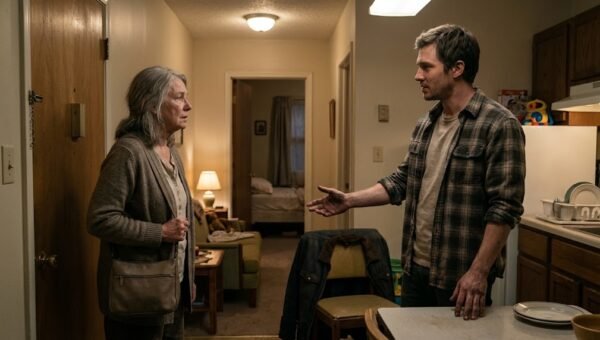
Two months earlier, Mom had come home on hospice. Nora took charge of the bills, the visits, the medication list, and the schedule for overnight help. She was good at it, honestly. She knew which number to call and which supply we were short on. But when I questioned a shift, she heard criticism. When she asked me to cover one and I couldn’t, I heard an order.
“We need a real schedule,” Nora said one afternoon, holding a yellow legal pad. “We can’t keep making this up every night.” I was tired and said, “I know that, Nora.” Then I added, “You don’t have to talk to me like I’m staff.” Chloe sat beside Mom in the other room. We knew she could hear us, but we kept going.
Nora was trying to keep Mom safe. That was true. She was also trying not to look at what was happening, and I was too proud to admit I was scared right along with her. We all hid in the jobs we’d picked up. Nora managed. I corrected her. Chloe stayed close to Mom and got so little sleep she once put the milk in the cupboard.
A week before Mom died, I brought tea into the kitchen. Mom sat at the table in her robe, one hand around the mug. She was thinner than the last time I’d really looked at her. That detail shames me. I’d been in the house, but I’d been watching the calendar more than her face.
“Does it hurt?” I asked. Mom shrugged. “Some. I’m tired of being a project.” She said it in the same voice she used when the pharmacy sent the wrong size of bandage.
Not angry. Just done with pretending. I put my tea down and didn’t know what to say.
Mom looked toward the front room, where Nora and I were arguing about overnight coverage. “Nora thinks if she gets everything right, I won’t die,” she said. “And you keep fighting her because you don’t want her to be in charge.” I started to deny it. Mom lifted her hand. “I’m not asking you to agree. I’m asking you to see each other.”
I’d like to say I understood. I didn’t. I said Nora was making everything harder than it needed to be, which was a cheap thing to say to the person doing the most. Mom nodded, then told me she didn’t want her death turned into one more family production. I promised I’d remember. That’s not the same as promising I’d speak up.
On the dock, Nora had started her speech again. She said Mom brought us to the lake after hard times, when we needed to be together.
There was truth in that. There were also long weekends when Mom cooked for everyone and cleaned up while the rest of us swam. I remembered her carrying a plate of sandwiches down to the water because nobody wanted to stop playing.
“We’re here for her,” Nora said, one hand on the urn. “This is what she loved.” Her voice sounded practiced, though I don’t think she meant it that way. Nora needed the day to have a shape. She’d arranged the drive, the time, and what we’d do afterward. The speech was one more thing she could finish correctly.
Chloe held out her hand. “Nora, please give it back.” Nora closed her fist. “It’s not finished.” “That’s why I want you to read it,” Chloe said. She wasn’t loud. She looked worn out, the way she had looked through Mom’s last week, when she kept getting up to check whether Mom was breathing.
I stepped toward Nora. “Let her read it.” Nora looked at me like I’d made the choice to turn against her. Maybe I had. I’d let her make the lake plan because arguing felt exhausting, and because part of me wanted to be the good sister who didn’t make trouble at a funeral. “Claire, not now,” she said.
The note had started with, “If you’re all together, please do one thing for me.” I could make out the words from where I stood, but not the lines beneath them. Nora’s knuckles were tight around the paper. I thought of the purple ink and the dispenser in the kitchen. I thought of Mom’s voice, saying she was tired of being a project.
“You know what this is,” I said. Nora looked down at her hand. For a second, I thought she might deny it. Instead, she said, “I don’t know what she wrote.” That wasn’t an answer. Chloe took a small step closer. “I was with her that night. She asked me for a pen.”
Chloe said Nora and I had been downstairs arguing over who would cover the overnight nurse. I had forgotten that part. I remembered the argument, though. The way we kept lowering our voices, then getting louder anyway. Chloe stayed upstairs with Mom. She said Mom wrote something on the napkin after we finally stopped.
“She gave it to me,” Chloe said. “She told me to keep it until we were together.” Nora shook her head. “You should’ve told me.” Chloe’s reply came out tired, not sharp. “You would’ve planned what to do with it.”
That landed where it needed to. I saw Nora take in the words, then look toward the urn. She’d been there for every dose, every call, every decision. She had spent weeks believing that if she kept us on schedule, we could keep Mom from suffering. I knew she’d loved Mom. I also knew love hadn’t made the house feel easy for the rest of us.
I said, “Nora, give it back.” She pressed the napkin into her palm. “I did everything I could.” “I know,” I said. “But this isn’t about whether you did enough.” My own voice started to shake, which annoyed me. “It’s about whether Mom gets to say what she wanted.”
For a moment, nobody moved. Then Nora opened her fist. The napkin was damp where she’d been holding it. Chloe reached for it, but I took it gently, smoothed it once against my coat, and read the lines aloud. Mom’s handwriting wandered down the page, smaller at the end.
“Don’t leave me at the bottom of that cold water just because it makes you feel like children again. Split me three ways, take me to your own homes, and go get breakfast together. Stop managing each other and just listen.”
The sentence about the cold water was the one I couldn’t get through the first time. I started again, slower. Nora looked down at the urn. Chloe covered her mouth, then dropped her hand. The lake kept moving under the dock, like it had no part in what we’d brought there.
Nora wiped her face with the heel of her hand. “She hated the cold,” she said. Then, after a pause, “I thought she’d want the lake because we always went there.” Chloe said, “She went because we wanted to go.” Neither of them was trying to hurt the other. That didn’t make the sentence less true.
Nora sat down on the dock. She said she’d been afraid that if she stopped managing things, Mom would be left in pain and the rest of us would blame her. “I kept thinking there was one more thing I could fix,” she said. I wanted to tell her she couldn’t have fixed it. I also wanted to remind her how often she’d told me what to do. I held both thoughts and said, “I know you were scared.”
Chloe told us what the last week had really been like from the bedside. Mom didn’t always sleep. Sometimes she wanted water. Sometimes she wanted quiet. Chloe had sat close enough to hear her ask for the pen, while Nora and I were downstairs having another fight about the nurse schedule. I looked at Chloe and felt the particular embarrassment of realizing someone had carried a whole week while I was busy keeping score.
“I should’ve been there more,” I said. Chloe shrugged. “I wanted you there. I also didn’t want another argument.” I could’ve defended myself. I didn’t. Nora said, “I’m sorry I made you feel like none of it counted.” Chloe nodded. “It counted. I just don’t want to be invisible in it.”
We put the lid back on the urn before any ashes went into the lake. Nora folded Mom’s speech and put it away. I said we could scatter a handful, then divide the rest so each of us could take some home. There was a place in town where we could get small keepsake pouches. We could go there together, then get breakfast at the diner Mom liked.
Nora looked at the note. “No schedule?” she asked. I said, “We know where the diner is.” Chloe let out a little laugh, the first one all morning. Nora didn’t try to set a time for how long we’d stay or decide what we’d talk about. She just picked up the urn, and this time she asked if I wanted to carry it with her.
We scattered a small handful from the dock. I didn’t make a speech. Chloe said Mom’s name once. Nora stood beside us, her shoulder touching mine. The rest stayed in the urn until we were back in town, where we divided it carefully into three portions and sealed each one in a small velvet pouch.
At the diner, the coffee came before we ordered. Nora started to reach for the menu, stopped, and let it sit between us. We talked about Mom’s last week, then about the summers, including the parts that weren’t lovely. Nobody made a list of what we still had to do. Nobody rushed to make it all sound better.
There were three coffee mugs on the worn laminate table. The smoothed-out napkin rested beneath the salt shaker, and the three small velvet pouches sat side by side on the vinyl bench.