I was tying the last knot on a basket of cloverleaf rolls when the oven timer started ticking at David and Claire’s house. I remember that because my hands were covered in flour, and the little knot kept coming loose. I’d brought rolls, just like I promised. I had not brought my apple pie.
Two weeks before Thanksgiving, Claire had called me while I was putting away clean dishes. She said she wanted to host the whole meal this year, and she’d been planning the menu for weeks.
Then she said my pie made everyone compare her cooking to mine.
“Could you bring rolls instead?” she asked.
I said yes. I’m not proud that I didn’t ask what she was afraid of. I was hurt, though I told myself I was being sensible. I knew Claire worked hard to make our family feel welcome. I also knew she’d spent too many holidays watching people ask for my pie before they’d finished eating dinner.
So I made the rolls. I’ve baked them so many times I can do it without looking at the recipe. The house smelled like yeast and butter, and that’s a good smell, but it didn’t smell like Thanksgiving to me yet.
My mother’s apple pie had been on our holiday table since Leo was born. Every holiday dinner, no matter whose house we used. My mother wrote the recipe on an index card, then stained it with cinnamon and butter over the years.
She never made a fuss about it. She’d just cut the pie and say there was enough for everybody.
I guess I’d started thinking of that card as proof that I still had a place in the family. That’s not fair to Claire, but it’s true.
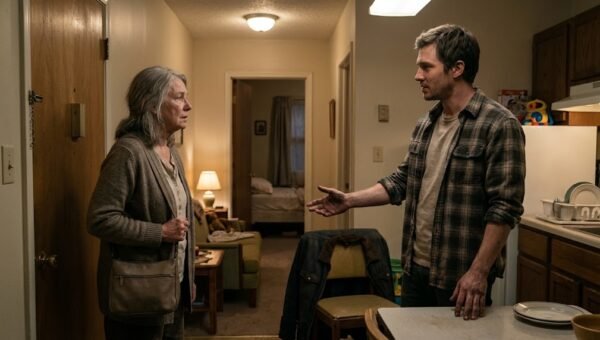
When I got to their house, Leo was standing near the oven with a dish towel over his shoulder. He was ten and trying hard to look like he was doing a grown-up job. He glanced at the basket in my arms, then leaned close.
“Grandma, Dad said you’d know what to do,” he whispered.
There was a pie tin under a clean towel near the oven, and the timer was counting down. I set the rolls on the counter. Before I could ask him what was going on, Claire came in carrying her dessert.
She’d made a salted-caramel pear tart. It was neat and lovely, with the fruit laid out in careful rows.
Claire had been up early and spent four hours on it. I knew that because David had mentioned it on the phone the night before, and because Claire looked tired in the way people do when they’ve been working at something all morning.
“It looks beautiful,” I told her.
“Thank you,” she said. Then she glanced at the towel by the oven. “What’s that?”
I could’ve pointed at Leo. I could’ve lifted the towel and let the whole thing fall on David before I knew what he’d done. Instead, I said I wasn’t sure, and I meant it. I wanted to find out who was at risk of getting hurt before I started talking.
Claire took her tart to the dining room to set it down. Leo stayed planted by the oven. His dish towel was crooked now.
“Dad said you’d fix it,” he said.
I lifted the towel just enough to see the tin. The edge of the crust was sagging in places, and the crimp looked familiar in the way a crooked fence post looks familiar when your son put it there.
David always pressed too hard with his thumb, then tried to even it out with the next one. He’d done the same thing to pie crust when he was a boy.
The apples had gone soft without thickening. The crust underneath looked wet. It was sitting too close to the bottom of the oven, and the cinnamon smelled sharp, almost smoky.
“Did your dad make this?” I asked.
Leo nodded. He had the worried, pinched look kids get when they’ve promised not to tell and then somebody asks them straight.
“He said you’d know how to save it.”
I wasn’t sure I could. I was sure I didn’t want to make Claire walk back into the kitchen and think I’d brought my pie after all, or that I’d set David up to fail. The timer had less than a minute left. I turned it down and checked the temperature through the glass.
David came in before it rang. He had flour on his collar and was carrying a serving spoon he didn’t need. That was when I saw the recipe card sticking out of the cookbook rack. It was a wrinkled copy, flour-dusted, in David’s handwriting. He must’ve copied my mother’s directions and figured he could manage from there.
“You made this,” I said quietly.
His eyes went to the timer. “I thought I could.”
“You’ve got flour on your collar.”
“I know.”
I asked him why he hadn’t said anything. He looked down at the spoon in his hand and said he couldn’t picture Thanksgiving without Mom’s pie. He also knew Claire had asked me not to bring one. He’d tried to keep both of us happy by doing it himself, in secret.
That’s not how it works. I told him so.
“You have to tell her,” I said.
He said he would, but his voice was thin. He looked toward the dining room, then back at the pie. The oven timer rang.
Claire came in with a stack of napkins just as David reached for the handle. She stopped when she saw the pie tin. Then she looked at me.
“I thought we agreed,” she said.
“I did agree,” I told her. “I left my pie at home.”
The timer rang again. David opened the oven, and the smell came out all at once, cinnamon and scorched butter. Leo pulled his towel up to his chest. Claire set the napkins down.
“David,” she said. “What is this?”
He started to answer, then looked at me. I didn’t answer for him.
“I made it,” he said. “I’m sorry. I shouldn’t have done it behind your back.”
Claire’s mouth tightened. She looked at the pie, then at the pear tart visible through the doorway. “So you thought my dessert wasn’t enough?”
“No,” David said. “That’s not what I meant.”
“Then what did you mean?”
He took a breath. His collar was still white with flour. “I missed it. I missed Mom’s pie. I wanted the taste I grew up with. I didn’t think about what it would look like to you.”
Claire kept looking at him. I could see she was hurt, but I could also see she was trying to work out whether he was telling the truth. David had a habit of waiting for the hard part to pass instead of saying what he meant. Today, there was nowhere for him to wait.
I stepped between them, not to rescue him, but to stop this from turning into a contest between two women who hadn’t baked the pie.
“Claire,” I said, “I meant what I said two weeks ago. I didn’t bring mine.”
She nodded once, still looking at the tin.
“I’m sorry,” David said again. “I wanted both things. I handled it badly.”
“You did,” Claire said.
I don’t remember what I said after that word. I remember the oven door was open, and Leo was holding his breath, and I remember the tart sitting in the dining room, perfect rows of pears shining under the kitchen light. Claire had worked four hours on it. That was real. The pie was real too, but it wasn’t a judgment on her.
I told her I could help save it, if she wanted. I also said I wouldn’t pretend it was my work. David could tell her exactly what he’d done, and I’d show him how to fix the crust.
Claire rubbed flour off the counter with the side of her hand. “I don’t want another person telling me this is better,” she said.
“I understand,” I told her. “Your tart is yours. The pie is just a recipe my mother gave me.”
I was surprised by how plain that sounded once I said it. My mother had been dead for years. The recipe wasn’t a prize she’d left me to defend. It was how she fed people. There was a difference, even if I’d forgotten it.
Claire looked at the tart. “I thought everyone expected your pie.”
“Some people probably do,” I said. “But that doesn’t mean you have to compete with it.”
I didn’t say that I’d enjoyed being the person they expected it from. I’d liked hearing the requests. I’d liked how Leo called it “Grandma pie,” as if the name belonged to me now. I had helped make the comparison Claire dreaded, even when I hadn’t meant to.
David turned the oven down and moved the rack. I showed him how to slide a sheet pan beneath the tin, and how to cover the edge before it darkened any more. The crust needed time. The apples needed heat. I told him to stop opening the oven every thirty seconds.
“I’m checking,” he said.
“You’re fussing,” I told him.
That made Leo laugh, just once. David smiled too, but he kept his eyes on the oven. I showed him where the crust had gone wrong. He’d skipped the short first bake that keeps the bottom from getting soggy, and his butter crimp was too thick in one spot. He’d tried to make my pie from a copied card and a memory of watching me bake it. I had to admit, I understood the impulse.
Claire stood beside him and watched. Then she asked if the filling needed more time or if the crust was going to burn. It was a small question, but it was the first time she’d sounded curious instead of cornered.
“We can watch it together,” I said.
She nodded. “All right.”
That was as much of a truce as we got in the kitchen. It was enough for then.
Dinner went on. I carried the rolls to the table, and Claire brought out her pear tart after we’d eaten. David said, in front of everyone, that he’d made the pie without asking Claire and shouldn’t have. He didn’t make a joke of it or blame Leo for keeping watch. I was glad. I hadn’t wanted my grandson learning that a secret was a good way to handle a hard conversation.
Claire didn’t say much at first. Then she told everyone how she’d made the caramel and that the pears had to be sliced thin or they got too soft. My brother-in-law asked her how she arranged them, and she showed him. It was nice to watch her explain something she’d made without having to defend it.
The pie came out a little later. The edge was darker than it should’ve been, and the bottom was softer than my mother would’ve liked. David cut it anyway. I told him it was his pie to serve, and he looked at me as if he hadn’t expected that.
“Mom’s recipe,” he said.
“Your attempt,” I answered.
He gave me a small, grateful look. Claire set both desserts on the sideboard, close enough that nobody had to pick a side. People took slices of each. Leo asked for another bite of the pear tart, then ate half a piece of pie too.
After dinner, Claire and I cleared the plates while David helped Leo wrap leftovers. I told her the recipe had never been hard to get. I’d always been happy to share it. She said she’d thought it was something people compared, because everyone talked about it like it was the thing I did best.
I told her I hadn’t noticed how that sounded. I should have. I asked if she wanted my mother’s old card, not the floury copy David had made. I wanted her to have it if she wanted it, not because she owed me a place for it.
She didn’t answer right away. She washed one last serving spoon and set it in the rack.
“I’d like that,” she said.
I gave it to her after the dishes were done. The card felt soft at the corners from years of being handled. Claire brought over her recipe binder, and we slid the card beside it instead of tucking it away by itself.
Later, the kitchen was quiet except for the dishwasher. Two mismatched dessert plates sat together on the cleaned granite island, each with a fork and a smear of filling. The handwritten card rested safely beside Claire’s recipe binder.