I had my phone halfway up when I noticed Arthur’s name on the empty chair in Row C. The card was taped to the back, right at eye level. I lowered my phone and looked at it longer than I meant to.
The gym smelled like floor wax and the cinnamon rolls the school had put out near the entrance. Maya was with the other graduates, lined up by height in her cap and gown.
Her grandfather was supposed to be in that chair. A week earlier, he’d told me he couldn’t come because Greg was having his summer barbecue.
I kept the brass ticket from the chair. At the time, I didn’t know why I picked it up. I only knew I was tired of looking at Arthur’s name where Arthur should have been.
Two months before graduation, Arthur had promised Maya he’d sit up front and help with her college expenses. He said it at Sunday dinner while he was passing the potatoes. “I’ll be there, kiddo,” he told her. “Front row. And I’ll handle your college fund.”
Maya looked at him and said, “Really?”
“Really,” he said.
I remember how careful she was not to seem too excited. That’s how she is. She gets her hopes up quietly, like she thinks she can keep them from getting hurt if she doesn’t make a fuss.
The family had been uneven for years. Greg’s kids got Arthur at school concerts, ball games, birthday dinners, all of it. If Greg called, Arthur found a way to go. If Maya had something, there was always a reason the timing was bad.
I told myself Arthur was getting older. I told Maya he loved her even if he wasn’t good at showing it. I said those things because I wanted her to have a grandfather, and because I didn’t want another fight with my father. That part was on me.
About a week before graduation, Arthur called to say he wasn’t coming. I was standing by the sink, rinsing a plate, and I remember the water hitting the metal strainer because I stopped moving.
“Greg’s doing the barbecue that day,” Arthur said. “It’s the first one of the summer.”
“Dad, Maya graduates that afternoon.”
“I know when it is.”
“You told her you’d be there.”
He sighed, like I’d asked him to drive across the country. “You’re too sensitive about these things.”
I wiped my hand on a dish towel. “It’s her graduation.”
“I’ll see her another time.”
There it was. Another time. He’d used those words for birthdays and school awards, too.
I almost said something about every milestone he’d missed, but I could hear the argument starting before either of us had raised our voices.
So I said, “Fine.”
I hated myself for it as soon as I hung up. But I didn’t call him back. I didn’t want Maya to see me fighting for a seat he’d already decided not to fill.
She took it better than I did, which wasn’t the same as being fine. When I told her, she just nodded and went back to checking the clasp on her graduation necklace.
“He said he’d come,” she said.
“I know.”
“It’s okay, Mom.”
It wasn’t. I let her say it anyway.
On graduation day, I saw the Row C card and understood that Maya had arranged the seat herself. She’d asked the school for a reserved place for Arthur weeks earlier, back when she still believed his promise.
The card had his name printed neatly across it. Maya hadn’t told me she’d done it.
I sat with my hands folded around the program. The paper had a rough edge that kept catching my thumb. I could have taken a picture of the empty chair, but I felt petty. Then I thought about how often I’d swallowed what I felt so Arthur wouldn’t have to hear it.
I took the picture.
Maya’s name came up, and everybody clapped. I stood with the rest of the parents. She walked across the stage, shook the principal’s hand, and accepted her diploma. When she turned toward the audience, her eyes went to Row C.
She saw the chair.
She gave one small nod, then lifted her chin and kept going. I knew that nod. It was the one she used when she was telling herself not to cry in public.
I clapped until my palms stung. I wasn’t proud of myself for noticing the seat during her graduation. I wanted to be looking only at Maya. But I had spent so many years making Arthur’s absence easier to explain that, for once, I couldn’t pretend I hadn’t seen it.
After the ceremony, Principal Alvarez asked me and Maya to stay behind. The crowd was filing out, and someone had left a paper cup of water on the bleacher steps. Maya was holding her diploma folder against her gown.
“Is something wrong?” I asked.
“No,” Principal Alvarez said. “I have something important to give you.”
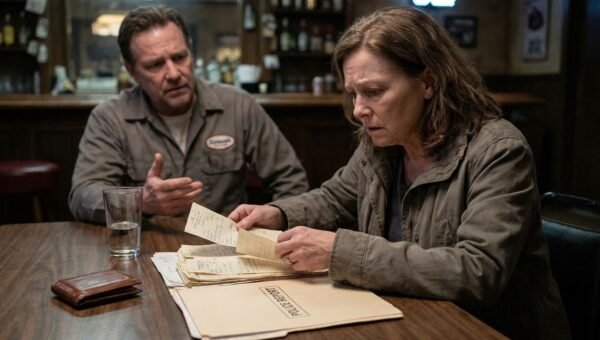
We followed her to the administrative office. The hallway was cooler than the gym, and the noise faded once the door shut. She set a thick folder on her desk and asked Maya to sit down.
“This is about a scholarship,” she said. “A fifteen-thousand-dollar endowment through the regional education foundation.”
Maya looked at me. I looked back at Principal Alvarez.
“I thought it was a community merit scholarship,” I said.
“It is,” she said. “But the donor’s name was kept private until Maya’s award was finalized.”
She opened the folder and slid the first page toward me. I read the amount first. Then the line about the award covering Maya’s freshman tuition. I had to read that twice.
Maya leaned closer. “Who gave it?”
Principal Alvarez turned to the next page. “Your grandmother.”
For a second, I couldn’t make my eyes move from the signature at the bottom. My mother’s name was written in the same slanted hand I remembered from birthday cards and grocery lists.
My mother had been gone four years. She’d set up the gift before she died and placed it through the school foundation. The papers said the money was to be held for Maya’s education and could not be redirected by family members.
There was a handwritten note attached to the trust paperwork. Principal Alvarez let me read it by myself first. Then I passed it to Maya.
My mother wrote that she wanted Maya’s education protected from family pressure and unequal promises. She didn’t name Arthur or Greg. She didn’t need to.
I had one hand over my mouth. My mother had known. I don’t mean she’d guessed that Arthur might miss a graduation. She’d watched him give Greg’s family the time and help he told me he didn’t have for us. She’d seen me explain it away.
“I didn’t know she did this,” I said.
“She wanted the award handled fairly,” Principal Alvarez said. “We’ve confirmed all the documents.”
Maya read the note again, slowly. “Grandma did this for me?”
“Yes,” I said. My voice came out rough. “She did.”
The folder had one last page for me to sign, confirming Maya’s acceptance. I signed it without calling Arthur or asking Greg what he thought. My hand shook a little, which annoyed me, but the signature was clear.
Principal Alvarez made copies for us. When she handed over the original, I noticed the corner of the old brass ticket sticking out of my purse. I’d brought the empty seat’s name card with me without thinking. I slid it back in and thanked her.
Maya and I drove home together. We stopped for food because neither of us had eaten since breakfast. I don’t remember what I ordered. I remember Maya keeping the scholarship folder on her lap, both hands over it like it might blow away.
At home, she hung her gown over a chair. The zipper caught on the sleeve, and I fixed it for her. Then she asked me about the seat.
“I asked the school for it,” she said. “Grandpa told me he’d sit up front.”
“You didn’t have to tell me.”
“I know.”
“Were you still hoping he’d come?”
Maya rubbed the corner of her diploma folder with her thumb. “A little.”
I sat down across from her. I wanted to say he should have been there. I wanted to say she deserved better. Those things were true, but she already knew.
“I didn’t want you to feel bad,” she said. “You were already upset.”
That hit harder than the empty chair. My daughter had spent the day managing my feelings because I’d spent years trying to manage Arthur’s.
“I’m sorry,” I said.
She shook her head. “You didn’t make him stay home.”
“No. But I kept telling you not to take it personally.”
Maya didn’t argue. She just leaned over and rested her hand on mine. I had a lot more to say, but I didn’t make her sit through all of it.
Arthur called that night while I was putting away the scholarship papers. I could hear Greg’s family in the background and, over them, the clank of dishes and somebody laughing. Arthur sounded like he’d been outside all afternoon.
“You didn’t bring anything over,” he said.
I thought he meant food for the barbecue. “I didn’t know you wanted me to.”
“Greg had enough people to feed. You could’ve stopped by after the cap-and-gown fuss.”
I looked at the Row C ticket on the table. “Maya graduated today.”
“I know. I said I’d see her another time.”
“You also promised her you’d be in the front row.”
“I had plans with Greg.”
“You’ve always got plans with Greg.”
He let out a short breath. “You’re too sensitive about these things.”
Usually, that was where I backed down. I’d tell him I was tired or say we could talk later. I’d get off the phone and then explain him to Maya.
Not that night.
“No,” I said. “I’ve been making excuses for you.”
“What’s that supposed to mean?”
“It means you missed her graduation after telling her you’d be there.”
“I can’t be in two places at once.”
“You didn’t even try.”
He got quiet, then said, “I told her I’d help with college.”
I picked up the scholarship folder. “You told her you’d handle her college fund. What happened to that money?”
“That’s none of your business.”
“It became my business when you promised it to Maya.”
He started talking over me. I heard Greg’s voice in the background, then a door shut on their end.
“I used the money for the pontoon boat and the outdoor kitchen,” Arthur said. “Greg needed help getting the deck set up. It’s for the whole family.”
There it was. The money he’d said was for Maya had gone to make Greg’s summer nicer. I didn’t ask how much. I didn’t ask whether Arthur meant to pay it back. I’d spent enough years treating his promises like something I could hold him to if I found the right words.
“Mom left Maya a fifteen-thousand-dollar scholarship,” I said. “The foundation has the papers. It’s protected for her education.”
“She did what?”
“She made sure Maya wouldn’t have to depend on you.”
He made a little noise, like he was about to laugh but decided not to. “Your mother had no right to go behind my back.”
“She didn’t go behind your back. She made her own choice with her own money.”
“You’re turning this into some big thing.”
“It is a big thing.”
I put the letter and the brass ticket side by side on the table. “Maya saved you a seat in Row C because she believed you’d show up.”
“I would’ve gone if Greg hadn’t, ”
“No. You chose not to.”
He started in on how I was making him the bad guy and how family shouldn’t keep score. I let him finish. Then I said, “We’re done begging you to show up.”
“Elena, don’t start.”
“I’m not starting anything. I’m telling you what’s finished. Maya and I won’t keep making room for you to disappoint her.”
He said I was being cruel. I said, “You can think that.”
I told him I wasn’t bringing the barbecue leftovers home, wasn’t going to argue about my mother’s scholarship, and wasn’t going to explain his choices to Maya anymore. If he wanted a relationship with her, it would have to be one where she didn’t have to compete with Greg’s kids or pretend his broken promises didn’t hurt.
He said, “You can’t keep her from me.”
“I’m not keeping her from you. I’m not asking her to wait for you.”
Then I ended the call. My hand hovered over the phone for a moment, because hanging up on Arthur felt like doing something I wasn’t allowed to do. I unplugged it anyway.
The next morning, the college foundation confirmed that Maya’s freshman tuition was covered by the award. The scholarship papers went into a folder by the front door. I didn’t call Arthur to tell him. I didn’t call Greg, either.
Maya’s mortarboard ended up on the entryway console beside a framed photo of my mother. I tucked the brass Row C ticket under the frame. It wasn’t a memorial to a fight. It was just proof of the seat Maya had saved, and of the day I stopped asking my father to fill it.