The carbon copy in my truck was thin enough to tear if I got careless with it. I’d carried it around for six years, folded inside an old service manual, telling myself I kept it because it might come in handy. That afternoon, at a coffee shop table near a law office, I was still pretending it was just paper.
I’d finished fixing a pipe under the law office’s break room sink.
My hands smelled like old copper and the orange hand soap they kept by the utility closet. I had forty minutes before school pickup, so I got coffee and sat down. Then a woman in a blazer stopped at my table.
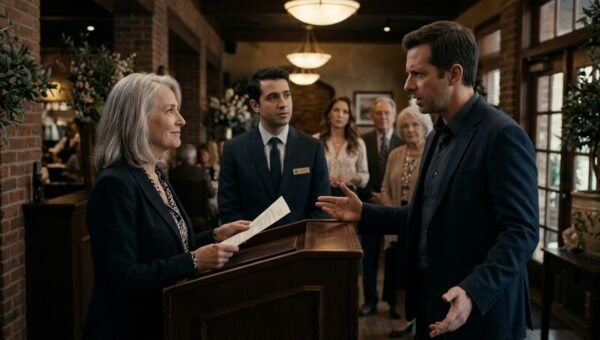
“This table is reserved.”
I started to stand. I’m not a man who likes a scene. But she had a tight grip on a silk scarf, and her voice had that pinched sound people get when they’ve repeated the same argument to themselves for years.
“Do you have any idea what this afternoon cost me?”
She said it loud enough that the people near the window stopped talking. I looked at her and recognized her face, though I hadn’t seen it in years. Julianne Vance. Her brother had been the architect blamed for the fire that destroyed the old office block downtown.
I didn’t know what else to say. “Valve B-17. My report was dated October 14.”
Her hand hit my cheek before I could add anything. The cup rattled against its saucer. Nobody said a word.
I touched my face. She looked at me as if she’d meant to hit someone else and only just realized I was there. Then she turned and went out fast. Her scarf slipped off her arm and landed beside the chair.
I could’ve let her go. That was my old habit. Keep my head down, get Maya from school, make dinner, don’t bring six-year-old trouble into the house. But the letters on the scarf tag were the name of her law firm, and I knew I couldn’t use that as an excuse to do nothing again.
I grew up fixing whatever leaked. Pipes, faucets, the bad connections behind walls. My father used to say water always found the weak spot. I’ve used that line more times than I should. It’s a plain saying, but it fits this.
Six years ago, I was doing small inspection jobs for contractors and property managers. The building that burned was a landmark office block, the kind people used as a shortcut when they walked downtown. Julianne’s brother, Peter Vance, had designed the renovation. He was known for doing careful work, but the official report said his plans left the building unsafe.
I wasn’t part of the fire department. I was called in after the fire to check damaged basement lines and write up what I saw. The sprinkler system had failed. That much was obvious. What wasn’t obvious was why the shutoff valves had been changed.
The basement smelled like wet ash and melted wire. I remember kneeling near the main line and seeing fresh tool marks on a valve that should’ve been untouched. I wrote down the serial number. I wrote that the valve had been shut from the control side. I also wrote the date and time I’d checked it.
The property management company had paid me for the inspection. A man there told me the building was being cleared out, the city had already decided what happened, and I should stick to pipes. He wasn’t threatening me exactly. He just named Maya’s daycare and said it was hard to keep steady work when a client got a bad feeling about a contractor.
Maya was three then. She had been sick on and off, and I’d just gotten her back on a routine. I was scared of losing the work that kept her fed. So I let my report go missing.
I had made a carbon copy before I turned in the original. I kept it. I didn’t call Julianne. I didn’t go to the city. I told myself I’d wait until someone asked. Nobody did.
By the time Maya was settled in the car after school that afternoon, I could feel the slap when I touched my cheek. She noticed.
“Did somebody hurt you, Dad?”
“I walked into a cabinet,” I said.
I hated how easy that lie came out. She accepted it because she was seven and had a spelling test the next day. We stopped for milk on the way home. I put the carton in the fridge, then stood there with the door open longer than I needed to.
The next morning, I called the number on Julianne’s firm’s website. I said I had information about the Vance building fire. The receptionist put me on hold twice. When Julianne finally got on, she didn’t sound surprised.
“You want money?”
“No,” I said. “I want to show you the log.”
There was a pause. Then she gave me an address and a time. I almost called back to cancel. Instead, I took the carbon copy out of the manual and put it in a plastic folder so it wouldn’t catch on anything.
Her office had a lobby with a security desk and a bowl of wrapped mints. I didn’t take one. Julianne met me herself and brought me to a conference room. She had changed out of the blazer, but the scarf was back around her neck.
She didn’t apologize for the slap. I didn’t ask her to. She set a paper cup of water in front of me and waited.
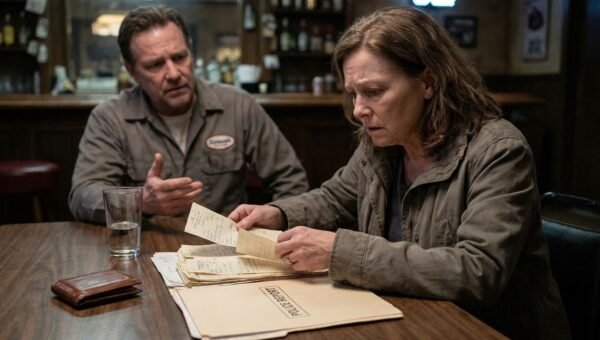
I laid down the copy. The paper was yellow at the fold. My handwriting was ugly, but the number was clear: B-17. The inspection date was clear too.
“That’s your writing?” she asked.
“Yes.”
“You signed off on the basement lines.”
“I signed the work order. I didn’t sign off on that valve.”
She read the page twice. Then she said her brother had spent the last six years trying to clear his name. He’d lost his license and most of the work he’d built his career around. He died before the inquiry was reopened. Julianne didn’t say how. I didn’t ask.
“I thought you took their money,” she said. “Your name was on the inspection log.”
“I know.”
“Why didn’t you come forward?”
I could’ve told her about Maya being sick. About the daycare. About being scared. All of it was true, and none of it made six years disappear.
“I was afraid I’d lose the work,” I said. “I let your brother take the blame.”
She looked down at the notes. Her hand stayed on the page.
The copy wasn’t enough by itself. It proved I’d written down the valve number, but it didn’t prove who had changed anything or when. So Julianne asked me to help find the archived records, and I said yes before I could talk myself out of it.
For three days, we went through old inspection files and city records. The city had digitized some of the water-pressure charts, but a box of older printouts was still in storage. Julianne had to make calls through her firm. I had to explain why my name was on one log but not the report in the archive.
It was ugly work. Pages were misfiled. Some records were scanned crooked. One clerk kept sending us to the wrong department. But the pressure charts showed a sharp drop in the sprinkler line at 9:42 on the night of the fire, followed by a change that didn’t match a normal failure.
Julianne laid the chart beside my copy and ran her finger down the dates.
“This says the valve was closed remotely,” she said.
“That’s what I wrote.”
She looked at me, then back at the chart. “Why did they keep the original?”
“They didn’t,” I said. “They kept the version they wanted.”
She didn’t answer. She called the city archive again.
The next lead came from a backup file tied to the property management company. It had been saved on an old digital storage drive that turned up with archived insurance records. Julianne got the company’s former records clerk to confirm the files had been kept as part of a routine backup, not made for us. That mattered. So did the audio file tucked among the records.
We listened in her office. The recording was rough and short. A senior property manager was talking to someone from the company about the inspection logs. He said the logs had been changed. He said they needed the fire to look like a design failure before the pending demolition order went through. The insurance payout would cover the loss.
Then he said my original report had to stay out of the city file.
Julianne stopped the recording. She didn’t cry. She pressed both hands against the desk and leaned forward, like she was trying to keep herself from coming apart.
“He said your report,” she said.
“Yeah.”
“My brother didn’t do this.”
“No.”
She shut her eyes. “I slapped you.”
“I know.”
That was all I could give her. I didn’t tell her it was fine, because it wasn’t. I also didn’t want to make her pain about my cheek.
The company didn’t agree to meet us at first. Julianne’s firm sent a notice that the records would be presented at the reopened inquiry. Once the company knew there was a recording, they asked for a private meeting with senior people who could speak for them. I had no reason to trust that meeting, but Julianne said she’d stand beside me, and I believed her.
At the corporate office, I put my old field notes on the table. Julianne played the recording. One of the executives reached toward the tablet, but she slid it out of his reach.
The room got quiet.
The company’s lawyer said the recording didn’t prove who ordered the valve closure. Julianne put down the pressure charts. I pointed to the serial number and the date on my copy. The lawyer stopped talking for a minute.
I had spent six years wishing somebody else would make the first move. That day, I finally had to be the one sitting there while they looked at me.
The zoning inquiry reopened. The company settled out of court to avoid a criminal case, and the city issued a public retraction. Peter Vance’s work record was cleared after his death. Julianne told me the settlement included restitution for his estate. It didn’t give him those six years back, but it stopped the official record from calling him responsible.
Julianne never asked me to forgive her for the slap. I never asked her to forgive me for staying quiet. We both knew what the other had done, and we kept working anyway.
A few weeks later, I sat at the same coffee shop table. This time it wasn’t reserved. Julianne had coffee across from me, and Maya was outside on the pavement, hopping over cracks while she waited for me to finish.
Julianne watched her through the window. I could still see the fold in the old carbon copy in my mind. For six years I’d carried it around, but the heavy part wasn’t the paper.
Maya skipped past the window again. Julianne lifted her cup. I did too. Neither of us said anything about the table.