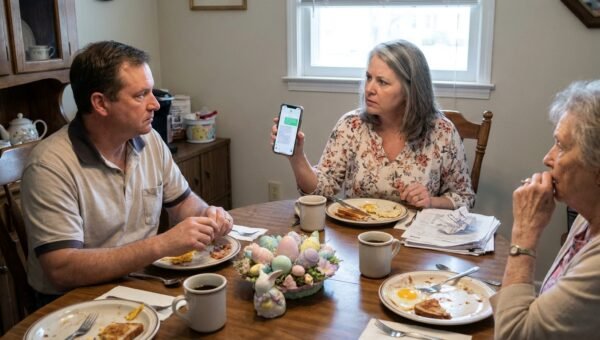
The coffee was still dripping when Julian set the divorce papers beside my mug. His mother was taping up one of my boxes, and Giselle was in my silk robe, leaning against my counter like she’d lived there for years.
The morning before, at 9:02, I’d approved a $150,000 transaction. Julian thought I’d paid off the debt that had been dragging down his business. He thought he was free to leave me.
He wasn’t.
“Sign today,” he said. “You’re no use to me anymore.”
Then he nodded at Giselle. “She’s moving in.”
I looked at the robe first. Then I looked at him. “Take that off,” I told her. “Julian, check your bank account.”
I’d been awake since four. I’d had plenty of time to decide what to say, and that was all I had.
Evelyn stopped taping. Arthur kept folding my sweaters into a box, though he was standing in my house. Julian gave me a little smile, the kind he used when he thought I was being difficult.
He picked up his phone.
To explain the $150,000, I have to go back three weeks. That was when I found out Julian was sleeping with Giselle and using household money to keep his company afloat.
I wasn’t looking for an affair. I was looking at our joint account because a property tax payment had bounced.
I found three transfers that didn’t match anything in our house. Julian had called them “vendor costs” when I asked. The amounts were $2,800, $4,100, and $6,300.
I checked more statements. I found the same thing, over and over, with different descriptions. He’d been moving money out while telling me his business was almost through a rough patch.
I’m not proud of what I did next. I copied his account records onto my laptop and read through his email while he was in the shower. I wanted to catch him in a lie so cleanly that he couldn’t talk his way out of it.
Instead, I found pictures of Giselle at a hotel and a draft agreement promising her half of Julian’s company once he was “debt-free.” I read it twice. Then I read the emails about his loan.
The commercial lender had given Julian’s boutique logistics firm a $150,000 line of credit.
He’d signed a personal guarantee and pledged the company’s equipment, trucks, and operating accounts as collateral. The loan had fallen into default. The lender was selling the note.
I took the papers to a corporate attorney named Denise and a forensic accountant she recommended. Denise did not tell me I was a genius. She told me to slow down, keep records, and stop touching Julian’s accounts.
“What did he say the money was for?” she asked.
“He wants me to pay off his debt.”
“And what do you want?”
I said I wanted my money back. I also wanted Julian to stop making choices with my savings as if they belonged to him. Denise pointed out that those were not quite the same thing.
I knew that. Still, I went ahead.
The lender was willing to sell the defaulted note and personal guarantee to a holding company. Denise set up Apex Holding Corp, which I owned by myself, and handled the paperwork.
I used money from my private savings, not our joint account. The sale was reviewed and documented. It wasn’t a trick, though I knew Julian would call it one.
I could have told him then. I could have asked him to explain the account transfers and the contract with Giselle. Instead, I kept quiet. I told myself I was protecting my position. If I’m honest, I also wanted him to feel the first surprise for once.
The lender’s notice said the account was in default and the full balance could be demanded. The signed agreement included an asset pledge and a confession-of-judgment clause. Denise explained what we could file and what we couldn’t just do because I was angry.
“This is a legal process,” she said. “Not a punishment.”
“I understand.”
I did understand, mostly. I still wanted the papers in my own name.
At 9:02 the next morning, Julian stood by the kitchen island while I approved the $150,000 wire. He had the account number open on his laptop. He was watching the screen like a man waiting for the last bill to disappear.
“Once that clears, we’re done,” he said.
“Done with the debt?” I asked.
“Done with the lender. Done with all of it.”
He didn’t ask where I was getting the money. He knew it was my savings. That had always been enough for him.
When the confirmation came through, Julian leaned over and kissed the top of my head. It was the first time he’d touched me kindly in weeks.
“You saved me,” he said.
I didn’t answer. I watched him close the laptop.
The money paid for the assignment of the note and the guarantee to my holding company. It did not make the debt disappear. Once the transfer was complete, Apex owned the debt and had the right to use the remedies in the loan documents. Denise filed the required notice and the demand for payment.
At the time, Julian thought the lender had been paid in full. I let him think that. That part is hard to defend, even now.
I slept badly. Then, the next morning, Julian brought his parents and Giselle into my kitchen.
I don’t know why I remember the coffee maker clicking off right as he slid the papers toward me. Maybe because it was the most ordinary sound in that room.
“Sign it,” he said. “We can keep this easy.”
Evelyn was already packing my clothes. Arthur had one of my boxes open on the floor. Giselle was sipping coffee in my robe, the one I’d bought after my sister’s wedding because I wanted something soft for the hotel the next morning. That tiny detail stayed with me. Not the wedding. The robe.
“You brought her into my house?” I asked.
Julian shrugged. “It’s going to be our house now.”
“No,” I said. “It isn’t.”
He smiled like I’d made a joke. “The papers are straightforward.”
That was when I told him to check his account.
He opened the banking app. His thumb moved once. Then it stopped.
“What is this?” he said.
I stayed on the other side of the counter. “Read it.”
The phone showed an administrative freeze and a commercial levy tied to the note his company had defaulted on. The notice came from Apex Holding Corp.
Evelyn let go of the box. It hit the floor, and one of my shoes slid out.
“What did you do?” Julian asked.
“I bought your note.”
He looked at me, then back at the screen. “You paid the lender.”
“I paid the lender for the assignment. I own the note now.”
“That’s my company’s money.”
“It’s your company’s debt.”
His mother was staring at the phone too. Arthur stopped folding my sweaters. I don’t say that to make them sound wicked. They had spent years believing Julian’s version of every problem because it was easier than asking him questions.
Giselle stepped closer to Julian. “You said it was paid.”
“I thought it was,” he said.
That answer did not help him.
The notice named Apex as the secured creditor. It demanded the balance under the agreement and listed the collateral: equipment, fleet, and business accounts. The freeze wasn’t a magic button I pushed in anger. The bank had acted on filed documents after the default and the demand. Denise had also filed the personal judgment paperwork allowed under the agreement.
Julian read the name at the bottom again. My name was there as the sole owner of Apex.
“You can’t do this to me,” he said.
“You signed it.”
“I signed with the lender.”
“Yes. And the lender assigned it.”
He shook his head like repeating no might change the paperwork. “You used my own loan against me.”
“I used the agreement you signed.”
That was the clean answer. The less clean answer was that I knew exactly how badly he wanted to feel free of me, and I let him celebrate a day early.
Giselle had stopped looking at Julian’s face. “You told me I was getting fifty percent.”
“I was,” he said. “Once the debt was clear.”
“It isn’t clear,” I said.
She looked at me then. “You knew about the contract?”
“I found it.”
Julian reached for the phone. “Give me that.”
“I’m not holding your phone.”
He stared at me, angry now, but it was an anger with nowhere useful to go. The company couldn’t use its operating funds while the levy was in place. The collateral was tied up in the foreclosure process. And Giselle’s promised share was in a company that wasn’t debt-free, profitable, or even able to pay its bills.
“You said I was joining a clean company,” Giselle told him.
“I was going to make it clean.”
“With her money?” she said.
He didn’t answer.
There it was. Not love, not some grand plan. Julian had promised Giselle a stake in the business once he used my savings to get out from under the debt. She had believed the part that benefited her. I had believed the parts that benefited me, too. For a long time, I’d told myself Julian was just under pressure and I was the steady one who could help him through it.
I wasn’t stupid. I was invested. There’s a difference, though it can look the same from the outside.
Giselle untied the robe. Under it, she was dressed. She held it out by the belt, eyes fixed on the floor.
“Here,” she said.
I took it. I didn’t need to say anything else.
Julian looked toward his parents. “Tell her to stop.”
Evelyn’s mouth tightened. “You said the debt was paid.”
“I thought it was.”
“You always think it’s handled,” Arthur said. His voice was low. “And then somebody else pays.”
Evelyn had dropped the box because she finally understood what she’d been helping Julian do. She had packed my things assuming her son had secured the company and arranged his next life. Instead, she was standing in a kitchen owned by me, with his accounts frozen and a foreclosure notice on my counter.
I went to the small desk in the hall and brought back the house deed. I’d bought the house before Julian and I married. The deed and the marriage records were clear. The divorce could decide what belonged to the marriage, but the house wasn’t part of that.
“Read the owner’s name,” I said.
Julian glanced down. He knew it already. He’d signed the mortgage waiver years before and told me I was being overly careful.
Evelyn looked at him. “You said this was yours.”
“I said it was our home.”
“It is my home,” I said. “You can have your lawyer call mine about the divorce. Nobody is moving in today.”
I’d asked Denise what to do if Julian refused to leave. She’d told me to stay calm and call for help if I needed it. I had the number saved. I didn’t use it. Julian’s parents weren’t going to force their way into anything, and Giselle was already gathering her purse.
“You said you had money,” she told him.
“I do.”
“Not right now.”
“I’ll fix it.”
She gave a short laugh. “You keep saying that.”
Then she walked out. Not with a dramatic speech. She just left, carrying her purse, and didn’t turn back.
Evelyn and Arthur put my clothes back in the closet. They didn’t apologize. I didn’t ask them to. Arthur carried the empty box outside, and Julian followed him.
At the door, he turned around. “You planned this.”
“I planned to protect what was mine.”
“You ruined my company.”
“No. I bought the debt you couldn’t pay.”
He looked as if he wanted me to soften that. I nearly did. Lord knows I’d spent years softening things for him. But I had spent enough time making his choices sound better than they were.
The divorce went forward. Julian had no claim to the house, and his lawyers had little room to argue about the note because the assignment and default records were in order. The business foreclosure is still a legal process, not a switch I flipped that morning. I’m pursuing the collateral and the balance through the proper channels.
I didn’t get all my money back right away. I didn’t get an apology. The company’s equipment and accounts are part of a longer recovery, and the marriage is over.
That’s the practical part.
The part I don’t say out loud much is that I still feel bad for the woman I was when Julian kissed my head after the wire cleared. She heard “You saved me” and wanted it to mean he loved her. I know better now, but I can’t go back and tell her.
After his parents’ sedan pulled away, I shut the oak front door. I put my robe on, poured fresh coffee, and set the divorce papers beside the foreclosure filing.
Then I sat down in my own kitchen and drank it while it was still hot.