I was pouring coffee into the mug I’d brought from home when James Fuller said, “Because you’re my daughter.”
The coffee ran over the rim. I put the mug down too hard and got some on the counter.
For eight seconds before that, he hadn’t said a thing. I counted because I was holding my phone to my ear and watching the drip from the mug spread across the laminate.
Then he said my mother’s name, and the amount he’d sent every month, and I heard the answer to a question I hadn’t known how to ask.
I need to go back to the drawer.
I was at Mom’s house sorting the kitchen after her funeral. The mug was mine. I’d brought it because I thought I’d be there all afternoon, and I was. I had a stack of donation boxes by the back door and a list on a grocery receipt. Keep, donate, trash. I’d done the same thing with her coats and towels, like the right label could make it feel manageable.
The locked drawer was in her bedroom desk. I’d already tried two keys from the kitchen junk drawer. The third one, attached to a bent brass ring, turned.
Inside were a few old papers, two photos, and a yearbook with a dark blue cover. 1974 was printed on the front.
I sat on the floor because my knees don’t love small desk chairs, and started flipping through it.
Mom was seventeen in the picture. Her hair was feathered out at the sides, and she had the same little crease between her eyebrows she got when she was trying not to laugh. I knew the yearbook photo version of her. I didn’t know that girl.
On the back page, a boy had written a note in blue ink.
“To Margaret. I will find you again. I promise. Love, James.”
My mother never mentioned a James.
My father’s name was Robert. He’d died years earlier, and for most of my life it didn’t occur to me to make a distinction between “father” and “the man who raised me.” Robert was the one who taught me to ride a bike, kept a flashlight by the basement stairs, and took the middle piece of pie because he said it was “for quality control.” That was Dad. That was the whole answer.
But the yearbook had a James Fuller under the photo marked CLASS PRESIDENT. Beside his picture, somebody had typed “Most Likely to Succeed.”
I took a picture of the inscription with my phone. Then I put the book in my bag, because I didn’t want to leave it in that house. I told myself I was only curious. I was also angry with Mom, though I couldn’t have said exactly what I thought she’d done yet.
I looked up James Fuller that night. A retired judge in Savannah. Seventy-one years old. The first result had an old newspaper photo, and he looked older than the boy in the yearbook but had the same square chin.
I stared at the number on the screen for a while. I nearly called the next day, then didn’t. I told myself it was rude to call a stranger and ask about a note he’d written at seventeen. I told myself a lot of things that sounded sensible.
A week later, after I’d read the inscription so many times I could see it without opening the book, I called.
He answered on the third ring. I said my name and that I was Margaret’s daughter. I heard nothing back. Not a hello. Not a question.
Eight seconds.
Then he said, “Margaret’s daughter.”
I asked how he knew who I was.
“Six hundred dollars a month,” he said. “For 38 years. To a PO box in your grandmother’s name. I never missed a payment.”
He stopped there, and that was when I spilled the coffee.
“Why?” I said.
He didn’t answer right away. His voice sounded old, but steady. I could hear a clock ticking on his end. Then came the line I’d been trying to prepare myself for, even though there was no way to prepare for it.
“Because you’re my daughter.”
I hung up.
Not dramatically. I just put the phone down on the counter and stood there, looking at the coffee. I wiped it up with a paper towel, then rinsed the mug. I did both because I didn’t know what else to do with my hands.
After a few minutes, I called my husband and said I’d found something in Mom’s desk. I didn’t say what. I wasn’t ready to hear myself say it out loud again.
That night I called James back. He didn’t sound surprised.
“I’m sorry I told you like that,” he said.
“Did my mother know you were sending it?”
“Yes.”
“Did Robert?”
A pause. “I don’t know what Margaret told him.”
It was a careful answer. I hated it. I also understood why he gave it.
James said he’d seen me once, when I was a baby, from a distance. He said Margaret had asked him not to come to the house or call. She was married to Robert, and she didn’t want to break the life they’d built. James said he thought he was doing the right thing by staying away.
I asked him if he had proof. He said he’d kept the bank records and letters, but he’d never expected me to ask.
I said I’d call again. Then I called the bank.
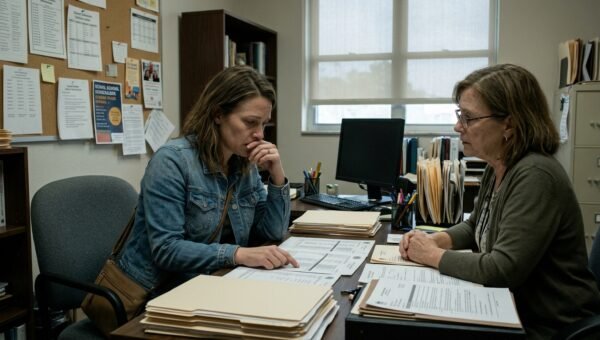
The next two weeks were a mess of boxes and old statements. Mom had kept records the way she kept everything: inside other things. A bill folded into a recipe book. A receipt tucked behind the warranty for a toaster nobody owned anymore. I went back to her house and searched the desk, then her closet, then the boxes I’d already put in my car.
I found the postal receipts among my grandmother’s papers. They were in a small envelope marked “Box,” written in my grandmother’s tight handwriting. There were stacks of them. Some were faded enough that I had to tilt them toward the window. The address was a PO box under my grandmother’s name.
Then I found bank statements with deposits listed month after month. Six hundred dollars. Every month. The earliest one I could confirm was from the year I was born. The latest was 38 years later.
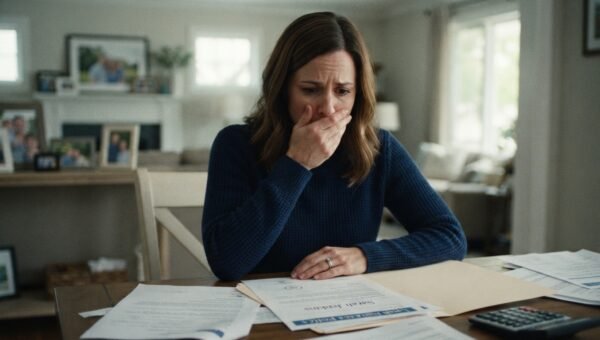
I added them up, even though I didn’t need to. I wanted the total to be something I could point to. The deposits came to $273,600.
I sat on the bedroom floor again. The receipts were spread across my lap, and one of them had a crease through the number six. I remember that part. I don’t know why. I mean, I remember it because I’d just been told my whole life had another person standing outside it, and there I was worrying about a crease.
I was mad at Mom. I was mad at James. I was mad at myself for being mad at either of them when Robert had never made me feel like anything was missing. Then I felt guilty for thinking about Robert at all, as if accepting one truth meant I had to take something away from him.
I’d spent years calling Robert Dad without thinking. I didn’t want a new fact to erase old ones. I didn’t want to look at baby pictures and start asking whether the man holding me loved me “enough” or whether his love was somehow borrowed. That was unfair to Robert, and I knew it. But grief doesn’t always take turns in a neat line. My mother had just died, and now I was looking at a stack of paper that seemed to say she’d kept a whole other life in that desk.
James called the next evening. I let it ring twice before picking up.
“I can send you everything,” he said.
“I don’t want you to buy your way into my life.”
“I know.”
“Then why the money?”
“Because I could do that much.”
He said he’d found out about the pregnancy after Mom married Robert. He didn’t say how. He said he’d been angry, then ashamed of being angry. He asked Mom’s mother to take the money, and she agreed. He had planned to make it temporary, he said. Then one year became several, and he kept going.
I wanted to ask why he hadn’t come to see me. I did ask.
“I thought Margaret had a right to decide,” he said. “And I thought you had a right to the home you had.”
That wasn’t a bad answer. It wasn’t enough, either.
He asked if I’d come to Savannah. I told him I didn’t know. He said he understood, then added that he’d be there if I changed my mind. He didn’t say “daughter” again.
I found one more envelope before I left Mom’s house. It had no note inside, just a few letters in James’s handwriting. He’d written to Mom over the years. Some were short. One was only a card with “I hope she’s doing well” in the middle. There were no replies.
I couldn’t tell whether Mom had answered and thrown them away, or whether she’d never answered at all. That bothered me more than the money. I’d wanted a clean explanation. I wanted to know whether she’d been scared, or stubborn, or trying to protect Robert, or me, or herself. The papers couldn’t tell me.
I booked a flight to Savannah two weeks later.
The day I went, I almost changed my mind at the airport. I kept checking the address James had texted me, though I already knew it. On the plane I read his short letters again, then put them away because the person in the next seat had fallen asleep against the window and I felt strange being watched while I tried to understand my life.
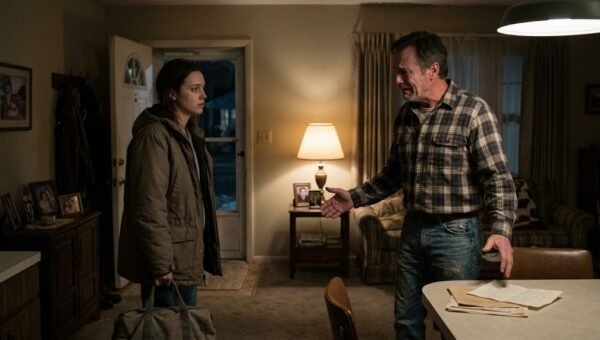
James was waiting outside his house when I arrived. He had on a light blue shirt and held his hands together like he wasn’t sure whether a handshake was right. I stood at the bottom of the porch steps with my bag still on my shoulder.
“I’m glad you came,” he said.
“I’m still not sure why I did.”
“That’s fair.”
He didn’t reach for me. I appreciated that. We went inside and sat across from each other at a small table. He had photographs in a folder and a glass of water he hadn’t touched.
The first picture was Mom and James together at a school dance. They looked so young that I almost laughed. Mom had her head tipped toward him. James was looking at her, not the camera.
“I loved her,” he said.
I looked at the photo again. “Did she love you?”
“Yes.”
He didn’t add anything. He didn’t need to. The picture did enough.
He told me they had planned to get married. His family thought he should go to college and keep his options open. Mom’s family didn’t think a teenage marriage was a good idea. Then she got pregnant, and the adults around them made choices as if the two of them were too young to have any.
James said he had been ready to marry her. He said Mom didn’t want to leave town with him and start a life built on a fight with both their families. By the time he found out she’d married Robert, she had already made her decision.
“Was she happy?” I asked.
“She told me she was.”
I studied his face. “And you believed her?”
“I wanted to.”
It was the first answer that felt less like a prepared one. I believed him then. Not all the way, maybe. But enough.
He showed me letters he’d written and never sent. I recognized Mom’s old address on some of them. He’d kept them tied with a string, though the paper had gone soft at the folds. There were also bank records, neatly sorted by year.
“You really never missed one?” I said.
“Not one.”
The statement was so plain that I didn’t know what to do with it. I thought of the receipts in my grandmother’s envelope. The monthly routine of it. James sending money while I was learning to read, losing baby teeth, graduating high school, getting a job, coming home for holidays. All those ordinary parts of my life. He had been there in a way I couldn’t see.
I asked him what he wanted from me now.
“Whatever you want to give,” he said. “I’m not asking you to call me Dad.”
That mattered. Maybe more than he knew.
“I have a Dad,” I said.
He nodded. He didn’t look hurt, or if he did, he kept it to himself.
“I understand.”
I went to Mom’s grave with James the next morning. I didn’t plan that part until he asked if I wanted to go. At the cemetery I told him some stories about her that weren’t about 1974. How she’d call me to ask if I was eating enough, then insist she wasn’t checking up on me. How she kept spare buttons in a jar and saved gift bags until the handles wore out.
James told me he remembered the way she laughed when she was trying not to. I recognized it. That little catch before the sound came out.
I didn’t forgive her in one visit. I don’t know if forgiveness is even the right word. I was still angry. I also missed her so much I wanted to call her and ask why she’d kept the yearbook locked up, which is the sort of thing you think only after it’s too late to ask.
Before I left Savannah, James invited me onto the porch. He brought out the yearbook I’d packed in my carry-on. I’d shown it to him the night before, but we hadn’t looked through it together.
He opened it to the last page. His old handwriting was still there. The ink had faded, but not the words.
He moved over on the porch swing to make room. I sat beside him, close enough that our shoulders touched. Then he turned the book so we could both see the promise he’d made to my mother.