2:07 a.m. I was standing in the hallway outside our bedroom, listening to my husband tell another woman he loved her.
The light from Wade’s phone made a bright square on the wall. I could hear him whisper through the half-closed door. “I love you, baby. She doesn’t.”
He said he’d leave me by Christmas.
I stayed there for eleven minutes. I know because the old clock in the kitchen chimed at quarter past, and I heard it from the hall.
I didn’t cry or walk in. I went back to bed when the call ended, and Wade came in a little later smelling like the mint gum he chewed when he didn’t want me to smell his whiskey.
I lay facing the wall. He slept beside me.
For years, I’d thought our quiet life meant we were doing all right. We lived near a lake in northern Michigan, and every Sunday Wade made coffee while I puttered around the kitchen. He could be thoughtful when he wanted to be. He kept the snow shovel by the back door because my shoulder bothered me in winter.
I’m not saying he was a monster. That would make this easier to explain. Wade was a man who got used to me being there, and I let him get used to it.
By then, his phone had started staying face down. He took calls in the garage and called it work.
When I asked why he was still answering emails at midnight, he said his crew had a problem.
“Nothing you need to worry about,” he told me.
I’d believed him because I wanted the answer to be ordinary. That’s embarrassing to admit. But it’s true.
At 2:07, I stopped wanting to know why his phone was face down. I knew enough.
The next morning, I waited until Wade left for work. I made coffee, but I forgot to add the grounds. The machine ran hot water into the pot, and I stood there watching it like it was going to explain something.
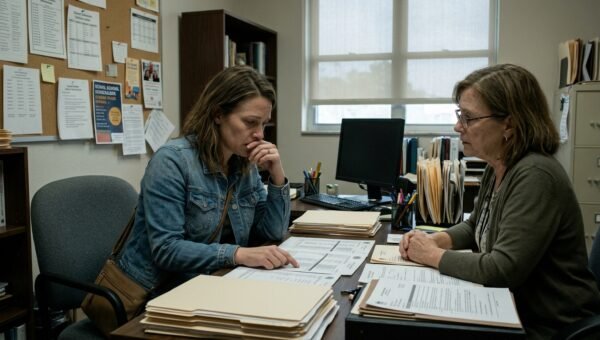
Then I called a lawyer.
I’d never called one before. I had Mr. Vance’s number from a friend who’d gone through a divorce. I wrote down what I planned to say on a yellow pad, crossed out half of it, and called anyway.
His assistant asked what the problem was. I said, “My husband’s planning to leave me, and I need to protect my half of our money.”
I didn’t say I had heard the exact words. Not right away. Even on the phone, saying them felt like handing them to somebody else.
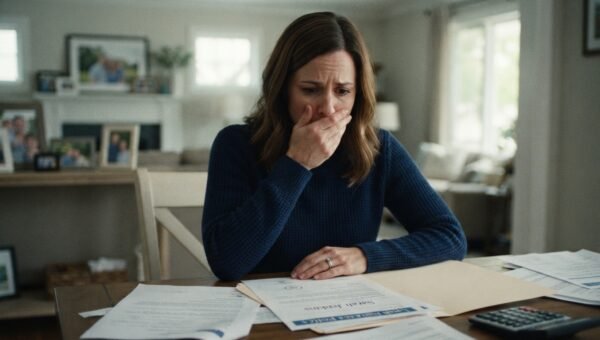
Mr. Vance saw me that afternoon. I brought the last bank statement and a folder of old tax papers. The statement showed $680,000 in our joint liquid accounts. I kept touching the corner of the page while I talked.
“Did he say when?” Mr. Vance asked.
“Christmas.”
“Did he say anything about the money?”
“He said he’d leave me. I don’t know what he planned to do with the money.”
That part was true. I knew what I’d heard, not what Wade had planned for every dollar. Still, I could picture him deciding what was fair after he’d already decided I wasn’t worth staying with.
Mr. Vance was careful with me. He didn’t tell me I could do whatever I wanted with a joint account, and he didn’t promise the trust would make a divorce painless.
He explained the rules, the paper trail, and what could be challenged. He also explained that I had to move quickly and handle it properly.
“What I can do is secure your share,” he said. “We’ll document every step.”
I signed the papers to place $340,000 in an irrevocable trust for my independent security. It was half the liquid money. The rest stayed in the joint accounts. Mr. Vance arranged the transfer and prepared the required notices and separation filings.
I remember the printer making a little squeak when the last page came out. That noise seemed ridiculous to remember. I remember it anyway.
I went home with a copy of everything in my purse.
Wade was standing in the kitchen when I got back, telling me he’d fixed the loose latch on the back door. He had a screwdriver in his hand.
“Was it a hard day?” he asked.
“No,” I said. “Just errands.”
He smiled and put his hand on my shoulder. That was the first time I understood that I could let him touch me and feel nothing that looked like anger. I didn’t pull away. I didn’t lean in either.
The next few weeks were strange in a very plain way. Wade got nicer.
He asked what I wanted for dinner. He took the trash out without being asked. He brought me a little bottle of hand lotion from the grocery store because I’d mentioned my hands were dry.
“Trying to stay in your good graces,” he joked.
I said, “You’re doing fine.”
I hated how easy it was to say. I was helping him believe that nothing had changed. Every day I let the lie sit at the table between us, I felt less like myself. Then I remembered the call, and I kept doing it.
He started talking about Christmas plans. We’d usually gone to my sister’s house, but Wade said he might have to work around the holiday.
“Let’s not lock anything in,” he said.
I looked up from the dishes. “Sure.”
I almost asked what he meant. I didn’t. I wanted him to keep talking to the other woman. I wanted to know whether Christmas was his own idea or something he’d promised her. That made me feel mean, but I didn’t stop listening for clues.
Wade didn’t know about the transfer. He still checked the account sometimes, but not while I was in the room. He made little comments about how the money was “in good shape,” as if it belonged to him to manage.
I used to appreciate that he handled the finances. It saved me from having to look at bills and password changes. I had called that trust. Maybe it was also convenience.
Once, he asked if I’d noticed a small transfer from checking.
“Which one?” I said.
He shrugged. “Never mind. It was nothing.”
I nodded, and I hated myself a little for being glad he hadn’t looked closely.
Then came the roses.
Wade came home last night with grocery-store flowers wrapped in cloudy plastic. There were a few leaves bent down, and one stem had a little tear in it. He put them on the entryway table like he’d brought home something special.
I don’t know why that detail stuck. Maybe because he’d never brought flowers home unless there was a reason. He’d forgotten our anniversary the year before, so I’d stopped expecting them.
“Just because,” he said.
“Thank you.”
He watched my face. I could tell he was waiting for some sign that the flowers had worked. He’d been doing that lately, offering me small kindnesses and checking whether I would soften.
I took the flowers and set them back down. I kissed his cheek. His skin felt warm from being outside.
“You’re the only woman I’ll ever love,” he said.
The line came out smooth. He looked right at me when he said it.
For one second, I could see the hallway again. The phone light on the wall. The eleven minutes. The clock reaching quarter past.
I smiled and handed him the envelope.
He looked at it. “What’s this?”
“Open it.”
He peeled the flap back and read the first page standing by the table. The roses were between us. His eyes moved down the page, then back to the top. His hand tightened on the paper.
“What did you do?” he said.
I didn’t answer yet.
He flipped through the documents. The trust papers were there, along with the notices and the separation filing. His fingers caught on one page and crumpled the corner.
“Three hundred and forty thousand?” he said.
“It’s my share of the liquid assets,” I told him. “Mr. Vance handled it.”
He looked at me like I’d done something he couldn’t fit into the version of me he’d been carrying around.
“How long have you known?”
I had thought about that answer on the drive home from Mr. Vance’s office. I’d thought about saying, “Long enough.” I’d thought about saying nothing.
“Since 2:07 that morning,” I said. “I heard you tell her you’d leave me at Christmas.”
He sat down hard on the little bench by the door. The envelope slid onto his knee. For a moment he didn’t speak, and I noticed the torn rose stem on the table. One green leaf had fallen off.
“You heard all of that?”
“Eleven minutes.”
He rubbed his thumb along the edge of the papers. He wasn’t yelling. Neither was I.
“Why didn’t you ask me?”
I looked at him. “Would you have told me the truth?”
He didn’t answer.
That was enough. I’d spent weeks wanting to know what story he would tell me, but the story didn’t matter anymore. I’d heard him say it to someone he thought I couldn’t hear.
Wade got up and tried to reach for my hand. I moved mine away.
“I made a mistake,” he said.
“No,” I said. “You made a plan.”
He looked down again at the trust papers. “You can’t just take all of it.”
“I didn’t. It’s half. The filings explain where it went, and Mr. Vance can answer anything you want to contest.”
I didn’t say it to scare him. I didn’t need to. I had copies of the records, and I’d followed the lawyer’s advice. The money wasn’t sitting there waiting for Wade to decide what happened next.
He asked if we could talk before I did anything else. I told him the separation had already been filed. I told him we’d communicate through the lawyers from now on.
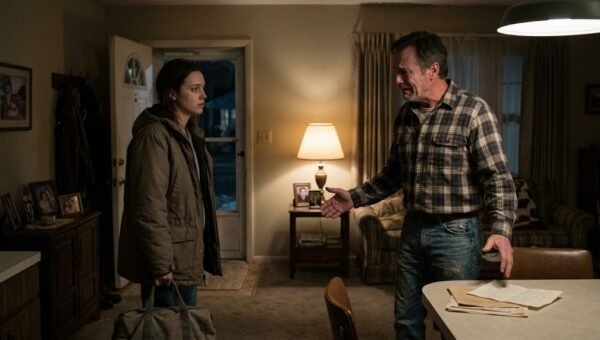
Then I asked him to pack a bag and stay somewhere else.
He stared at me. I could see him trying to find the old version of me, the one who would apologize for making the evening uncomfortable.
“I live here too,” he said.
“You do,” I said. “But I’m asking you to leave tonight.”
He stood there another few seconds. Then he went upstairs.
I stayed by the entryway table, beside the roses. I heard drawers open and close. He came back down with a duffel bag and his keys in his hand.
At the door, he paused. “I never meant for it to go like this.”
I didn’t ask what he’d meant. I opened the door.
He stepped out. I shut it behind him.
The roses stayed on the table. The $340,000 was no longer his to move around, and the papers had his name on them. I didn’t feel happy. I did feel finished with waiting for him to tell me what my life was worth.
The door was closed. The roses were still there.