My mother left me with Grandma, and for a long time I thought that meant I wasn’t worth keeping.
I was 24 when Grandma Evelyn died. At the reading of her will, I learned she’d left Mom the house, my older sister, Tessa, the bank balances, and me a framed zoo photo. I’d been expecting nothing, I guess. Still, seeing my name next to a picture felt like getting told it out loud.
Mr. Vance, Grandma’s attorney, handed me an envelope. Mom sat beside Tessa, already talking about what the house might sell for. I kept looking at the envelope, then at the family photo hanging in the hall outside his office.
The one from the zoo.
“For you, Tom, our framed photo from the zoo. Love you. Grandma.”
Mom made a small sound through her nose. Tessa looked at the envelope and said, “That’s what you get.”
Nobody stopped her. I didn’t either.
The will reading took maybe twenty minutes. It felt longer because Mom kept asking Mr. Vance about the house, the taxes, and how fast she could list it. Grandma had lived there for decades. I’d lived there too, though I’m not sure Mom ever thought of it as my home.
The next day, I went back to get the picture. Mom had said I could take it, as though she was doing me a favor.
The house was quiet, and the hallway smelled like the lemon cleaner Grandma used on the wood floor. I remember the smell because she used to tell me not to track mud in, even when I was already wiping my shoes on the mat.
That was Grandma. She noticed things.
When I was eight, Mom moved in with a boyfriend and told me it was temporary. Then there was another boyfriend, and then another. I don’t know the exact count. I just know I started keeping a toothbrush at Grandma’s before anyone said I was staying there for good.
My sister was old enough to understand what was happening. She mostly acted like I wasn’t there. I used to follow her around anyway, trying to get her to listen to a joke or look at a drawing I’d made. She’d say, “Go ask Grandma,” without looking up.
Grandma always did.
She made me lunch for school and sat through my bad clarinet practice.
She took me to the zoo once, when I was ten, because I’d been staring at a picture of a giraffe in a library book. I don’t remember much about the animals. I remember her laughing because I got mustard on my sleeve, and her telling me the giraffe looked like it had been assembled wrong.
We took a photo by the entrance. Grandma had one arm around my shoulders, and I was squinting. She put it in a wooden frame and hung it in the hallway.
So I took it off the wall the day after the will reading. I told myself I wanted the picture because it was the only thing she’d left me. That’s what I thought then.
At my apartment, I set the frame on the kitchen table. There was a crack in the wood near one corner. It must have happened when I pulled it off the wall, though I couldn’t swear to that.
I turned it over to see if I could fix it and noticed the backing had a second layer of cardboard.
That didn’t seem right.
I got a butter knife from the drawer and worked it under the cardboard. The edge gave way with a dry little pop. A folded envelope slid down onto the table.
I didn’t open it right away. I just sat there with the photo face down and the envelope beside it. Grandma’s handwriting was on the front.
“My brave boy, look behind the cardboard.”
I opened the envelope.
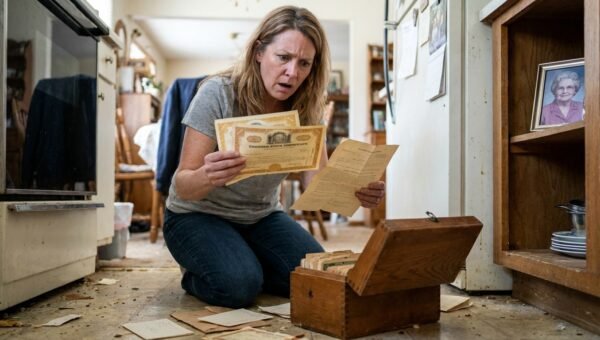
There was a letter, a stamped property document, and a bank certificate tucked inside. I knew enough to see the deed had Grandma’s name on it and mine. I didn’t know enough to tell what it meant, so I read the letter first.
She wrote that her health had started to worry her about eighteen months earlier. She didn’t tell me. She wrote that she had watched Mom and Tessa argue over the house while she was still alive, and that she knew they’d fight if she left me anything important in the will.
I read that part twice. Then I read it again.
Grandma explained that the property papers had been recorded outside the will. The cottage and orchard were mine, transferred directly to me. The account confirmation showed a separate investment trust, also set up for me. The house and bank money in the will were meant to satisfy Mom and Tessa and keep them from dragging the estate into court.
I sat down on the floor. My back was against the kitchen cabinet, and the photo was still on the table.
The letter didn’t say Grandma thought they were monsters. It said she knew how they were. Mom wanted money from the house, and Tessa wanted the money Grandma had saved. Grandma thought if they got what they expected, they wouldn’t come after me.
Then I found the sentence I couldn’t read without stopping.
“I gave them the house. I gave you a way out.”
She wrote that she had bought the cottage years earlier, after selling a strip of land near the highway. She’d fixed the roof and planted fruit trees. She said she’d put aside money a little at a time, and the checks in the envelope were the first of a group she’d made for the property expenses.
The letter was plain. No big speech. She said she was sorry to leave me with a hard-looking will, but she didn’t want me spending what little I had on lawyers while Mom and Tessa fought over the rest.
At the bottom she wrote, “You were never the thing I forgot.”
That was the line that got me. Not because it was pretty. Because I’d spent years acting like I didn’t care whether Mom remembered my birthday or Tessa answered a text. I did care. I had cared the whole time.
I called Mr. Vance the next morning. I didn’t tell Mom or Tessa. I wanted to know if the papers were real before I let myself believe anything.
Mr. Vance asked me to bring the whole frame and every paper. His office had a little brass bell on the counter. I kept tapping it with my thumb while he looked through the deed and the account confirmation.
He didn’t rush. He checked the recording information, made a call, and asked me to wait while he pulled a file. I was embarrassed by how badly I wanted him to say it was all valid.
When he came back, he had an official copy of the deed and a set of keys.
“It’s yours, Tom,” he said. “The transfer was recorded a year ago. It didn’t go through probate.”
I asked him if Mom could challenge it. He said she could try, but the paperwork had been done properly and the property was already registered to me. He also explained that Grandma had left the trust documents in his custody, not inside the frame. The papers in the frame were the clues and the personal note. He had the full record.
I held the keys in my hand. They were smaller than I expected.
Mr. Vance said Grandma had planned it carefully. She’d told him she wanted me to have a place of my own, away from family arguments. He had made sure I understood that the cottage had no mortgage and that the trust was mine alone.
I asked why she hadn’t just told me.
He looked down at the file for a second. “She thought keeping you out of it was safer.”
I understood the reason. I still wished she’d let me say goodbye knowing what she was doing. I don’t think there’s a clean way to feel about that.
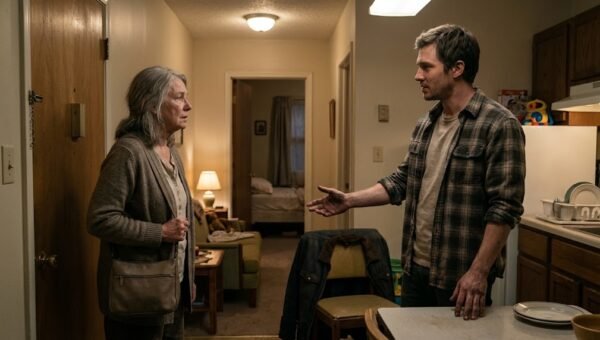
A few days later, Mom called. She said she needed me to come to the house and help move furniture before she listed it. Tessa was there too, she said, and they couldn’t do it alone.
I almost said yes. That’s the embarrassing part. Mom could call after months of not asking how I was, and I’d still start planning how to be useful.
Then I looked at the old frame on my table.
“I’ll come get my things,” I said. “I’m not moving the house.”
Mom got quiet, then said, “Don’t start this.”
I didn’t. I drove over that afternoon.
The living room was already full of boxes. Tessa had marked some with a thick black pen. Mom stood near the couch, holding a list. The whole place looked smaller with Grandma gone. Or maybe I’d just stopped being a kid in it.
Mom handed me a box and said, “You can take these downstairs.”
I set it back on the floor.
“I’m here for my things.”
Tessa gave me a look. “You got the picture. What else do you need?”
There it was again. That same idea that anything Grandma gave me was somehow less real than what she gave them.
I went to my old room and packed the small things I’d left behind: two school ribbons, a stack of comic books, and a chipped mug Grandma had given me when I got my first job. I didn’t take much. I had already learned to keep my life small enough to carry.
When I came back downstairs, Mom was still looking at me like I owed her an explanation.
“You’re not going to help us?” she asked.
“No.”
She said the house needed repairs before it could sell. There were taxes due, and a problem with part of the roof. I didn’t know the amounts, and I didn’t ask. That wasn’t my job to fix.
Tessa folded her arms. “You’re acting like you have somewhere better to be.”
I had the keys in my pocket. I didn’t take them out. I didn’t want them to turn my grandmother’s choice into something I had to prove.
“I do,” I said.
Mom stared at me. “What does that mean?”
“I have a place of my own.”
For a second neither of them said anything. Mom looked at Tessa, then at me. Tessa asked if I meant an apartment. I told them it was a cottage, and that Grandma had left it to me.
Mom’s first question was, “Why didn’t Mr. Vance tell us?”
I said, “Because it wasn’t part of the will.”
She told me that couldn’t be right. I said it was recorded. She wanted to see the papers, and I told her Mr. Vance had them. I wasn’t going to hand over the deed for them to inspect at the kitchen counter.
Tessa said Grandma must have been confused. I felt my voice get sharp, so I stopped talking for a second.
“She wasn’t confused,” I said. “She planned it.”
Mom said she needed time to think. Tessa started arguing with her about the boxes. I picked up my things and walked out.
I didn’t feel like I’d won. I felt tired. The difference was I didn’t go back in to make them feel better.
The cottage was small and sat near the lake, with an orchard Grandma had planted over several years. I’d been there with her twice, but I hadn’t known it was meant for me. There were apple trees and a little garden bed by the porch. Some branches needed trimming. The place needed cleaning, not rescuing.
The house Mom inherited had deferred taxes and repairs that cost more than she expected. She called me once to say the roof estimate was “ridiculous.” I said, “I’m sorry.” I didn’t offer money. I didn’t offer to come haul anything. I didn’t say what I was thinking, which was that Grandma had known the house would take work.
I moved into the cottage that month. I took my time. I fixed what I could, and I paid someone for the roof work I couldn’t do safely. The trust gave me room to handle the bills without calling Mom.
I bought a sturdy walnut frame for the zoo photo. The old backing had torn when I opened it, so I couldn’t put it back together the same way. I kept the letter and the documents in a safe place, but I read the letter more than once.
One afternoon, after I’d finished cleaning the living room, I carried the photo to the mantel. Sun came through the front window and landed on the garden outside. I set the frame in the middle.
In the picture, Grandma’s arm is around me. I’m squinting at the camera, and she’s laughing at something I can’t remember.
I used to think that picture was all she had left for me. Now it sits above the cottage she made sure I could call home.