The last ordinary thing Dad said to me was that the faucet display looked crooked. I was standing on a step stool in the front window, nudging a box of brass handles to the left, and he was out on the sidewalk with his coffee. He said it like he’d said a hundred things like it before. I moved the box. He nodded once and went back inside.
That was about three weeks before he died.
I’m Darlene. I was 48 when all this happened, and I’d worked at Dad’s hardware store since I was thirteen.
My younger brother, Wade, left for Arizona at 22 and came home twice a year if the flights worked out. Dad always said Wade would inherit the store because “women don’t want that kind of life.” I heard that often enough that I stopped arguing with him. Or told myself I had.
The lawyer’s office smelled like burnt coffee and copier paper. Dad’s will was short. Wade got Dad’s truck and whatever was left in his personal checking account. There were some small things for me, too, but the business wasn’t listed.
Wade sat beside me, tapping his shoe against the chair leg. When the lawyer finished reading, he looked at me like the hard part was done.
“I’ll have someone come in and look at the inventory,” he said. “We can get a price by next week.”
I didn’t correct him. I couldn’t, because I thought he was right.
The lawyer explained that the store wasn’t part of Dad’s estate. I heard that sentence, but I heard it through a kind of fog. Dad had always said the store would go to Wade. So I figured there was some legal reason it wasn’t in the will, and Wade would sort it out. I hate admitting that. At 48, I was still waiting for someone to tell me what my father meant.
The lawyer said he’d asked Mr. Pruitt, Dad’s accountant, to meet us at the store. There was paperwork he needed to explain. Wade said we should go together, so I drove straight there from the office. I remember thinking the green trim on the building needed a fresh coat. It was the first thing I noticed.
Mr. Pruitt was waiting outside with a brown folder tucked under one arm and a leather binder in his hand. Wade was already there.
He’d beaten me by maybe ten minutes and was looking at the front door like it belonged to him.
The familiar sight of him standing there pulled up every visit he’d made over the years. Twice a year, usually around Christmas and the Fourth of July, he’d come in wearing clean shoes and ask how business was. Dad would show him the new tool display and tell him things were fine. I’d be in back hauling boxes or on the phone with a supplier, trying to keep the place fine.
Wade had never learned how to run the register. That wasn’t an insult. He’d never needed to. Dad told him he had bigger plans.
“What’s the other folder?” I asked Mr. Pruitt.
“The company records,” he said.
Wade reached for the binder. Mr. Pruitt shifted it away from him, not rudely, just enough to make his point.
“This concerns both of you,” he said. “But Darlene needs to see it first.”
I thought he was about to tell me I’d been left with some bill.
For a second, I was almost relieved. At least a bill would make sense.
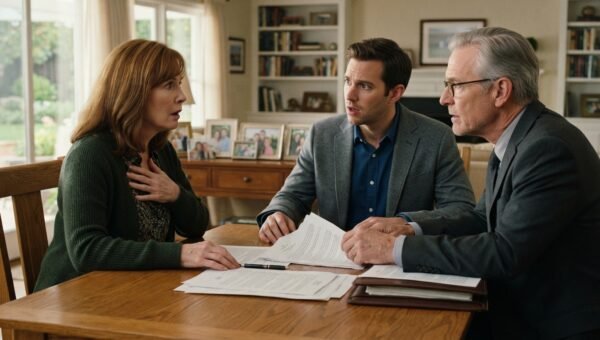
He opened the binder on the hood of his car. The first papers were an amended corporate charter and a stock ledger. I recognized the store’s legal name. I didn’t recognize the date.
Nine years earlier.
My name was typed on the line for the sole shareholder. The number of shares beside it was every share the company had issued.
I read it once, then again. I was looking for a second name, or a footnote, or something that made it temporary. There wasn’t one.
Wade leaned over my shoulder. “That can’t be right.”
Mr. Pruitt turned to the next page. There were signed corporate resolutions, a stock certificate in my name, and filing records. The paperwork said Dad had transferred the entire company to me nine years earlier. It had been filed. It was real.
I kept looking at the signature. Dad’s handwriting slanted down at the end, the same way it did on the notes he left beside the cash drawer. The paper smelled faintly like the old metal filing cabinets in his office. I don’t even know why I remember that part.
“What is this?” I asked.
Mr. Pruitt said Dad had restructured the business when the debt started getting bad. A tax lien was close. The store could have been forced into a sale. Dad had worked out a plan with him, moved the debt away from the store’s day-to-day operations, and transferred the shares to me. The business debt had since been cleared. The store was solvent.
I couldn’t make those facts fit with the man who’d spent years telling me the store was going to Wade.
For nine years, I’d thought I was an employee. I thought the inventory was Dad’s and the future was Wade’s. I’d signed purchase orders, handled payroll, covered Saturdays, and taken calls from customers who wanted to know if we had a certain washer size in stock. I’d done all of it because I knew the store needed doing. Dad was getting older, and somebody had to know where everything was.
The first time I closed the store alone, I was seventeen. A storm had knocked out the power, and Dad had driven home to get a flashlight. I stayed behind with a battery lantern and a line of people waiting for screen patches. I remember counting change by touch. Wade was living in Arizona by then, I think. Or maybe that was a year later. The dates blur. The work doesn’t.
Mr. Pruitt showed us the bank records. The money Dad had borrowed to get the business clear wasn’t sitting on the store books as operating debt. There were dates, payments, and statements. It was all laid out. Dad hadn’t handed me a failing business and called it a gift. He’d saved it first.
Wade stared at the paperwork, then at me.
“He told me it was mine,” he said.
Mr. Pruitt didn’t argue with him. He turned another page.
The company had been transferred before Dad’s health got worse. The documents weren’t part of the will because Dad didn’t own the shares when he died. He had made the change while he was alive. Quietly. Nine years ago.
Wade started talking faster. He said the transfer must have been for tax purposes. He said Dad would never give me the whole store and leave him out. He said the business had value and he wanted an inventory appraisal right away. He asked what I planned to do with “his share.”
I said nothing. I was still reading.
Maybe I was being stubborn. I’ve always been bad at asking for help, and I can turn a simple question into a whole day of silence. But Wade had been assuming the store was his before he’d even asked me what I thought. I wasn’t going to fix that for him.
“Can you explain the reason for the transfer?” I asked Mr. Pruitt.
He pulled out one last sheet. It was an original corporate resolution in Dad’s handwriting, not a copy typed up by the accountant. Mr. Pruitt said Dad had asked him to keep it with the company records and show it to me if the time came.
Wade made a short, sharp sound through his nose. “This is ridiculous.”
Mr. Pruitt put the page in front of me.
Dad wrote that he was transferring the shares because I had kept the business running, and because Wade had no interest in running it. Dad also wrote that if Wade ever got control, he would sell the store for cash as soon as he could. He’d feared I would spend my life working there and still have no say in what happened to it.
Then came the part I read out loud, because my eyes had gone back to it three times.
“I don’t want her at the mercy of Wade’s next need for money.”
That was all. No apology for what he’d told me. No note about the years I’d spent believing I was second in line. Just that sentence in his handwriting.
I was angry. I was also proud of him, which made me more angry. He’d protected the store and my future, but he’d done it by keeping me in the dark. He’d let me think my brother was the son who mattered, then quietly made sure I couldn’t be pushed out.
Wade said the resolution didn’t prove Dad wanted me to keep the store. He said he’d call a lawyer and challenge the transfer. Mr. Pruitt told him the filings were complete, the shares had been transferred while Dad was alive, and the records showed no legal basis for undoing it.
Wade turned to me. “You can’t just keep me out.”
I finally looked up from the papers. “It’s my store. You don’t get to sell it.”
He said he was still Dad’s son. I knew that was true. I also knew it didn’t make him the owner.
That’s where I’m not going to pretend I was noble. Some part of me wanted him to feel small. I wanted him to understand what it was like to spend years being treated as the help while he got to be the future. I didn’t say that, but I thought it.
I told him I wasn’t agreeing to an inventory appraisal. He could visit if I invited him, and he couldn’t come in and make business decisions. If he wanted to challenge the documents, he could do it through a lawyer. Until then, he had no claim to the store.
He called that spiteful. I didn’t answer.
Mr. Pruitt stayed beside the car while Wade walked off toward his rental. Wade said he’d be back with a lawyer. Mr. Pruitt told me the paperwork had been checked and the company was mine. He didn’t promise Wade wouldn’t make noise. He said noise wasn’t the same as a case.
I went inside after that. I’d opened the register thousands of times, but I couldn’t make myself touch it right away. The store smelled like sawdust, rubber hoses, and the lemon hand soap Dad bought in bulk. There was a list of special orders on the counter with my handwriting at the top.
I picked it up and went through each line. Two faucet cartridges, a box of hinges, one replacement screen. Ordinary things. Still needed doing.
For the next few weeks, I worked with Mr. Pruitt to update the business records and make sure every account listed me as owner. I changed nothing fast. I didn’t want to make choices just to prove I could. I also didn’t ask Wade for permission. Those were new habits for me.
When he called, I let it go to voicemail. When he left a message saying Dad had “promised him the store,” I kept it. I didn’t answer. I had spent enough years being careful not to upset him.
The first morning I opened as the undisputed owner, I got there before sunrise. I took the new key from my pocket. It was heavier than the old one, or maybe I was just paying attention this time.
The brass key turned smoothly in the front door lock. I stepped inside, set my bag under the counter, and started the coffee.