I lied to my mother about the worst year of my life, and ten years later her new boyfriend was standing at her door.
I had a pie balanced on the passenger seat and my hand was still shaking when I rang the bell. Mom swung the door open before I could put my other hand down.
“OH MY GOD, YOU’RE HERE!” Evelyn said.
Then Arthur stepped into view behind her.
I knew his face. The little crease beside his left eye. The silver pen in his hand.
For a second I couldn’t make my feet move. My mother looked so happy, and Arthur looked like a man who had been waiting for this exact moment and hoped it would go well.
I almost made up an excuse and left.
Instead, I stepped inside.
For six months, Mom had been seeing Arthur. They met at a community garden at the botanical center, where Mom had gone to help with a planting day and came home talking about a retired housing counselor who knew more about tomato cages than she did.
She sounded lighter when she talked about him. Not giddy, exactly. Just pleased. She’d start a story with, “Arthur says…” and catch herself smiling.
I was glad. Mom had been on her own for a while, and I didn’t want to turn her new relationship into a family committee project. So when she said she wanted to keep it private until she knew where it was going, I agreed.
I didn’t ask to see a picture. I didn’t ask for his last name. She didn’t post photos online, and I figured that was her choice. Maybe I was also relieved not to have to make small talk with someone new while I was still getting used to the idea.
Then she invited me to dinner.
I bought a pie from the bakery near my house because I wanted to show up with something. I spent too long deciding which one, as if a pie could make an evening go right. Mom had made chicken, she told me, and Arthur was bringing a salad.
At the door, he said, “It’s good to meet you.”
I heard myself answer, “You too.”
Mom took my coat and kept talking. She didn’t notice anything. Arthur stood beside the entry table with that silver fountain pen in his hand, rolling it between two fingers.
I remembered that pen from a different table, ten years earlier, in a small office that smelled like wet coats and burnt coffee.
I kept walking because my mother was smiling at me.
In the living room, she had put out the good napkins. A framed photo of me sat on the sideboard. I was about twenty-five in it, wearing a haircut I still can’t defend. Arthur glanced at the picture, then at me. He didn’t say a word.
Mom asked whether I wanted anything to drink. I asked for water.
“Are you okay?” she said.
“Sure. Just a long day.”
That was the kind of answer I’d gotten good at giving.
Ten years earlier, I was behind on rent and running out of time. I was working full-time, but my hours had been cut, and I had a stack of bills I kept turning face down on the counter.
The landlord had given me a notice. I can’t remember the exact date now, but I remember folding that paper into quarters and stuffing it into the pocket of my work bag.
I was too embarrassed to tell Mom. She’d already helped me plenty when I was younger, and I was determined to prove I could manage on my own. So I told her everything was fine. If she asked about work, I said things were steady. When she offered to send groceries, I said I had plenty.
I had almost nothing.
A neighbor told me to call the community assistance office. I waited until my lunch break and nearly hung up when someone answered. Arthur was the building administrator and a community mediator then. He came out to meet me, asked what was going on, and let me explain without acting like I was stupid for getting behind.
He helped me apply for housing stabilization support and talked with the landlord about giving me time. He helped me get rental deposit assistance for a cheaper apartment across town, too. He never treated me like a charity case. He didn’t tell me to call my mother. He just put the papers in front of me and helped me work through them.
I got out of that apartment. I got a new place. I got back on my feet.
And I didn’t tell Mom.
At the time, I called it protecting her. I didn’t want her worrying. I didn’t want to hear her say, “Why didn’t you tell me?” I didn’t want to see her look at me like I had failed at being an adult. I told myself I was saving her the trouble.
The truth is, I was ashamed. And once I’d lied, telling her the truth felt like a bigger job than fixing the rent.
Now Arthur was in her living room.
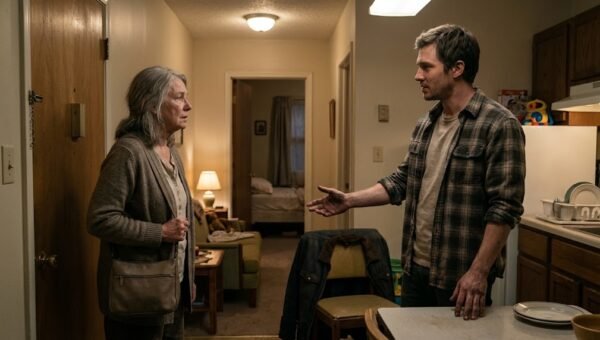
Mom walked toward the kitchen to check on dinner. As soon as she was out of earshot, I turned to him.
“How long have you known who I am?”
He set the pen down on the table. “About two months.”
“Why didn’t you say something?”
“I saw the photo at Evelyn’s,” he said. “I recognized you.”
I looked toward the kitchen. Mom was humming while she moved pans around. I wanted to be angry at Arthur. I wanted him to have done something plainly wrong, because that would’ve made this easier.
“You’ve been dating my mother for months,” I said. “And you knew.”
“I knew we had a history,” he said. “I didn’t know what you’d told her.”
“So you just waited?”
He held my eyes. “I didn’t want to take your story away from you.”
I hated that answer because it was kind. I also hated that he was right. He could’ve told Mom about the office, or asked her what I knew, or dropped the whole thing into their new relationship before I’d even met him. He didn’t. He let me decide what happened next.
But I still had to sit down at the table and look at my mother.
Arthur picked up the salad bowl. I took the pie into the kitchen. Mom turned to me with a dish towel over her shoulder and said, “You two getting along?”
I nearly laughed. “We have some things to talk about.”
She looked from me to Arthur. Her smile faded a little.
“Is something wrong?” she asked.
“Not with Arthur,” I said.
That answer didn’t reassure her much. We carried dinner to the table anyway.
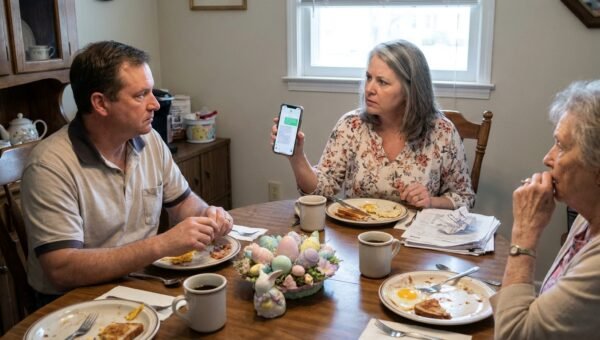
For a while, we did what people do when nobody wants to start the hard part. Mom told me about the garden. Arthur told a story about a zucchini growing so big it leaned over the edge of its planter. I asked what Mom had planted. She told me she had killed basil twice, which made Arthur laugh.
I laughed too. A little late.
Mom kept looking at me. She knew me well enough to hear when I was doing the polite version of myself. I took a bite of chicken and chewed too long.
Arthur started talking about his old work. He said he’d spent years helping people keep housing when a missed paycheck or a rent increase put them in a bind.
Mom glanced at him. “You never said you worked with people in this area.”
“I did,” he said. “A long time ago.”
I put down my fork. It made a small click against the plate.
Mom looked at me. “Do you know Arthur from work?”
“No,” I said. Then I stopped. “Well. Sort of.”
Arthur didn’t jump in. He let me have the room, which made it harder to keep hiding in it.
“I met him ten years ago,” I said. “When I was about to lose my apartment.”
Mom’s hand stopped on the table. “What?”
I looked at the placemat instead of her face.
“I was behind on rent. I got help from the community office. Arthur was the person who helped me.”
She didn’t speak right away. I could hear the kitchen clock ticking. It was one of those clocks that makes every second sound louder when nobody answers.
“How close were you to losing the place?” she asked.
“Close.”
“Why didn’t you tell me?”
The question came out quiet. That made it harder.
I could’ve given her the answer I’d been using for ten years. I could’ve said I didn’t want to worry her. That was part of it, but not all of it.
“I was embarrassed,” I said. “I thought I should be able to handle it. And then I kept saying I was fine, so it got harder to admit I wasn’t.”
Mom blinked a few times and pressed her lips together. I couldn’t tell if she was hurt or trying not to cry. Probably both.
“I would have helped you,” she said.
“I know.”
“No, I don’t think you did know.”
She was right. I looked down at my plate. I had spent ten years telling myself I was protecting her, but some of it was me not wanting to feel small in front of the person who had raised me.
Arthur spoke then, but he didn’t make it sound like he was defending himself.
“Evelyn, I recognized the photo,” he said. “I asked whether she knew about that time. She said no. I told her we should have dinner, but I didn’t want to bring it up without her here.”
Mom looked at him. “You could have told me.”
“I could have,” he said. “But it wasn’t mine to tell.”
I believed him. That was the part I hadn’t expected. He hadn’t hidden it to get close to my mother. He hadn’t used the secret as some test. He’d seen a photo on a sideboard, recognized a person he once helped, and held his tongue so I could speak for myself.
Mom reached for her water, then set it back down without drinking.
“Was it awful?” she asked me.
I told her about the notice, the late rent, the calls I avoided. I told her how I kept my work bag zipped because the paper was inside it and I couldn’t stand looking at it. I told her Arthur helped me talk to my landlord and find a place I could afford. I didn’t give her every dollar or every date. I gave her enough.
She listened. She didn’t interrupt to fix it or tell me what I should’ve done.
When I ran out of words, she reached across the table and took my hand.
“I wish you’d let me be there,” she said.
“I know.”
“I’m not mad that you needed help,” she said. “I’m sad you thought you had to hide it from me.”
That hit me harder than the question had. I squeezed her fingers, and I wished I could say that I understood why I had kept the secret without making it sound like a defense.
Arthur sat quietly while we talked. The silver pen was beside his plate now. I had forgotten it was there until Mom glanced at it.
“Is that the pen from your old office?” she asked him.
“One of them,” he said.
I laughed, a short, odd sound. “I remember that pen.”
Arthur smiled a little. “You used to tap your folder with yours.”
“I was nervous.”
“I know.”
Mom looked between us, and some of the tension left her face. Not all of it. She was still taking in the fact that there had been a whole part of my life she hadn’t known about. I couldn’t make that easy for her. I could only stop making it harder by lying.
Dinner went on. Mom asked what kind of apartment I’d moved into, and I told her. Arthur remembered that the building had a bad laundry room. I remembered the dryer that ate quarters. Mom shook her head and said, “You never mentioned that either.”
“I know,” I said. “I was trying to seem like I had it all handled.”
“How’d that work out?” she asked.
“Not great.”
She laughed. Then I did too. It wasn’t a big release or some perfect family moment. The food was getting cold, and the pie sat on the counter until Mom remembered it. But we weren’t pretending anymore.
After dinner, Mom wrapped a piece of pie for me to take home. Arthur helped wash the dishes while I dried them. We talked about the garden and the ridiculous basil. Mom told me she’d like me to come by next Saturday and see the tomatoes.
I said I would.
When it was time to go, Arthur walked me to the door. Mom followed with my coat. I thanked him, and I meant it in a different way than I had at the threshold.
“I’m glad you came in,” he said.
“Me too.”
Mom touched my arm. “You can tell me things, even when they’re bad.”
“I know,” I said. I didn’t tell her I was still learning how to believe that.
Outside, the porch light was on. I got to my car and turned around. Through the front window, I could see Evelyn and Arthur standing side by side, waving together.
For once, I wasn’t trying to keep either of them out of the story.