PART 1
When I brought my seven-year-old daughter, Chloe, home from the emergency room at two in the morning, our life was scattered across the damp front lawn. Cardboard boxes were soaked with dew. Chloe’s winter coat lay in the dirt near the driveway, and my plastic storage bins were tipped over by the porch steps.
Chloe was still shivering, holding my hand with the white hospital wristband still taped to her wrist.
She had spent the last six hours on an IV for severe dehydration after an intense stomach virus.
Before I could even put the car in park, the front door swung open. My mother, Helen, stood on the porch in her thick bathrobe, pointing a finger straight at my face.
“Pay the two thousand dollars right now or get off our property!” she screamed into the quiet neighborhood street.
“Helen, stop,” I said, keeping my voice down so the neighbors would not wake up. “Chloe just got discharged. She has been throwing up for twelve hours. Let me put her in bed, and we will talk about the money in the morning.”
“No morning!” she yelled. “You owe two thousand dollars for your share of this roof, and you think you can play games with me! You pay tonight or you sleep on the curb!”
I had already paid twelve hundred dollars on the first of the month.
That was the exact agreement we had made when my husband walked out four months earlier and I moved Chloe into my parents’ spare rooms. But over the last three weeks, my mother had begun inventing new fees every time she bought groceries or ran the air conditioner.
My father, Arthur, stepped out behind her. He did not say a word at first. He walked down the three porch steps, his slippers scraping against the concrete.
“Arthur, please,” I said, stepping between him and Chloe. “I gave Mom twelve hundred dollars twelve days ago. I do not have another two thousand dollars sitting in checking while I am paying off the clinic bills. You know that.”
He did not argue. He did not negotiate. His face went tight, and his hand came up faster than I could move. The slap caught me squarely across the left cheek and mouth, the crack echoing off the siding of the garage.
My feet slid on the wet grass, and my shoulder hit the walkway.
Chloe screamed. It was a high, thin sound that tore through the cold night air, the kind of scream a child makes when they think the world has cracked open. She dropped down beside me on the grass, grabbing my jacket. “Mom! Mom, get up!”
My mouth tasted like copper. I pushed myself up on one elbow, the porch light spinning above me, my jaw throbbing where his knuckles had grazed bone.
Arthur stood over me, looking down like I was a stray dog that had stepped on his clean porch.
“Maybe now you will learn to obey your mother,” he said. He looked at Chloe, then back at me. “Pack your junk into that rusty car and clear out before sunrise. Do not come back inside this house.”
He turned his back, walked up the steps, and let the front screen door slam shut behind him.
My mother locked the deadbolt. The porch light clicked off, dropping the yard into total darkness.
Chloe was crying so hard she was choking on her breath, clinging to my sweater. I pulled her against my chest with my good arm, wiping the warm blood from my lower lip with the cuff of my sleeve.
They thought that slap was the end of the conversation. They thought leaving me bleeding in the grass with a sick child would force me to beg on my knees, empty out Chloe’s small savings bond, and hand over every cent I had left.
They had no idea what was sitting inside the locked glove box of my car.
PART 2
I picked Chloe up, her sneakers dangling against my shins, and carried her back to the passenger seat. I turned the engine on, flipped the heat on high, and reclined her seat back so she could lie down.
“Are we going to be okay, Mom?” she whispered, her cheeks wet and her little hand clutching my thumb.
“We are going to be fine, baby,” I told her, kissing her forehead. “Close your eyes. Nobody is going to hurt us.”
I waited until her breathing slowed. Then I took my keys, reached across the center console, and unlocked the glove box.
Inside sat my black leather planner. Tucked inside the zippered pocket were two documents I had kept safe since my grandmother died three years ago: the certified deed to the house, and the notarized family trust agreement my grandmother, Evelyn, had executed before her death.
My parents had always told everyone that the four-bedroom house on Maple Street belonged to them. When Arthur took early retirement from the county road department, he acted like the lord of the manor. When my mother hosted her church circle on Tuesdays, she bragged about their home equity.
The truth was written on page four of Grandma Evelyn’s trust.
Evelyn had bought the house with cash in 1984 after my grandfather passed away. When she grew older, Arthur begged her to put his name on the title so he could manage repairs. Grandma Evelyn was cautious. She set up an irrevocable trust instead.
Under the terms of that trust, Arthur and Helen held a lifetime right of occupancy, on one strict condition: they had to pay the annual property taxes, maintain the structure, and they could never sublet, charge rent to blood heirs, or attempt to encumber the property. If they committed waste, abandoned the property, or defaulted on the taxes, the life estate terminated immediately, and full title passed to Evelyn’s sole named remainder beneficiary: me.
For three years, I had kept quiet about that document. I had even paid them twelve hundred dollars a month because I wanted to help with utilities while I got back on my feet after my divorce. I had treated them like landlords out of respect, not out of legal duty.
I pulled out my phone and checked the county tax portal under the porch dome light.
The property tax bill had been due on September thirtieth. The portal showed an unpaid balance of four thousand eight hundred dollars, plus a late penalty. A red banner read: DELINQUENT NOTICE MAILED.
Arthur had not paid the county taxes. He had taken the twelve hundred dollars I gave him every month and spent it elsewhere, likely on the lottery tickets and riverboat trips he took every second weekend. That was why they were screaming for two thousand dollars in cash in the middle of the night. The county had threatened a tax lien.
I did not scream. I did not pound on the front door.
I took photos of Chloe’s hospital paperwork, photos of my swollen face and split lip, and photos of our belongings scattered across the wet grass. Then I dialed the non-emergency dispatch line for the county sheriff.
PART 3
Deputy Miller arrived twenty minutes later. He stepped out of his cruiser, his flashlight sweeping across the clothes bags, Chloe’s plastic dollhouse, and the overturned boxes.
He looked at my face, then at the locked front door. “Ma’am, did someone strike you?”
“My father did,” I said clearly. “About forty minutes ago. Right in front of my daughter after we got back from the hospital. He hit me because I refused to give him two thousand dollars.”
I showed him the clear cut on my lip, the swelling along my jaw, and the time-stamped photo I had taken two minutes after it happened. Then I showed him the trust document and the deed.
“I am the legal remainder owner of this property,” I told Deputy Miller. “My parents have a conditional life estate. They unlawfully locked me out, threw my minor child’s medical supplies into the yard, and my father assaulted me on the walkway.”
Deputy Miller looked at the paperwork, then walked up the porch steps. He knocked firmly with the butt of his flashlight.
It took three minutes for Arthur to answer. When he opened the door, he looked annoyed, wearing his flannel robe and reading glasses.
“What is the problem, officer?” Arthur asked, acting polite. “This is a private family matter. My daughter is having emotional problems, and we asked her to leave our home.”
“Step outside, sir,” Deputy Miller said.
Arthur frowned. “This is my house.”
“Actually, Arthur,” I said, walking up the steps and standing two paces behind the deputy, “it is Grandma Evelyn’s trust property. And under Section 6B, your right to occupy ended the moment you let the county taxes go delinquent and assaulted an owner.”
My mother appeared in the hallway behind Arthur, her face pale under the entryway light. “What is she talking about? Arthur, tell them to get off our porch!”
“Mr. Vance,” Deputy Miller said, his voice flat, “step outside and keep your hands where I can see them. We have a visible injury on your daughter and a child witness.”
Arthur tried to argue, claiming I had tripped over a box, but Chloe was awake now. She sat in the front seat of my car, watching through the rolled-down window. When a second deputy arrived to take her statement, she told him in her clear, small voice exactly what her grandfather had done.
The deputies placed Arthur in handcuffs by the front fender of his own sedan. My mother started sobbing on the front stoop, begging me to call the chief of police, claiming Arthur had high blood pressure and could not spend a night in the county jail.
“You should have thought about his blood pressure before he hit me in front of Chloe,” I said.
I did not drop the charges.
By sunrise, Arthur was booked into the county detention center for domestic assault. I spent the morning moving Chloe’s bed and our dry clothes back into the house under civil standby with the sheriff’s office.
ENDING
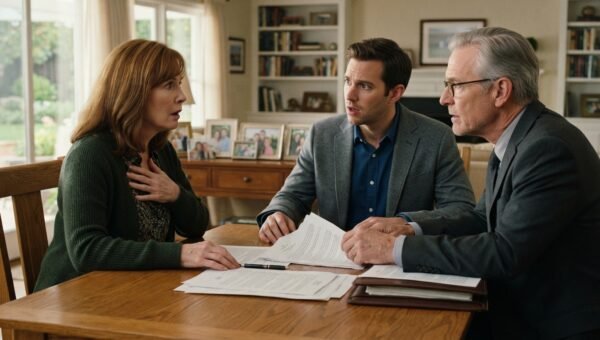
Three days later, I sat down at the kitchen table with an estate attorney named Robert Cole.
The legal reality was completely clean. Arthur’s assault conviction entered a preliminary diversion plea that barred him from coming within five hundred feet of Chloe and me. Because the life estate required compliance with county taxes and prohibited criminal waste of the estate, my attorney filed a petition to terminate the occupancy right.
My mother tried to corner me at my office a week later. She sat in the visitor chair, holding a damp tissue, her voice quiet for the first time in my life.
“Rachel, you cannot put your own parents out,” she pleaded. “Arthur made a mistake. He was stressed about the money. Where are we supposed to go at our age?”
“You have Arthur’s retirement pension,” I told her across the desk. “And you have your social security. You can rent a one-bedroom apartment in town, just like you expected Chloe and me to do on twenty minutes of notice.”
I did not scream at her. I did not call her names. I simply slid a certified check for the delinquent property taxes across my desk to show the receipt.
“I paid the four thousand eight hundred dollars to the county myself,” I said. “The house belongs to Chloe and me now. You have thirty days to remove your furniture and personal items.”
Arthur took a plea deal that gave him two years of probation, mandatory anger management, and a strict no-contact order. My mother found a quiet duplex three miles across town near the senior center. They moved out on a Saturday morning while Chloe and I were at the park.
When we came home, the Maple Street house was completely quiet.
Chloe sat on the clean kitchen floor, coloring in a notebook with the porch door open, listening to the afternoon birds in the maple tree. Her hospital wristband was finally thrown away in the wastebasket by the fridge.
I looked at the spot near the kitchen doorway where my father had thought he could break my will with one swing of his hand.
The floor was spotless. The front door was locked from the inside, and for the first time in thirty years, the keys in my pocket belonged to me.