PART 1
I was vacuuming out my husband David’s four-year-old sedan on a Tuesday afternoon because we were trading it in that weekend. I reached between the fabric crease of the back bench seat, feeling around for dropped coins, and my fingers hit something small and hard. It was a heavy gold earring, shaped like a twisted knot with a tiny seed pearl set in the middle.
It was not mine. I have had sensitive ears since I was a teenager, and I only wear sterling silver wire loops.
I sat back on the driveway concrete, turning the gold piece over in my palm. The back post was slightly bent. It had clearly been worked loose under the seat cushions a long time ago, coated in dry gray dust.
When David came home from work, he left his keys on the entryway table and went straight to the refrigerator. I stood by the counter with the earring deep in my pocket. I watched him drink cold water from a glass, his shoulders hunched from a long day at the district warehouse. A bad thought had crossed my mind, the kind of thought that makes your stomach sour, but I kept my mouth shut. I did not want an argument built on guessing.
Instead, I suggested having his mother, Evelyn, over for roast chicken that evening. Evelyn lived twelve minutes away in a ground-floor condo David helped pay the HOA fees on.
She had been visiting us every Sunday since David’s father died six years earlier.
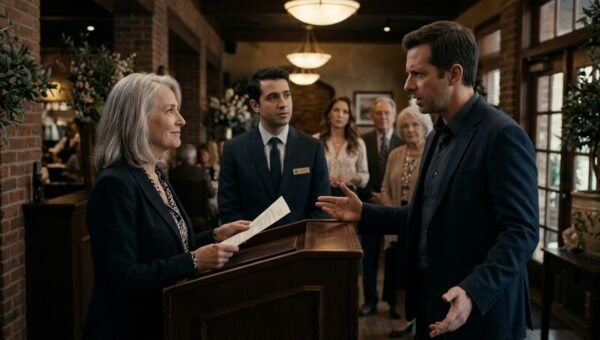
When Evelyn arrived, she walked through our side kitchen door carrying an aluminum tin of sweet rolls. She took off her light beige cardigan and hung it over the back of the dinette chair. That was when I saw her ears.
In her right lobe, she wore a twisted gold knot with a small seed pearl in the middle. Her left ear was bare.
My husband was sitting across the table, unfolding his paper napkin. He was talking about the interest rate on the new crossover we were looking to lease on Saturday.
I walked over to the table. I did not raise my voice, and I did not ask a question. I pulled the matching gold earring from my pocket and set it down quietly on the edge of Evelyn’s placemat, right beside her water goblet.
The metal made a small click against the wood.
Evelyn stopped talking mid-sentence. She picked up the earring, turning it between two fingers. Then she looked directly across the table at David.
David did not look at her. His gaze dropped immediately to the linoleum floor between his knees.
Then Evelyn looked up at me, and what came out of her mouth was not an explanation about riding in his car.
“You found it,” Evelyn said, her voice completely flat. “I wondered if he ever had the nerve to take that box out from under the spare tire, or if he just let you drive around on top of it for four years.”
PART 2
David didn’t move. He kept staring at his boots like there was something written on the toe leather.
“What box, Evelyn?” I asked.
“Ask your husband,” she said. She dropped the matching earring into the small pocket of her cardigan. “He took it from my bedroom closet the night after his father’s burial.
He told me it was safer in his trunk than in an empty house. Then every time I asked for it back so I could pay my assessment fees, he told me he’d forgotten where he stashed the key.”
The air went thick and quiet in the kitchen.
Four years ago, right after my father-in-law passed, David and I had sat at this exact table going over our household budget. David had told me his mother was completely destitute, that his father had left behind nearly thirty thousand dollars in unpaid medical debts from the clinic in town. David insisted we take out a twenty-five-thousand-dollar home equity loan to help clear those bills and keep Evelyn in her condo. I had agreed without hesitation. We had spent the last four years paying almost four hundred dollars a month toward that equity line, cutting back on our own retirement contributions and putting off repairs on our back porch.
“David,” I said.
He finally raised his head. His face looked tired and pale under the kitchen light. “Evelyn, stop it. Don’t do this here.”
“I have been waiting four years to do this,” Evelyn replied. She wasn’t angry; she was exhausted. “I lost that earring the day you moved the lockbox out of my closet into your car trunk. It caught on the upholstery when I was trying to pull the lockbox back out of your hands in the driveway. You pushed me away, David. You shoved your own mother into the hedge, threw the box under the back seat, and told me you were managing the estate now.”
“There wasn’t an estate!” David snapped, his voice cracking. “Dad left nothing but liens!”
“There was twelve thousand dollars in savings bonds,” Evelyn said steadily, looking straight at him. “And the deed to the parcel in Clark County. The one your father bought in 1988.”
I looked at David. “What parcel?”
He swallowed hard. He didn’t answer.
I didn’t finish dishing up dinner. I turned around, took David’s car keys off the counter, and walked out into the garage.
PART 3
David ran out behind me, catching the screen door before it slammed. “Mary, wait. Just let me explain. You don’t know how my mother is with money.”
“Stay in the house,” I said.
I opened the trunk of the sedan. The trunk smelled like old carpet and windshield washer fluid. I pulled up the heavy cardboard mat that covered the spare tire well. The emergency jack sat in its foam holder, along with a pair of jumper cables. Tucked deep under the curve of the spare tire rim was a flat, dark gray metal security box with a keyed latch.
I pulled it out. It was heavy.
I carried the box straight back into the kitchen and set it down on the table, right between the roast chicken and Evelyn’s water glass.
“Give me the key, David,” I said.
He stood by the kitchen door, his jaw set. “No. That’s family business from before we were even dealing with the equity loan.”
“I took out that equity loan with you,” I said. “My name is on that debt. My paycheck pays half of it every single month. Hand over the key or I will take a crowbar from the garage and break the latch on this table right now.”
Evelyn reached into her leather handbag on the floor. She pulled out a small silver safety pin, bent straight, and a spare brass key on a worn yellow plastic tag. “His father gave me the duplicate thirty years ago. I kept it in my coin purse.”
She leaned across the table and inserted the key. It turned with a dry, sharp click.
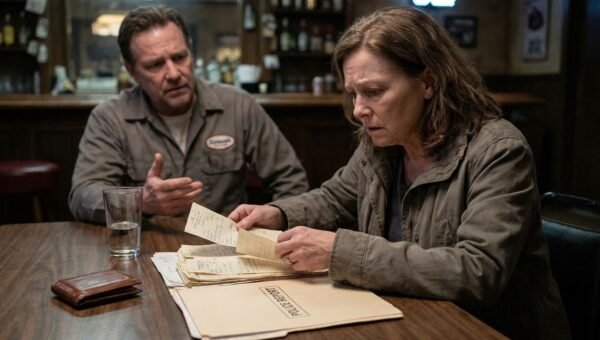
Inside the box were two manila envelopes.
The first envelope contained the paper savings bonds Evelyn had mentioned, untouched, made out in her late husband’s name and payable on death to Evelyn.
The second envelope held county tax records and a transfer deed for twenty acres of scrub timberland in Clark County. Dated fourteen months ago, the deed had been transferred out of Evelyn’s name through a power of attorney David had convinced her to sign during her knee surgery recovery. Next to the deed was a settlement statement from a commercial timber buyer for $36,900, deposited into a solo checking account in David’s name at a regional credit union I didn’t even have access to.
David hadn’t used our home equity loan to pay off medical debts. His father’s debts had already been resolved through basic probate estate funds. David had pocketed our loan, sold the family land behind his mother’s back, and kept the entire thirty-six thousand dollars tucked away in a private account while letting me pinch pennies for groceries every single week.
He didn’t speak. He just leaned back against the kitchen cabinets, looking down at his shoes.
ENDING
Evelyn picked up the envelope with the savings bonds and tucked it carefully into her handbag. She didn’t cry. She had spent four years suspecting what had happened, living in fear of being evicted because she couldn’t afford the special roof assessment on her building while her son claimed there was no money left.
“I’m taking the bonds to the bank on Thursday,” she said to David quietly. “And you will transfer the land proceeds back to my name by tomorrow afternoon, or I will hand these timber receipts to the county clerk myself.”
David nodded once, slowly. He didn’t offer an excuse because there wasn’t one left to make.
I didn’t trade in the car that weekend. On Wednesday morning, I went down to our bank alone and used half of the remaining balance from the timber money, which David had been forced to transfer over under threat of Evelyn’s report, to pay off the twenty-five-thousand-dollar home equity loan in full.
I took my name off the lease application for the new crossover. Two weeks later, I signed the lease on a modest two-bedroom apartment three miles across town, near the library where I work.
I still have that seed-pearl earring in my jewelry tray on the bedroom dresser. Evelyn told me to keep it the night she left our kitchen. She said she didn’t want to wear gold knots anymore, and that having one half of a pair was just a reminder of something that had broken long before anyone noticed it was gone.