PART 1
My husband Jim never missed a single Sunday morning service at Grace Bible Church. Every week at a quarter past eight, he pulled on his navy blue blazer, tied his Sunday shoes, and set a fresh cup of black coffee beside my plate on the kitchen table.
“I’m heading out, Ruthie,” he would say, kissing the crown of my head. “Be back around eleven.”
I never once went with him. Twenty years ago, our eight-year-old daughter, Clara, died of acute leukemia after seven brutal months in the county hospital.
At her service, three different deacons told me Clara was taken because the Lord needed another flower in His garden. That afternoon, I set my good Bible on the high pantry shelf and closed the door. I told Jim I was done. I told him I would not sit in another wooden pew pretending that kind of loss was part of some divine plan.
Jim never fought me on it. He never raised his voice, never quoted scripture over the dinner table, and never made me feel small for staying behind. While the bells rang three blocks over, I watered my porch ferns, read the Sunday paper, and tried to ignore the hollow quiet in our kitchen.
Jim passed away six weeks ago from sudden heart failure. The funeral was small and polite. Most of the people from Grace Bible sat on one side of the chapel, and I sat on the other with my sister.
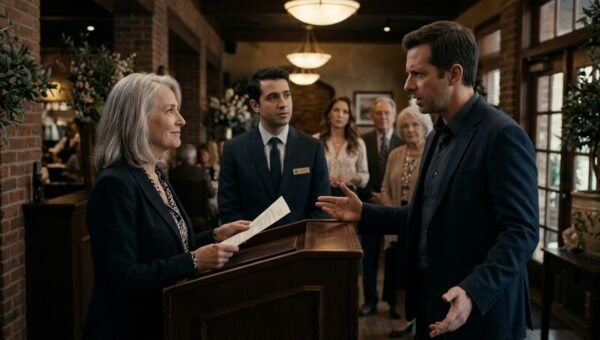
Ten days after we buried him, Howard Vance, the head of the church trustee board, drove his truck up my gravel driveway. He did not bring a casserole. He carried a tan file folder and sat on my porch swing with his hat in his lap.
“Ruth,” Howard said, clearing his throat. “Jim made a binding pledge during the capital campaign two years ago. Sixty-five thousand dollars for the new youth wing. He wanted to make amends for the spiritual state of this home before the end. We expected the funds upon his passing, and the builder is waiting.”
The room seemed to drop ten degrees. Sixty-five thousand dollars was nearly every dime Jim and I had kept in our savings account from his forty years running the hardware shop.
“Jim never mentioned a pledge,” I said, my voice shaking. “Not one word.”
Howard gave me a thin, tight smile that did not touch his eyes. “Jim carried a heavy burden, Ruth.
He carried the faith for both of you. A good man tries to cover his wife’s shortcomings where it counts. I have the signed intention sheet right here.”
I felt sick to my stomach. For two weeks, I could barely sleep. I stared at Jim’s side of the bed, wondering if the gentle man who had kissed my forehead every Sunday had actually looked down on me with pity, or if he felt so ashamed of my doubt that he gave away our retirement cushion just to buy my redemption.
Then, yesterday morning, my landline rang. It was Pastor Miller. He had been out of town on medical leave during Jim’s funeral, recovering from hip surgery.
“Ruth, please come by the study,” Pastor Miller said quietly. “There is something Jim asked me to hold for you. Every Sunday, for twenty years.”
PART 2
The church parking lot was nearly empty when I pulled in at ten on Tuesday morning.
My hands were stiff against the steering wheel. Walking up those front steps felt like stepping backward into the worst years of my life.
Pastor Miller was sitting behind a worn mahogany desk. He looked older, leaning heavily on a wooden cane, but his eyes were clear. On top of his blotter sat a green steel lockbox with a heavy brass latch. Beside it lay a small brass key.
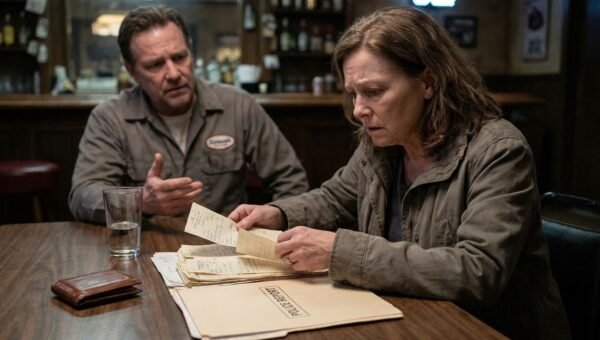
“Howard Vance came by my house two weeks ago,” I said before I even sat down. “He said Jim pledged sixty-five thousand dollars to the church building fund. He said Jim gave it because of me.”
Pastor Miller stopped mid-motion. He rested both hands flat on his desk and let out a long breath. “Howard Vance overstepped his authority, Ruth. Two years ago, Howard ambushed Jim after a deacon meeting and tried to pressure him into signing a pledge card. Jim signed a blank survey line to get Howard out of his face, but he wrote ‘Not authorized’ right across the margin. I have the original in the church safe. Jim did not owe this church sixty-five cents, let alone sixty-five thousand dollars.”
I leaned against the arm of the leather chair. The knot in my chest loosened, but the green box remained between us.
“Then what is that?” I asked.
“Jim brought me an envelope every single Sunday morning,” Pastor Miller said. “He walked into my office before the prelude started, set it on this desk, and told me to keep it locked away until the day he was gone. He did it rain or shine, fifty-two weeks a year, for twenty years.”
Pastor Miller pushed the key across the wood. “Open it, Ruth. It belongs to you.”
My fingers trembled as I turned the key. The lock popped open with a dry metallic snap.
Inside, stacked in tight, neat bundles wrapped in ordinary rubber bands, were hundreds of white business envelopes. Every single one had a date written in Jim’s neat block lettering, beginning on the first Sunday after Clara died in October of 2004.
I picked up the first envelope and slid my finger under the flap. There was no money inside. There was a folded sheet of lined yellow paper.
“Ruthie,” Jim had written. “Pastor asked us to bow our heads and pray for what we miss most. Howard Vance prayed for new carpets in the sanctuary. I prayed for you sitting at the kitchen counter with your tea. You think God left that hospital room when Clara died. I think you loved that little girl so hard you could not bear to see her hurt, and there is nothing unholy about that. You are the best thing in my life. I am coming home to fix the screen door.”
I pulled out another envelope at random, dated six years later.
“Pastor preached on forgiveness today,” the page read. “He said it takes a strong soul to hold a home together. I thought about how you took care of your mother through her dementia without once complaining. If that is not grace, I do not know what the word means. I bought two peach pies at the bakery down the street. We will eat them on the back steps.”
PART 3
I sat in that chair and read five more letters while the grandfather clock in the corner ticked.
Every Sunday, while I sat alone feeling distant from him, Jim had spent the thirty minutes of silent prayer writing to me. He wrote about the garden. He wrote about how funny I looked when I wore his wool socks around the house. He wrote about Clara’s laugh, keeping her memory alive on the paper because he knew it hurt me too much to say her name out loud.
Underneath the stacks of letters lay a blue passbook from the First Farmers Credit Union.
I opened it. The account had been opened twenty years ago under my name, with Jim listed only as the transfer agent. Every week, beside each envelope, Jim had deposited thirty dollars from his Saturday mechanic work. With compounding interest over twenty-four years, the balance stood at $41,280.
A note clipped to the passbook read: “For Ruthie. To replace the roof when it leaks, or to take that train trip to Maine we always talked about. You never asked for anything.”
Just then, the door to the office clicked open. Howard Vance walked in with a clipboard under his arm.
“Pastor Miller, good to see you back on your feet,” Howard said loudly. He stopped when he saw me, then noticed the green box. His jaw tightened. “Ruth. I hope you brought the checkbook. The contractor needs the first draw for the framing by Friday.”
Pastor Miller stood up slowly, using both hands on his cane to steady himself. He did not raise his voice, but every word came out cold and sharp.
“Howard, you will leave this office right now,” Pastor Miller said. “And if you ever set foot on Ruth’s property again, or mention that non-existent pledge to anyone in this county, I will call an emergency meeting of the entire congregation on Sunday morning. I will read the forged survey note from the pulpit, and I will hand over the financial records to the district superintendent.”
Howard’s face lost all its color. He looked from the pastor to the open metal box on the desk, then back again.
“I was only trying to secure the building fund,” Howard muttered, stepping back toward the hallway.
“You were trying to bully a grieving widow,” Pastor Miller said. “Get out.”
Howard pulled the door shut behind him. The hallway fell dead quiet.
ENDING
Pastor Miller helped me carry the green steel box out to my car. He set it carefully on the passenger seat, patted my shoulder, and told me to take all the time I needed.
I drove home along the river road. The morning sun was high, lighting up the yellow birch trees along the water. For twenty years, I had believed Jim went to church to escape our quiet, broken house. I had convinced myself that he needed a holy place because I was not enough, and because my grief had ruined the peace we used to share.
Now I knew the truth. Jim had never gone to church to get away from me. He had gone there every Sunday morning just to find a quiet desk where he could tell me how much he loved me.
I carried the box into the kitchen and set it on the table right where my coffee cup had rested every Sunday morning for two decades.
I took the rubber band off the very last envelope, dated the Sunday before he died.
“Ruthie,” his handwriting said, slightly shakier than the early years, but still steady enough to read. “The preacher said today that faith is believing in what you cannot see. I do not need to look up at the ceiling to find that. I see it every time I walk through our front door and find you waiting. Put the kettle on. I am on my way.”
I folded the paper carefully, slid it back into its sleeve, and set it next to his old coffee mug by the window. Then I sat down in the morning sun and poured myself a cup of tea.