PART 1
I closed on the two-story house on Elmwood Terrace for $280,000 in early October. It was built in the late 1960s, solid brick, with overgrown yews crowding the porch and water stains along the lower foundation. After thirty years of renting and scrimping on a dental receptionist salary, having something with my name on the deed felt like breathing fresh air for the very first time.
The unfinished basement smelled like damp lime and old furnace oil. A crude partition wall had been thrown up decades ago right across the center of the floor, cutting the laundry area in half.
I wanted it open so I could put in proper metal shelving and a washer hookup. I hired an independent contractor named Mark, a local guy with graying hair and worn work boots, to tear out the drywall and framing.
On Tuesday morning around ten, my cell phone vibrated on the reception desk at the clinic.
“Marilyn,” Mark said. His voice was flat, totally stripped of his usual cheerful drawl. “You need to come home.”
“Did you hit a main pipe?” I asked, keeping my voice low so the waiting patients wouldn’t overhear. “Is the foundation cracked?”
“Just come back to the house,” he said. “Please.”
I took an early lunch, told Dr. Miller there was a home repair emergency, and drove the twelve minutes through town with my knuckles white on the steering wheel. When I pulled into the driveway, Mark’s red pickup was parked crooked near the garage. The front door was unlocked.
I went down the wooden cellar stairs. The single overhead bulb swung slightly. Mark was standing near the middle of the room, holding an industrial yellow flashlight. Concrete dust hung in the air, and pieces of splintered two-by-four were piled neatly against the outer wall.
He stepped aside and aimed the beam at the narrow, dark cavity where the framing met the back chimney wall.
“Look,” he muttered.
The beam hit the raw timber studs. Scratched deep into the dry pine were hash marks. Groups of five, gouged into the grain with a nail or a knife tip, running from knee height up to eye level. Hundreds of them. They looked frantic, like someone counting days in the dark.
Then Mark tilted the light down toward the dirt sill near the floor.
My breath caught in my throat. It was a neat, deliberate pile of children’s shoes.
Canvas sneakers with rotted laces, tiny red buckle flats with scuffed toes, worn brown loafers, faded blue slip-ons. Dozens of pairs, stacked heel to toe. The musty leather smell hit me, mixed with the cold damp of the masonry.
I felt violently sick. My hands began to shake so hard I nearly dropped my keys. “Mark, get outside,” I whispered. “Get outside right now.”
We stood on the sunlit lawn while I dialed 911. My teeth were chattering in seventy-degree weather. Within twenty minutes, two squad cars rolled down the quiet street, followed shortly by an unmarked sedan and a crime scene van. Yellow tape went up around my maple trees. Uniformed officers kept me on the porch steps while investigators in white paper suits carried heavy tools and spotlights down into my basement.
The neighborhood was dead silent except for the low hum of the generator on the crime scene truck. Two hours passed. Then three.
Around three in the afternoon, Detective Vance came slowly up the basement stairs. His face was gray, his eyes hollow. He peeled off his rubber gloves, ducked under the tape, and walked toward where I was sitting on the porch rail.
“Ma’am,” he said quietly. “We tore up the floorboards along that rear crawlspace. We found something buried under the shallow foundation pour.”
He reached into his jacket and held up a clear evidence bag.
Inside lay an engraved silver heart locket, tarnished black along the edges, hanging from a thin broken chain.
I couldn’t breathe. My heart hammered against my ribs until my vision blurred. I knew every scratch, every notch on that clasp. I had bought that exact sterling silver locket at an estate jeweler twelve years ago for my niece, Chloe, for her tenth birthday.
It was the locket she was wearing the day before she disappeared without a trace while walking home from school.
PART 2
The world went completely silent. Detective Vance caught my elbow as my knees gave out, guiding me down onto the wooden porch bench.
“Marilyn?” he said, his voice sharp with concern. “Do you recognize this?”
“I bought it,” I choked out, staring through the clear plastic bag at the worn silver heart. “Chloe Martin. My niece. She had her initials engraved on the back. C. E. M. Look at the back.”
Vance turned the evidence bag over with gloved fingers. The tiny cursive letters were faint under decades of grime, but they were there. Chloe Elizabeth Martin.
Twelve years ago, Chloe had vanished two blocks from her middle school on a cold Thursday afternoon in November. She had been walking home with her older brother, Kevin. Kevin was fifteen then. He had run ahead to grab a soda from the corner deli, leaving her alone on the sidewalk for less than four minutes. When he walked out of the deli, Chloe was gone. Her backpack was found lying by an open storm drain.
For twelve years, our family disintegrated. My sister, Sarah, fell into a deep depression she never climbed out of, eventually moving two states away just to stop staring at the empty sidewalk outside her window. Kevin carried the crushing weight of having left her, dropping out of college, moving between odd jobs, barely speaking to anyone.
“Who owned this house before you, Marilyn?” Vance asked, his pen already poised over a small notebook.
“The seller was an estate,” I stammered, pulling my phone out with trembling hands to check the closing paperwork. “The man who lived here died in a state nursing facility six months ago. His name was Arthur Vance. No relation to you, I assume. Arthur Wayne Vance. He was eighty-four. He lived here completely alone since the nineties.”
Vance wrote the name down, his expression hardening. “Arthur Wayne Vance. We have records on him. He was questioned briefly during the initial sweep twelve years ago, like every resident within a two-mile radius. He was an elderly recluse with a clean record who claimed he was at a medical appointment in the county seat that entire afternoon. His doctor confirmed the appointment time, so the task force moved on.”
“Did you find her?” The words ripped out of my throat, raw and terrifying. “Under the floor… is Chloe down there?”
Vance hesitated, the professional wall cracking just enough to show the man underneath. “We found human remains beneath a patched layer of concrete in the back corner of that footing. Small bones. We have the county coroner on site now. We won’t know for certain until the dental records and DNA come back, but based on the location and the jewelry, you need to prepare yourself.”
He had me sit in the squad car to give a full statement while technicians carried heavy plastic containers and wrapped items out of my basement door. Every box that came up the stairs felt like an iron weight dropped directly onto my chest.
When they finally cleared the scene around dusk, leaving my home sealed behind red evidence tape, I sat in my car parked at the end of the street and dialed my sister.
It was the hardest phone call of my life.
When Sarah heard my voice breaking, she knew. She didn’t scream. She just let out a dry, cracked sob that had been waiting twelve years to leave her body. “I’m calling Kevin,” she whispered. “We’re driving up tonight.”
PART 3
By midnight, Sarah and Kevin had arrived at my temporary motel room near the highway. Kevin looked exhausted, his hair unkempt, shadows carved deep under his eyes. He sat on the edge of the second double bed, staring at the floorboards, his knuckles white and rigid between his knees.
“You bought that house,” Kevin said quietly. His voice sounded like gravel. “Of all the houses in that county, Marilyn, you bought the one she was in.”
“I didn’t know,” I whispered. “Kevin, you know I didn’t know. The bank owned it. The listing didn’t have a history attached.”
“I walked past that house every single day after school,” Kevin said, tears suddenly spilling down his cheeks without a sound. “I put up missing posters on the telephone pole right in front of his driveway. I taped her picture to the wooden pole forty feet from his front porch. He watched me do it from his window. I remember seeing the curtain twitch.”
At eight o’clock the next morning, Detective Vance called us to the station.
We sat in a small conference room with cold fluorescent lights and a scratched laminate table. Vance placed three Manila folders in front of him, along with a certified laboratory printout.
“The dental match came back an hour ago,” Vance said gently. He looked directly at Sarah. “It is Chloe. I am so sorry.”
Sarah closed her eyes and gripped my hand. Her skin was freezing.
“We processed the basement entirely overnight,” Vance continued. “The shoe collection had thirty-two pairs. We are cross-referencing regional missing child files dating from 1978 up to 2012. Arthur Vance was a predator who hid behind the disguise of an eccentric, quiet old man. But there was something else under that subfloor. We found a steel lockbox buried beneath the foundation footing, wrapped in heavy plastic.”
Kevin leaned forward, his jaw tight. “What was in it?”
Vance opened the top folder. “Arthur Vance kept logs. Spiral notebooks. Dates, names, small personal belongings he took from them. He was meticulous. But what caught our attention was the final notebook, dated November 2012.”
Vance slid a high-resolution photograph across the table. It was a photocopy of a handwritten page.
The handwriting was shaky, an old man’s scrawl:
*November 14, 2012. Girl from Elm Street. Picked up near corner of 4th. Had silver heart necklace. Screamed for her brother. Locked in back space. Left home at 1:15 PM for doctor visit to create receipt. Returned 4:30 PM.*
Underneath that entry, written three days later in the same pencil, was another note:
*Boy with flyers came by. Taped picture to telephone pole. Stood on sidewalk crying. Left him alone. Floor poured Sunday night.*
Kevin buried his face in his hands. A violent shudder ran through his body. Twelve years of torturing himself, believing she was grabbed by a passerby on the highway, wondering if she was alive in another country, wondering if she had suffered for years. The truth was brutal, but it was anchored to reality. She had not suffered for years in captivity; the timeline was established. The old monster had covered his tracks immediately and died in an assisted living facility before the law could catch him.
“There is one more thing,” Detective Vance said, his voice dropping an octave. He looked straight at me. “The deed history on the Elmwood property.”
“What about it?” I asked.
“When Arthur Vance was moved to the state nursing home in early 2024, his estate went into conservatorship to pay down his Medicaid debt. The court appointed an independent trustee to liquidate the property. The house sat on the market as a distressed sale for five months before you put in your offer.”
Vance pushed another document toward me. It was the original land contract from 1968, when Arthur Vance first purchased the plot.
“The contractor who built that secret double wall in the basement thirty-five years ago wasn’t Arthur,” Vance said. “Arthur hired someone. We checked the old building permit archives in the basement of the courthouse this morning.”
I looked at the yellowed slip of paper.
The name on the builder’s permit for the basement partition wall in 1974 was Frank Miller.
Dr. Frank Miller’s father. The same family dental practice where I had worked for twenty-two years.
ENDING
The realization hit me like physical blow. Dr. Miller’s father had been a general contractor before he passed away in the nineties.
“Arthur Vance was Frank Miller Senior’s first cousin,” Detective Vance said quietly. “They owned land together in the county. We executed a search warrant on the older Miller estate storage barn two hours ago. We found old building supplies, spare cement mixers, and three journals belonging to the father. He knew what Arthur was doing. He helped him frame out that concealment wall under the guise of building a root cellar.”
The web of silence in that small town had stood for decades, protected by respectability, quiet handshakes, and families looking the other way. Dr. Miller himself was interrogated that afternoon; he claimed no knowledge of his father’s dealings with his eccentric cousin, but the business records showed Arthur Vance had transferred ownership of family parcels to the Millers decades ago to settle personal debts.
Within forty-eight hours, the state police reopened five cold cases from the late seventies and eighties, matching the shoes found in my basement to girls who had disappeared within a thirty-mile radius during the years Arthur Vance had worked as a county school bus driver.
I never spent another night in the house on Elmwood Terrace.
The city condemned the structure to allow forensic anthropologists to dig beneath the entire basement slab, bringing closure to three other families whose daughters had vanished without an answer decades before Chloe was born. The mortgage lender agreed to rescind the purchase under a rare material defect clause, voiding the $280,000 debt after the state prosecutor intervened.
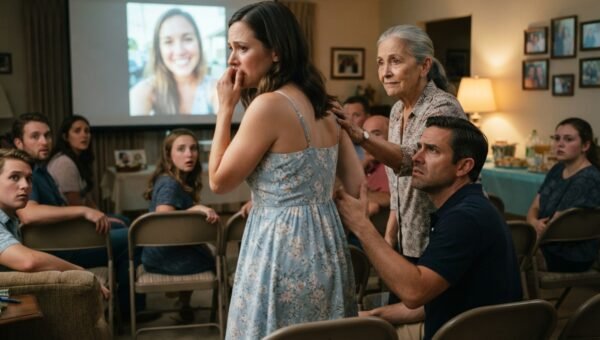
A month later, on a crisp November morning, we held a memorial service for Chloe.
We buried her in the small cemetery behind the Presbyterian church, right next to the woods where she used to collect colored leaves in the fall. The service was small, just family and a few old neighbors who still remembered her bright laugh.
Before the casket was lowered, Detective Vance handed me a small, clean jewelry box. The silver locket had been fully processed by the state lab and released back to the family.
I took the tarnished chain and placed it into Kevin’s open palm.
“She was close to you the whole time, Kevin,” I told him, holding his trembling fingers closed over the silver heart. “You didn’t abandon her. You looked for her until she was found.”
For the first time in twelve years, the hollow, guilty look in Kevin’s eyes broke, and he wept openly on his mother’s shoulder.
I quit my job at the clinic the following Monday. I packed my belongings into an apartment near the coast, three hours away from Elmwood Terrace, where the only sound outside my window was the steady, clean roll of the tide against the shore. I still wake up sometimes in the middle of the night smelling damp concrete and old pine, but then I remember the small stone in the churchyard, engraved with Chloe’s name, finally standing in the sun.