PART 1
The day after Dad’s funeral, I sat down at his kitchen table and laid out the reality of the small two-bedroom house he had built with his own hands back in 1984.
My name was on the deed. Dad had transferred the title into my name two years before he got sick, wanting to make sure the property stayed in our family. His will was simple: the house belonged to me, and his second wife, Brenda, received a straight cash bequest of $10,000 from his checking account. They had been married for seven years.
Brenda sat across from me in a bright pink velour tracksuit, stirring sugar into instant coffee like we were waiting on a lawn mower repair.
“Brenda, the taxes and insurance on this place run about six hundred a month,” I said quietly. “I cannot carry this house while paying my own mortgage across town. You received the $10,000 from Dad’s account. I am asking you to pay $400 a month to cover your share, or use that money to move closer to your daughter in Ohio.”
She set her spoon down so hard the coffee splashed over the rim.
“How dare you?” she snapped, her face tightening up. “I lived here for years! I took care of your father while you were busy working your state job. You think you can treat me like a stranger off the street? I am not giving you a single penny of my ten thousand dollars. Not one dime.”
“Then you can’t stay here,” I told her. “I’m not asking for market rent. Four hundred dollars doesn’t even cover the property taxes and the heat.”
“Try and throw me out,” she said. She leaned back, crossed her arms, and stared straight through me. “Just try it.”
I didn’t argue. I stood up, walked out to my truck, and drove straight down to the county clerk’s office. Two days later, my attorney served her with a formal thirty-day notice to vacate. When the thirty days expired, she hadn’t packed a single cardboard box. Instead, she changed the deadbolt on the front door and told the neighbors I was putting an elderly widow out in the snow.
It took four months and almost three thousand dollars in legal fees to get through the eviction process. On a cold Tuesday morning in November, the sheriff stood by while the locksmith drilled the cylinder and Brenda loaded three suitcases and two plastic tubs into her nephew’s pickup.
She didn’t look at me once. She just climbed into the passenger seat, slammed the door, and drove away.
For an entire year, there was dead silence.
I spent those twelve months cleaning out forty years of Dad’s tools, repainting the plaster walls, and catching up on the neglected plumbing. I put the house up for rent to a young couple from the community college. I thought the whole ugly chapter was buried.
Then yesterday morning at seven o’clock, my phone rang with a restricted number.
I picked it up, expecting a telemarketer.
“I need you to come to the diner on Route 4,” Brenda’s voice rasped across the line. She sounded breathless, almost frantic. “Right now. Do not bring anyone with you.”
“Brenda, we have nothing to talk about,” I said. “The house is rented. You took your money. Leave me alone.”
“You think you won that house clean, don’t you?” she cut in, her voice dropping down to an ugly whisper. “You have no idea what your father actually did.
If you don’t show up in twenty minutes, I am dropping these papers off at the county courthouse, and you will lose every square foot of that land.”
PART 2
The diner on Route 4 was half-empty when I walked in. The smell of old grease and burnt decaf hung thick in the entryway.
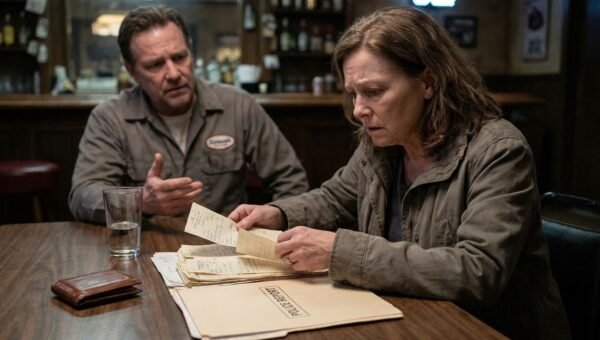
Brenda was sitting in the corner booth beneath a yellowed fluorescent light. She looked awful. In twelve months, she seemed to have shrunk into herself. Her blonde hair had grown out gray at the roots, and her fingers trembled against the vinyl table. Next to her untouched water glass sat a thick, dog-eared manila envelope held together by a cracked rubber band.
I slid into the booth across from her and kept my coat on. “Say what you called to say, Brenda.”
She didn’t offer a greeting. She pulled the rubber band off the folder and slapped a stack of papers down on the formica between us.
“Look at the dates,” she said, her voice hard. “Go ahead. Read them.”
I pulled the top document toward me. It was a formal loan agreement from five years ago, drawn up between Dad and a private equipment lender out of Clarksville. The loan was for $38,000, taken out when Dad had tried to expand his small backhoe business right before his back gave out.
Attached to the loan agreement was a lien filed against the property.
“He never told you about that, did he?” Brenda leaned in, her eyes wide with spite. “He put a mortgage on that house before he ever put your name on the deed. He couldn’t pay it back. He stopped making payments six months before he died. The lender has been hunting this money down, and they found me.”
I stared at the signature at the bottom of the page. It was unmistakably my father’s clumsy, left-handed scrawl. My chest went tight. When Dad deeded me the house, he swore on our family Bible that the parcel was free and clear. If this lien was valid, it attached directly to the real estate, which meant the lender could foreclose and force an auction.
“Where did you get these?” I asked, keeping my voice steady even while my stomach turned over.
“He kept them locked in the metal lockbox under his workbench,” Brenda said. “The one you couldn’t find the key to when you threw me out. I took it with me that morning. I held onto it because I knew the day would come when you’d have to pay me what I earned.”
She leaned across the table until I could smell the stale menthol cigarettes on her collar.
“The balance is up to $46,000 with penalties,” she whispered. “The lender is preparing to record the default. But the lender’s rep told me they’d settle the whole note for $25,000 cash if it’s paid before the end of the month. You give me $15,000 of that, and I give you the original note and the release forms. Otherwise, I hand this entire file to their collection attorney this afternoon, and you can watch the county sheriff auction off your daddy’s house.”
I looked down at the paper in my hands. The notary stamp was smudged, but the date on the filing was stamped with an official county seal. Dad had always been proud, too proud to admit when a business venture went sour. But something about the paperwork felt off.
“Why would the lender talk to you, Brenda?” I asked quietly. “You weren’t on the deed. You weren’t on the loan.”
“Because I was his wife,” she said immediately. “And because I have the original documents.”
I slid the papers back into the manila envelope. “I need twenty-four hours to verify this with the county recorder.”
“You have until five o’clock today,” Brenda said, snatching the envelope back against her chest. “Five o’clock. If my phone doesn’t ring with a cashier’s check ready, your family property is gone.”
PART 3
I walked out of the diner and got straight into my truck. My hands were shaking against the steering wheel, but not from fear. From anger.
Instead of panicking, I drove directly to the Clarksville County Courthouse. I knew the chief deputy clerk in the land records division, an older woman named Martha who had gone to school with my mother.
I laid out the details on the counter. “Martha, I need an immediate title search on parcel 104-B. My father’s place on Ridge Road.”
Martha pulled up the county terminal and typed in the parcel identification numbers. The clatter of her keyboard seemed to take an eternity. She clicked through three screens, pushed her wire-rimmed glasses up her nose, and turned the monitor slightly toward me.
“There is no active lien on Ridge Road,” Martha said firmly. “None.”
“Look back five years,” I urged her. “A private equipment note for thirty-eight thousand.”
“Oh, that one,” Martha nodded, tapping a folder icon on the screen. “That was recorded in August of 2021. But look right here. It was satisfied and formally released twenty-two months ago.”
I leaned in. Across the digital record was a clear, certified stamp: *SATISFACTION OF MORTGAGE FULLY RECORDED.*
“Who paid it off?” I asked.
Martha opened the scanned attachment. “Your father did. Wire transfer from an estate settlement he received from his brother in Oregon. Thirty-eight thousand dollars, plus interest. The lien was canceled completely before he signed the deed over to you.”
The room seemed to stop spinning. The lien was dead. The house was completely safe.
Then Martha tilted her head, reading the lower lines of the filing. “Wait a minute. There’s an addendum note here from three months ago. Someone came in here requesting a certified copy of the old pre-satisfaction paperwork, claiming to be the surviving spouse.”
“Brenda,” I said.
“Yes, Brenda Miller,” Martha confirmed. “She paid ten dollars for the historical record, but she didn’t request the satisfaction certificate that canceled it.”
I thanked Martha, walked out to my truck, and sat in the quiet cab for five minutes. Brenda hadn’t just held onto an old debt; she had deliberately taken an expired, paid-off mortgage note and tried to use it to extort fifteen thousand dollars from me. She had gambled that fear and grief would make me write a check before I ever checked the public books.
My phone screen lit up on the passenger seat. It was 3:45 PM. Brenda’s name flashed across the display.
I answered and put it on speaker.
“Have you got the money?” she demanded without a greeting.
“Meet me at the house, Brenda,” I said calmly. “Four-thirty. I will have the papers ready.”
“You better have the bank draft,” she said, and hung up.
I arrived at Dad’s old place fifteen minutes early. The young couple who rented the house were at work, and the gravel driveway was empty. When Brenda’s nephew’s truck pulled up, she stepped out alone, clutching that worn manila folder like a shield.
She marched up the front porch steps, her face twisted in triumphant satisfaction.
“You brought the cashier’s check?” she asked, stopping on the top step.
I reached into my coat pocket. I didn’t pull out a check. I pulled out the certified copy of the Satisfaction of Mortgage that Martha had printed and stamped with the raised seal of the county court.
I held it right in front of her eyes.
“Dad paid this off twenty-two months ago, Brenda,” I said, my voice dead level. “The lien was satisfied before he ever signed the deed to me. You knew it was paid off, because you were living in this house when the certified release letter arrived in his mailbox.”
The color drained from her lips so fast it looked like she had taken a blow to the ribs. Her mouth fell open, but no words came out.
“You took an expired document out of his private lockbox,” I told her. “You came to this county, pulled the pre-satisfaction file, and tried to extort fifteen thousand dollars from me under threat of a fraudulent foreclosure.”
“I… I didn’t know he paid it,” she stammered, stepping back toward the railing. “The lender called me… they told me…”
“Stop lying,” I said. “Martha at the clerk’s office remembers you. She documented the request you made three months ago. Attempting to obtain money by false pretenses on a forged or canceled debt is a felony in this state.”
She clutched the railing with both hands. Her shoulders slumped, and for the first time since my father drew his last breath, the arrogant sneer was completely gone from her face.
ENDING
“What are you going to do?” she whispered. Her voice was cracked and small.
“I called the sheriff’s department from the courthouse parking lot,” I told her. “Deputy Lawson is on his way out here right now to take an incident report for attempted fraud and harassment.”
“No,” she pleaded, tears finally spilling over her wrinkled cheeks. “Please. I don’t have anywhere to go. My daughter threw me out last month. I’m living out of a motel on the bypass. That ten thousand dollars from your dad didn’t last six months. I’m broke.”
I looked at the woman my father had chosen to spend his final years with. There was no pleasure in seeing her like that. Just an empty, heavy sadness for how cheap she had made everything. Dad had tried to give her a cushion with that ten thousand dollars. He had given her enough to start fresh, but her pride and greed had eaten it up before the first year was out.
“You leave that envelope on this porch,” I said. “And you get into that truck and never contact me, my family, or come within a mile of this property again. If I ever see your name on my caller ID, or if you show your face near my tenants, I will hand Martha’s certified log and this report directly to the county prosecutor.”
Brenda stood there for several long seconds, staring down at the concrete step between us. Then, with trembling hands, she dropped the manila folder onto the wooden porch swing.
She didn’t say another word. She walked down the steps, her head down, climbed into the passenger side of her nephew’s truck, and pulled the door shut. The truck backed down the gravel drive, turned onto Ridge Road, and disappeared past the timberline.
Ten minutes later, Deputy Lawson’s cruiser pulled into the drive. I handed him the paperwork, gave him a clear, factual statement of what had occurred, and signed the official complaint file so there would be a permanent paper trail on record with the county.
After the deputy left, the afternoon grew quiet.
The late autumn sun was setting behind the oak trees at the edge of Dad’s parcel, casting long, sharp shadows across the front yard. I picked up the manila envelope from the swing, walked inside, and unlocked Dad’s old rolltop desk in the corner of the living room.
Underneath the legal papers inside the folder was a small, brass-edged key: the spare key to his workbench lockbox that had been missing since the day she moved out.
I held that small piece of cold brass in my palm for a long time. Then I slid it onto my own key ring, locked the front door behind me, and walked down the steps to go home.