PART 1
My wife, Martha, kept every single birthday card our son David ever sent after he moved overseas. Even the plain ones that only had three lines written in blue ballpoint ink.
After Martha died in early April, I spent nearly two weeks avoiding her dresser. When I finally forced myself to open the bottom drawer, I found the stack. There were twenty-four cards tied together with faded green ribbon.
I almost tossed the whole bundle straight into the cedar memory box in the closet without untying them. It hurt too much to look at David’s handwriting while the house was so quiet.
Then I noticed the envelope near the bottom. The green ribbon had cut a small crease into its edge, but the paper flap was still glued shut. It had never been opened.
The postmark was dated nine years ago, in October. That was the exact autumn David stopped coming home for Christmas. Back then, he told us his engineering firm in Frankfurt wouldn’t approve the time off. The next year he made another excuse, and after that, the excuses turned into a quiet, permanent distance. We spoke maybe three times a year, always on birthdays, always polite, always rushed. Martha cried over it every holiday, wondering what she had done wrong as a mother.
I took a butter knife from the kitchen counter and slid it under the sealed paper.
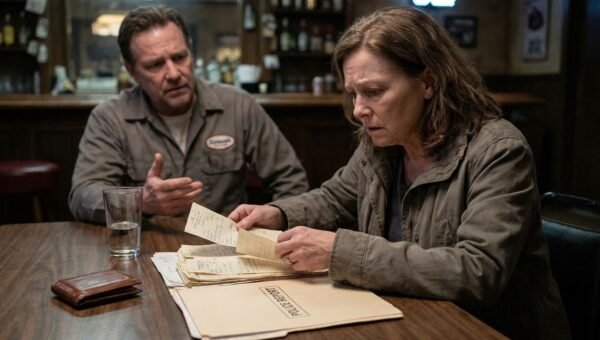
Inside, there was no birthday card. There was only a folded piece of hotel stationery and a yellowed register receipt from the Riverview Inn in Cincinnati, Ohio.
I had never been to Cincinnati in my life. I ran a small hardware supply warehouse in Grand Rapids, Michigan, and my travel barely ever took me south of Fort Wayne.
Written in pen across the notepad paper was David’s handwriting: “Mom, I saw Dad here. I don’t know how to tell you.”
I sat down on the edge of the unmade mattress, trying to make the pieces fit together. My eyes dropped to the receipt.
The name typed into the guest line was Arthur Miller, which is my name. The room had been booked for three nights in September, nine years ago. But right underneath it, printed clearly on the second guest line, was a name I knew just as well.
It was Evelyn Vance.
Evelyn was Martha’s younger sister. She had lost her husband to cancer twenty years ago, and she lived in our finished basement apartment for six years while she got back on her feet.
She had eaten dinner at our table five nights a week. She had helped Martha plant the garden every spring.
I stared at the paper until the print blurred. Martha had received this letter nine years ago, tucked it into the middle of the stack, tied the ribbon, and never said a single word to me.
PART 2
I did not sleep that night. I sat at the kitchen table with the receipt under the lamp, drinking stale coffee and going back through nine years of memories.
I remembered September of that year. Martha had taken a four-day trip down to Louisville to visit Evelyn, who had moved into a small townhouse there two years earlier. I had stayed behind in Michigan to cover an inventory audit at the warehouse. When Martha came home, she had seemed quiet, but I assumed she was just worn out from the drive.
Then came the holidays. David had called to say he could not make it back from Germany.
Martha had taken the call in the laundry room. When she came out, her eyes were dry, but her voice was flat. I thought she was hiding her disappointment.
Now, looking at the receipt, a sickening realization hit me. David had been in the United States that September. He must have flown in for a job interview or a conference, stayed near Cincinnati, and spotted a man who looked like me checking into a hotel with his aunt. He assumed I was having an affair with his mother’s sister. He sent the proof directly to his mother.
And Martha had looked at the name on that paper, believed it, and carried the weight of it alone until the day she stopped breathing.
The anger came fast, but the confusion was heavier. I knew my own life. I was sixty-four years old, and I had never cheated on Martha. I had never touched another woman, let alone her sister.
At seven in the morning, I pulled out our old bank binders from the file cabinet in the den. I went through the monthly statements from nine years ago. There was no charge for the Riverview Inn. There were no cash withdrawals that matched the $480 total on the receipt.
I picked up the phone to call Evelyn. My hand was shaking so badly I misdialed the first time.
When she answered on the third ring, her voice sounded raspy with sleep. “Arthur? Is everything alright?”
“Evelyn,” I said, keeping my voice as steady as I could. “I’m going through Martha’s things. I found an envelope David sent her nine years ago from overseas. It had a receipt from the Riverview Inn in Cincinnati with your name on it. And my name.”
The line went completely dead. I could hear traffic moving outside her window in Louisville, but she did not breathe into the phone.
“Evelyn?” I said.
“Arthur, please,” she whispered. Her voice cracked. “Martha swore she burned that.”
PART 3
“She didn’t burn it,” I told her. “She hid it in her dresser. And David hasn’t set foot in this house for nearly a decade because he thinks I betrayed his mother with you.”
Evelyn began to sob, not with anger, but with a deep, frantic panic. “It wasn’t you, Arthur. You have to believe me. Martha knew it wasn’t you.”
“Then why does this paper say Arthur Miller?” I demanded. “Why did my son see someone who looked like me, and why did my wife hide it until she died?”
“Because of Tommy,” Evelyn wept.
Tommy was my younger brother. He had struggled with gambling debts and bad checks his entire adult life. He looked enough like me that people in town used to confuse us all the time when we were younger, right down to the receding hairline and the heavy shoulders. Ten years ago, Tommy had borrowed money from some men in Toledo, got in over his head, and vanished south.
“Tommy reached out to me that summer,” Evelyn confessed, her words tumbling over each other. “He had nothing. He had no identification because he had lost his wallet and his driver’s license in a bar fight. He was hiding out in Kentucky. He showed up on my doorstep begging for help. He told me the collectors were looking for him and he needed to lay low.”
“What did that have to do with me?” I asked, my chest tightening.
“He had one of your old expired driver’s licenses,” Evelyn said. “You kept a box of old tax papers and spare keys in my basement apartment when I lived with you. Tommy stole that box when he helped me move. He used your expired license to check into that hotel because he was terrified of using his own name. I went with him because he didn’t have a credit card, and I paid the deposit with cash.”
I gripped the kitchen table. “And David?”
“David was at that exact hotel for a weekend engineering seminar,” Evelyn said. “Tommy saw him in the lobby and panicked, ducking his head and walking away. David only saw him from behind and from the side. Tommy was wearing your old wool barn jacket. David came up to the counter later, asked the clerk if an Arthur Miller had checked in, and the clerk looked at the register and confirmed it.”
The room seemed to shrink. “If Martha knew this, why didn’t she tell David? Why didn’t she tell me?”
“Because she drove down to see me that week,” Evelyn cried. “She came with the letter in her purse, ready to confront me. I told her the truth. I showed her Tommy. Tommy was sitting in my kitchen, broken and terrified. And then Martha found out that Tommy owed $35,000 to people who had already threatened to come to your warehouse.”
The truth landed like a concrete block.
“Martha knew your temper,” Evelyn said quietly. “She knew if you found out Tommy stole your identity and put your name on hotel records, you would turn him in, or you would confront those men yourself. And she knew Tommy had used your Social Security number to take out a $12,000 title loan on his truck before he left Michigan. She was terrified it would destroy your business and send your brother to prison.”
Martha had protected me from a violent mess, and she had protected my brother from his own ruin. But in doing so, she had traded away our son.
“She tried to write to David,” Evelyn said. “She told him it was all a misunderstanding, that you were never there. But David refused to believe her. He thought she was just covering for you to save face. He told her he couldn’t stand to look at your face across the dinner table anymore. And Martha couldn’t bring herself to show you the letter, because she knew you’d never forgive Tommy, and you’d never forgive her for keeping it quiet.”
ENDING
I hung up the phone without saying goodbye to Evelyn.
I booked a flight to Frankfurt that afternoon. I did not call David to ask for permission. I simply took a cab from the airport to his apartment building on a rainy Thursday morning, holding the green ribbon and the yellowed hotel receipt in my jacket pocket.
When he opened the door, he looked just like I did thirty years ago. He stared at me with the same guarded, defensive look he had carried in his eyes for nine years.
“Dad?” he said, standing in the doorway without stepping aside. “What are you doing here?”
I didn’t give a long speech. I didn’t raise my voice. I took the receipt, the note in his own handwriting, and my brother Tommy’s police record from Ohio, which I had stopped at the county courthouse to pull on my way to the airport.
“Your mother didn’t betray you,” I said. “And I never betrayed her. Come sit down.”
We sat in his small kitchen for three hours. David read the papers twice. He looked at the dates, the signature on the guest slip that was spelled in Tommy’s slanted, clumsy script, and the old letter he had mailed to his mother when he was twenty-six years old.
When he finally understood, he did not cry loudly. He just set his coffee mug down and buried his face in his hands, realizing that his mother had gone into the ground thinking her only boy hated the family home.
I put my hand on his shoulder. It didn’t fix the nine years of missed Christmases, and it didn’t bring Martha back to the garden she loved. But for the first time in nearly a decade, my son did not pull away.
“I’m coming home for Thanksgiving,” he told me quietly.
I nodded, took the receipt off the table, and let him keep the note.