PART 1
The paper beneath Maya crackled as the doctor pressed two fingers gently into her lower right abdomen. Maya suddenly sucked in a sharp breath, her eyes going wide, and her fingers clamped down around my wrist like a vise.
The doctor stopped immediately.
She did not ask Maya if it hurt twice. She did not tell her to relax or take a deep breath. She just eased her hands away, pulled her wheeled stool an inch closer to the edge of the exam table, and looked up at me.
Her expression was completely flat, the kind of quiet, disciplined stillness you only see on people who deliver terrible news for a living. Every sound in that small room seemed to cut out all at once, even the hum of the overhead fluorescent lights.
“I need to call upstairs,” she said softly.
She stood up and reached straight for the beige wall phone beside the stainless-steel sink.
My stomach dropped through the linoleum floor.
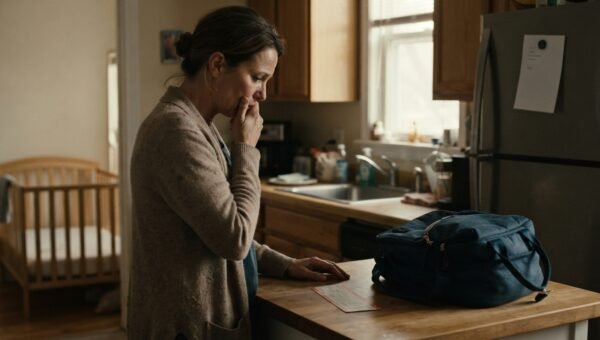
For nearly a month, my fifteen-year-old girl had been disappearing right in front of me. Maya had lost eleven pounds since the middle of October. Her school uniforms hung off her sharp collarbones like clothes on a wire hanger. She would come home from tenth grade, leave her backpack sitting on the floor by the front door, and crawl straight under the duvet on her bed without kicking her sneakers off. Whenever dinner was ready, she would push her chicken or rice around with a fork, swallow three bites, and press her palm flat against the waistband of her jeans.
And every single time I tried to step in, my husband Robert shut it down.
“She is fifteen, Sarah,” Robert would say from behind his laptop at the kitchen table, not even glancing up from his spreadsheets. “It is stress. She has honors chemistry, she is trying out for track, and she wants attention. If you jump every time she complains about a stomachache, you are teaching her how to be fragile. Give her some Pepto-Bismol and tell her to finish her homework.”
Robert had been an assistant high school principal for twelve years before moving into district administration. He thought he knew teenagers down to their molecular structure. In his mind, every teenage girl was an emotional tempest manufacturing drama out of thin air to get out of tests and chores. He had an answer for everything, delivered in that steady, reasonable, patronizing tone that made me feel like an hysterical idiot for worrying.
When Maya woke up dizzy on a Tuesday morning, Robert said she stayed up too late on her phone. When she threw up her orange juice on Thursday, Robert said she drank it too fast on an empty stomach.
Then yesterday happened.
At 1:15 in the afternoon, the school nurse, Mrs. Gable, called my cell phone directly.
“Sarah,” she said, her voice pitched low and urgent. “Maya is in my clinic again. This is the third time in six school days. She has a low-grade fever, she looks gray, and she is doubled over on the cot. I am not a doctor, but this is not school avoidance. This girl is in real pain. She needs to be evaluated by a physician today.”
I walked straight into our living room, where Robert was working from home on his laptop. I told him what the nurse said. I told him we needed to take Maya to urgent care or the emergency room right now.
Robert took off his reading glasses, pinched the bridge of his nose, and let out a long, theatrical sigh.
“Mrs. Gable panics over paper cuts,” he said, shaking his head. “She covers her own skin because of liability. If you pull Maya out of school right before fifth period, you are rewarding her. I will talk to Maya tonight at dinner. Do not go pick her up.”
I backed down. God forgive me, I listened to him. I convinced myself that maybe he was right, that maybe I was hovering, that maybe mothers just imagine the worst.
When Maya came through the door at four o’clock, she did not even make it up the stairs. She sat down on the second step, pulled her knees up to her chest, and rested her forehead against the banister. When I knelt beside her and asked why she had not told her father how bad it was getting, she looked straight at me.
Her eyes were sunken and bloodshot, completely dry of tears.
“I quit telling Dad,” she said softly, her voice barely a whisper against the wood. “Because he never believes me.”
That sentence went through me like a meat hook.
The next afternoon, at 1:00 sharp, I did not call Robert. I did not text him. I drove straight to the high school, signed Maya out of the attendance office under the watchful, nodding eye of Mrs. Gable, and drove her directly to St. Jude Regional Hospital.
I bypassed the retail urgent care clinic down the street. I went straight to the main hospital pavilion, guided by an ugly, gnawing dread in my gut that I had spent three weeks trying to drown out.
And now here we were.
The doctor hung up the wall phone with a sharp plastic click. She turned back around to face us, her hands resting flat against her lab coat.
“The surgical team on the fourth floor is prepping a bay for an emergency ultrasound right now,” she told me, her voice perfectly even. “We are not waiting on a standard radiology queue. Her white count came back from the rapid panel at nineteen thousand, her abdomen is rigid, and she is showing classic signs of acute peritoneal irritation. We need an ultrasound and a contrast CT scan within the hour.”
Before I could even wrap my mouth around the words to answer her, the heavy exam room door swung wide open.
There stood Robert.
His navy tie was loosened at the collar, his trench coat was unbuttoned, and his face was flushed bright crimson with fury. In his right hand, he was clutching his phone with our shared family location app still glowing brightly on the screen.
PART 2
“What the hell is this, Sarah?” Robert said, his voice dropping into that low, authoritative baritone he used to discipline unruly students in the hallway. “I had a tracking alert pop up on my phone showing Maya’s phone moving east down the parkway during fifth period. Then I called the school office and they told me you checked her out without a word to me. Are you out of your mind?”
He took two long strides into the room, barely glancing at the exam table. He pointed a finger at Maya’s sneakers.
“Put your shoes on, Maya. You missed your AP history quiz. We are going home.”
“Robert, stop,” I said, standing up so fast the plastic visitor chair scraped loudly against the wall. “Do not speak to her like that. Look at her.”
“I am looking at her,” Robert snapped, finally turning his glare to the doctor. “Look, I know how this works. She tells you her stomach hurts, you run five thousand dollars worth of unnecessary labs to protect your hospital from liability, and my insurance deductible gets wiped out before Thanksgiving. She has a nervous stomach. She gets it before every major test cycle.”
The doctor did not flinch. She took a single step between Robert and the table, effectively blocking his view of Maya, who had curled herself into a tight, trembling ball beneath the thin paper sheet.
“Sir, I am Dr. Keller,” she said, her voice dropping all warmth. “I do not know what your background is, but your daughter has an acute surgical abdomen. Her white blood cell count is nearly triple normal limits, her abdomen exhibits involuntary guarding and rebound tenderness, and she is currently febrile at 101.8. If you try to remove her from this hospital, I will immediately involve hospital security and file an emergency report with Child Protective Services for medical neglect. Now step back, or wait in the hallway.”
Robert’s mouth opened, but no sound came out. For the first time in the twenty years I had known him, he looked entirely stripped of words. His face drained of its angry red flush, turning a sickly, mottled gray.
Two nurses pushed through the door with a transport gurney before Robert could recover. Within ninety seconds, they had transferred Maya from the table. Dr. Keller walked beside the gurney, holding Maya’s IV bag high, while I ran alongside, holding my daughter’s freezing fingers.
Robert followed five paces behind, his expensive dress shoes clicking hollowly against the tile floor, completely useless.
They wheeled Maya straight into the imaging suite. I was allowed to stand in the corner of the ultrasound room behind a lead shield while the technician smoothed warm gel over Maya’s right lower quadrant. Maya groaned, turning her face into the pillow, crying quietly for the first time all day.
The technician stared at the dark screen, her mouth set in a hard, grim line. She measured something twice with the digital crosshairs, clicked three images, and then reached for the internal phone on the console to page the on-call pediatric surgeon.
Ten minutes later, in a private consultation alcove outside the CT scanner, a tall woman in green scrubs with her surgical cap already tied back approached us. Her badge read Dr. Elena Chen, Pediatric Surgery.
“Are you Maya’s parents?” Dr. Chen asked.
“Yes,” I said. Robert stepped forward beside me, clearing his throat, trying to regain his footing.
“I am her father,” Robert said, his voice shaking slightly now. “Is it an inflamed appendix? Can you manage it with intravenous antibiotics? I have read that the newer protocol—”
“Mr. Miller, be quiet and listen to me,” Dr. Chen interrupted, cutting him off with brutal surgical precision. “Your daughter’s appendix did not just get inflamed yesterday. Based on the extensive fluid collection, the tissue thickening, and the free air showing on the ultrasound and rapid CT, her appendix ruptured several days ago.”
A cold, sickening ringing started in my ears. “Ruptured?” I whispered.
“Yes,” Dr. Chen said, looking straight into Robert’s eyes. “Her body has spent the last three or four days trying to wall off a massive internal infection. That is why she was dizzy. That is why she could not eat. She is septic. The abscess has begun leaking into her peritoneal cavity. We are taking her into the operating room right now. We need to wash out her abdomen, place drainage tubes, and excise what remains of the necrotic tissue.”
Dr. Chen pulled a clipboard from under her arm and thrust a pen into my shaking hand.
“Every hour this sat undiagnosed increased her risk of systemic septic shock. You got her here just in time, but this is a major, complicated surgery. I need your signature right now.”
I signed the paper against the hard plastic clipboard, my hand trembling so violently the ink tore through the top page.
As the surgical team unlocked the gurney brakes and wheeled Maya through the heavy double doors of the operating theater, Robert reached out to touch her blanket.
Maya did not look at him. She turned her head toward me, her eyes glazed with fever, and whispered, “Mom, please don’t leave.”
“I am right here, baby,” I sobbed, watching the doors swing shut. “I am right outside.”
When the doors clicked shut, the hallway fell into a deafening, terrifying silence. Robert stood there in his neat dress shirt, looking at his open hands as if he did not recognize them.
PART 3
The surgery took three hours and twenty minutes.
Those hours were the longest, darkest stretch of my entire life. I sat in a hard vinyl chair in the fourth-floor surgical waiting area, watching the digital status board refresh every sixty seconds.
Robert sat two chairs down from me. At first, he tried to pace. He paced the length of the carpet, rubbing the back of his neck, picking up outdated parenting magazines and dropping them back onto the side tables. He pulled out his phone, checked his work emails, and put it away.
Every single movement he made filled me with a deep, burning rage that I had never felt toward another human being.
“Sarah,” he said around the two-hour mark, his voice cracking as he pulled his chair closer to mine. “Look… I didn’t know. You have to believe me. Kids at school… they exaggerate everything. Every week there’s a girl in the guidance office claiming she’s dying of something just to skip a midterm. I thought she was just overwhelmed. I thought I was protecting her from building bad habits.”
I turned my head slowly and looked at him. I did not raise my voice. I did not cry.
“She told you she was in pain for four weeks, Robert,” I said, every word feeling like ground glass in my throat. “She stopped eating. She lost eleven pounds. The school nurse called us. And yesterday, she told me to my face that she stopped coming to you because you never believe her. You didn’t care what was happening to her body. You only cared about being right.”
“That’s not fair,” he whispered, tears finally welling in his eyes. “I love her. I was trying to be a strong parent.”
“No,” I said, leaning in so close he could hear the ragged edge of my breath. “You weren’t being strong. You were being arrogant. You treated our daughter like a discipline problem instead of a sick child. If I had listened to you yesterday, our daughter would be dying in her bedroom right now. Do not talk to me about good parenting.”
He flinched as if I had struck him across the mouth. He shrank back into his chair, buried his face in his hands, and wept silently. I felt nothing. No pity, no urge to comfort him, no shared grief. The bridge between us had completely collapsed in the exam room downstairs.
At 5:15, Dr. Chen walked through the double doors, still in her surgical scrubs. She pulled off her paper mask, her face showing deep lines of exhaustion.
I shot out of my seat. Robert stood up half a second later.
“She made it through,” Dr. Chen said, letting out a long breath.
My knees buckled. I caught myself on the armrest of the vinyl chair, burying my face in my hands as a jagged sob tore out of my chest.
“We had to clean out extensive purulent fluid and necrotic debris,” Dr. Chen continued, her voice clinical but gentle. “The appendix had completely disintegrated. The infection had adhered to sections of her lower bowel. We placed two surgical drains in her abdomen, and she will be on broad-spectrum intravenous antibiotics for at least seven to ten days in the pediatric intensive care unit. She is stable, but she is very sick, and the recovery will be slow and painful. You can see her in about forty-five minutes once she is settled in the PICU.”
Dr. Chen looked at Robert then, a pointed, lingering look that stripped away whatever dignity he had left.
“She is a tough girl,” the surgeon added quietly. “Most adults would have been screaming in agony three days ago. The fact that she was walking around with that much internal infection tells me she has an unusually high pain tolerance, or she was trying very hard to hide it.”
When we finally walked into the pediatric ICU, the room was dimly lit. Maya looked tiny in the middle of the massive hospital bed. A maze of clear plastic tubing ran from an IV pole into the back of her hand and neck. Two suction bulbs filled with dark reddish fluid were pinned to her hospital gown, draining her surgical site. A nasal cannula hissed softly, feeding oxygen into her nose.
Robert walked up to the left side of the bed, his shoulders slumped, his chest heaving with quiet sobs. He reached out to take her limp, pale hand.
Maya’s eyelids fluttered open. The anesthesia had not fully cleared, but her gaze was sharp enough. She looked down at his hand resting against hers.
Slowly, deliberately, using what little strength she had left, she pulled her hand away from his grip and tucked it beneath the hospital blanket. Then she turned her head away from him, looking toward the window.
She did not say a single word. She didn’t have to.
Robert stood frozen, his empty hand hanging in the cold air of the room. He stepped back two paces, covered his mouth, and walked out into the corridor.
ENDING
Maya spent eight days in the pediatric unit and another three weeks at home on strict bed rest with a home-health nurse visiting twice a week to manage her wound care and monitor her blood panels.
Her recovery was brutal. The first week, she could barely sit up without crying out from the pulling of the surgical drains. She had to learn to walk down the hall again, hunched over like an elderly woman, gripping my arm with both hands while I kicked her IV pole forward one inch at a time.
I took four weeks of unpaid family medical leave from my job at the municipal water authority. I did not ask Robert for permission. I slept on the pull-out cot in Maya’s hospital room every single night, and when we came home, I moved into the guest bedroom right across from hers so I could hear her if she coughed or needed water in the dark.
Robert tried. In the beginning, he brought home flowers, soft blankets, and fancy takeout broths from the organic market across town. He tried to sit by her bed and read to her.
Maya never yelled at him. She never threw a tantrum. She was unfailingly polite, the way someone is polite to an intrusive stranger at a bus stop. When he asked how she felt, she said, “Fine, thank you.” When he offered to sit with her, she told him she was tired and wanted to sleep.
Her quiet withdrawal broke him far more thoroughly than any screaming argument ever could have. He had built his entire identity around being the calm, rational authority figure who knew best, and the reality of what he had almost done hollowed him out completely. He started sleeping in the finished basement on the sofa. He stopped offering opinions on household routines. He walked through our home like a ghost trying not to make the floorboards creak.
Two months after the surgery, Maya was finally cleared to return to school full-time. The surgical scars on her lower abdomen had faded from angry purple to pale pink, though the circular marks from the drainage tubes would remain for the rest of her life.
On a Sunday morning, Robert came up from the basement holding a cup of black coffee. He stood in the doorway of the kitchen, watching me pack Maya’s lunch for Monday.
“Sarah,” he said quietly. His hair had gone noticeably grayer at the temples over the winter, and the sharp, arrogant posture he used to carry was completely gone. “I made an appointment with a family counselor. Dr. Morrison in town. He has an opening on Thursday evening. I want us to go. I want to fix this.”
I finished slicing an apple, placed the slices neatly into a plastic container, and snapped the lid shut.
I turned around and wiped the counter with a damp cloth.
“You should go see Dr. Morrison, Robert,” I said, my voice completely steady. “You have a great deal of things you need to work through about why you need to control everything and why you refuse to listen to the people who depend on you.”
“What about you and Maya?” he asked, his voice cracking. “Will you come with me?”
“No,” I said.
I reached into the kitchen drawer, pulled out a manila folder, and set it down on the granite island between us.
Inside were the preliminary papers I had picked up from an attorney’s office three days earlier, along with the itemized medical bills that our insurance company was still sorting through. The hospital records were in there too, including Dr. Keller’s initial notes: *Patient presented with four-week history of worsening abdominal symptoms dismissed by primary caregiver.*
“I spent fifteen years letting you convince me that my instincts were wrong,” I told him, looking him dead in the eye without a trace of anger, just cold, final certainty. “I let you make me doubt my own eyes while our daughter was slowly poisoning from the inside out. I will never, as long as I live, put myself or Maya in a position where we have to ask you for permission to survive.”
Robert looked down at the folder. He didn’t open it. He didn’t argue. He didn’t cite school policies or child psychology or tell me I was being overly dramatic. A single tear rolled down his cheek, dripping onto the edge of the paper.
“I almost killed her, didn’t I?” he whispered.
“Yes,” I said. “You did.”
Maya came down the stairs a moment later, dressed in clean jeans and an oversized sweater that hid the slight pull in her side when she walked. She smiled when she saw me, her cheeks full of color again, her eyes clear and bright.
“Mom,” she said, ignoring her father entirely as she grabbed her lunchbox off the counter. “Can we stop by the library before you drop me at Emma’s?”
“Sure, sweetheart,” I said, picking up my car keys. “Let’s go.”
I walked out the front door into the bright morning sun, holding my daughter’s hand, and I never looked back.