PART 1
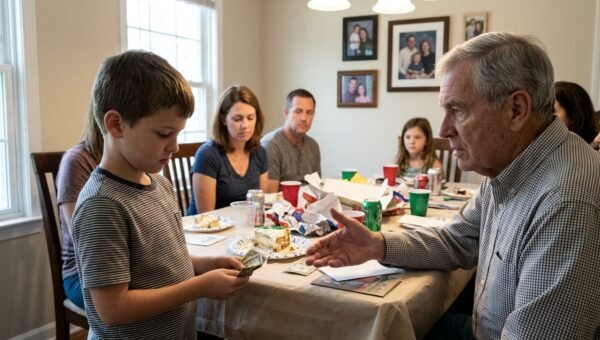
My brother, Kevin, did not show up for our mother’s seventy-second Christmas, even though hospice had already told us she would not see another one. He texted at 11:00 on Christmas morning to say the roads were slick and his wife, Brenda, had a headache. It was forty-eight degrees and dry in Richmond that day. I spent that afternoon pureeing sweet potatoes and spooning them into Mom’s mouth while she watched the driveway from her hospital bed in the dining room.
Every time gravel crunched outside, her eyes moved toward the window. Nobody came.
Mom passed away four months later, on a damp Tuesday in April. Kevin showed up at the funeral home forty minutes late, walked straight to the front row, and patted my shoulder twice like I was a distant neighbor.
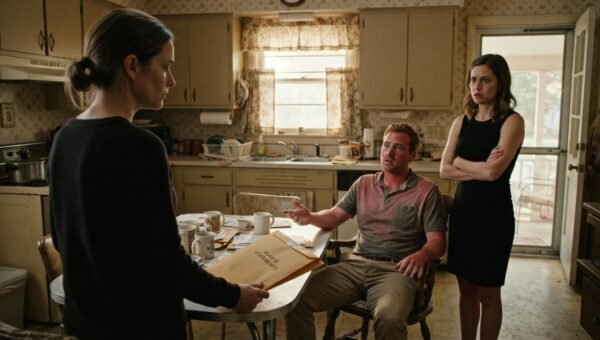
The very next weekend, we met at Mom’s small brick ranch to start sorting through her things. I thought we would take our time, go through her photo albums, and divide the everyday household items fairly. But Kevin did not even take off his jacket. He walked straight past the family bibles, past Dad’s old workbench tools in the basement, and headed directly into the formal dining room.
He pulled open the glass doors of the cherry corner cabinet. Inside sat Mom’s twelve-piece set of Noritake china with the thin gold rim. She had received it as a wedding gift in 1968.
For fifty-six years, she washed every single piece by hand with lukewarm water and mild dish soap. She never let a single saucer go into a dishwasher.
“Brenda wants the china,” Kevin said. He reached in and picked up a dinner plate, checking the stamp on the back. “Mom told Brenda she could have it. Mom always wanted us to share, and you already got the house.”
“The house has an eighty-thousand-dollar mortgage balance that I took over,” I said, keeping my voice as steady as I could. “And Mom didn’t say that.”
“She told Brenda back in November,” Kevin insisted. He set the plate down with an impatient clatter against the wooden shelf. “We’re hosting Thanksgiving this year. Brenda already bought cloth napkins to match the pattern. I brought boxes in my truck. I’m taking them today.”
I looked at him. I had spent eight months sleeping on a cot beside Mom’s bed, wiping her face, managing her morphine drops, and washing her nightgowns.
Kevin had visited three times total during that whole year, and each visit lasted less than twenty minutes because Brenda was waiting in the car with the engine running.
Part of me wanted to give up just to make him leave. I was so exhausted my bones ached, and fighting over dishes felt small while my grief was still raw. But something held me back. I remembered Christmas afternoon. I remembered Mom looking at that cold, empty driveway until the sun went down.
“I’m not packing these up today, Kevin,” I said. “We go through things together, piece by piece, when the estate account is settled.”
“Don’t be petty, Claire,” he snapped. “They’re just old plates to you. Brenda actually appreciates good china. Mom would be disgusted that you’re hoarding dishes out of spite.”
He stormed out the front door, slamming the screen door so hard the glass pane rattled.
Through the window, I watched his truck back down the driveway, kicking up gravel just like Mom had waited for him to do four months earlier.
I stayed in the dining room for a long time. The quiet of the house felt heavier once he was gone. I looked at the corner cabinet. I knew if Kevin came back while I was at work, he might just walk in and take them. I decided to pack them myself and move them into the hall closet under lock and key.
I went to the kitchen, grabbed a roll of bubble wrap and a bundle of clean packing paper, and carried them back to the table. I started with the dinner plates, wrapping each one carefully. Then the salad bowls. Then the teacups.
Finally, on the top shelf, sat the matching gravy boat on its attached oval platter. It had always been Mom’s pride. Every Thanksgiving, she poured hot turkey gravy from it and warned everyone to use two hands.
I lifted it carefully by the handle. When I turned it upside down to wrap the bottom, a strip of yellowed masking tape caught my eye.
Taped flat against the unglazed ceramic base was a folded index card. On the outside, in Mom’s shaky, familiar blue ink, was my name.
PART 2
I did not open the card right away. My hands were shaking so much I was afraid I would drop the platter onto the hardwood floor.
I set the gravy boat down in the center of the dining table, walked over to the front door, and locked the deadbolt. Then I went back to the table, sat down in Mom’s old wooden chair, and carefully peeled the masking tape off the bottom of the ceramic. The tape had dried out with age, leaving a sticky yellow residue on the porcelain.
I unfolded the small ruled index card.
The ink was slightly smudged, written with the heavy ballpoint pen Mom always kept in the drawer by the telephone. The handwriting was unsteady, the way her script had become during the final months when her arthritis flared up, but the date at the top was unmistakable: November 14.
That was six weeks before Christmas. It was the exact weekend Brenda had claimed Mom promised her the set.
Mom had written just three lines:
“Claire, this china stays with you. If Kevin asks, tell him no. Brenda took my pearl earrings from my dresser drawer this afternoon while I was resting, and she thinks I didn’t see her.”
I read the words three times.
A heavy knot settled in my stomach. The pearl earrings were not expensive, but they were the only jewelry Mom had kept from our father. Dad had given them to her for their twentieth anniversary, right before he got sick. When Mom went on hospice, I had looked for those earrings in her wooden jewelry box on top of the bureau so she could wear them one last time. The velvet slot where they always sat had been completely empty.
At the time, Mom had seemed confused when I asked where they were. She had just looked down at her hands and said, “Things have a way of walking when people think you’re already gone.”
I had thought she was having a bad day from the pain medication. Now, looking at the card in her own hand, the cold truth settled into place. Mom had not been confused at all. She had been lying in bed, helpless and weak, watching her daughter-in-law search through her dresser.
Mom hadn’t said anything to me back then because she knew it would cause a massive family blowout, and she simply didn’t have the strength left to survive an argument between her children. Instead, she had waited until Brenda left, taken an index card from her nightstand, written the truth, and taped it under the one piece in the cabinet she knew Brenda wanted most.
My phone buzzed on the table. It was a text from Kevin:
“Talked to Brenda. She said Mom promised the matching serving platters too. I’m coming by on Wednesday after work with boxes. Have them ready. Don’t make this ugly.”
I stared at the screen. For years, I had smoothed things over to keep the peace. When Kevin skipped birthdays, I made excuses. When he borrowed money from Mom’s savings and never paid back the three thousand dollars, I looked the other way because Mom begged me not to cause a scene. Even when he skipped Christmas, I had lied to our neighbors, telling them he had gotten snowed in up north.
I took a clear photo of the index card with my phone. Then I carefully placed the original card into my wallet, zipped it tight, and finished packing every single piece of china into three heavy-duty plastic totes. I loaded them into the trunk of my car and drove them across town to my own house.
PART 3
Wednesday afternoon at 5:15, Kevin pulled into Mom’s driveway. He didn’t come alone. Brenda was in the passenger seat, wearing oversized sunglasses and carrying two flat cardboard moving boxes and a roll of brown packing tape.
I was sitting on Mom’s front porch, waiting for them. The front door behind me was locked.
Kevin walked up the porch steps, Brenda trailing behind him. She gave me a tight, practiced smile.
“Hey, Claire,” Brenda said, stepping toward the screen door. “We won’t be long. We just want to get the dishes wrapped before the evening traffic gets bad. Kevin said you were being a little difficult on Sunday, but I told him grief makes people do strange things.”
“The dishes aren’t in the house,” I said plainly.
Brenda stopped on the top step, her hands tightening on the cardboard boxes. “What do you mean they aren’t in the house? Where are they?”
“They’re at my home,” I said. “Where they belong.”
Kevin’s face flushed dark red. “We talked about this, Claire. Brenda is family. Mom wanted her to have them. You don’t even host Sunday dinners. You’re keeping them just to stick it to us because I couldn’t make it down for Christmas.”
“You didn’t come for Christmas because you didn’t care enough to make the drive,” I said, looking directly at Brenda. “And Mom never promised you her china. In fact, she made sure you would never get a single cup.”
Brenda let out a sharp, mocking laugh. “That’s a lie. Mom specifically told me on November 14, right in her bedroom, that the Noritake pattern was mine. She said she wanted a woman who knew how to set a proper table to take care of it.”
“November 14,” I repeated. “You’re sure about that date?”
“Positive,” Brenda said, crossing her arms. “I came by to bring her groceries and check on her.”
“You didn’t bring groceries, Brenda. You came over while I was at the pharmacy picking up Mom’s prescriptions. And while Mom was lying in her bed, you went into her bedroom closet and went through her dresser.”
Brenda stiffened. The smugness vanished from her face so fast it looked like she had been slapped. “I don’t know what you’re talking about.”
“Where are Dad’s pearl earrings, Brenda?”
Kevin stepped forward, his voice rising. “What does that have to do with anything? Claire, you’ve lost your mind. Mom had dementia at the end, she forgot where she put things—”
“Mom did not have dementia,” I said, cutting him off with a flat, cold authority I had never used with him before. “Mom was fully aware. She was just too weak to fight you.”
I reached into my pocket, pulled out my phone, and held up the screen. I had zoomed in on the photograph of the index card, showing Mom’s handwritten note and the unmistakable November 14 date right at the top.
“She taped this under the gravy boat,” I said. “Read it.”
Kevin snatched the phone from my hand. He looked down at the screen. I watched his eyes scan the lines. His mouth opened slightly, then closed. He looked from the phone to Brenda.
“Brenda?” Kevin asked quietly.
“She was old, Kevin! She was confused!” Brenda’s voice pitched high and defensive, echoing off the porch eaves. “I was just looking for a safety pin because my blouse tore! I didn’t steal anything!”
“Mom named you,” I told her. “She wrote that sentence naming the one person she never wanted in possession of her wedding set. You stole from a dying woman in her own bedroom, and then you had the nerve to demand her family china six months later.”
Brenda turned on her heel and marched down the steps without another word, throwing the flattened cardboard boxes into the bed of Kevin’s truck before getting into the passenger seat and slamming the door.
Kevin stood on the porch for nearly two full minutes. He held my phone out to me, his hand unsteady. He didn’t look angry anymore; he just looked small, embarrassed, and exhausted.
“Claire,” he mumbled, looking down at his boots. “I didn’t know.”
“You didn’t know because you weren’t here,” I said. “You weren’t here when she was sick, you weren’t here when she was lonely, and you weren’t here when she died. You only showed up to see what was left on the shelves.”
He swallowed hard. He didn’t try to defend himself, and he didn’t ask for the china again. He turned around, walked down the porch steps, got into his truck, and drove away.
ENDING
Three days later, a small padded yellow envelope arrived in my mailbox. There was no letter inside, no apology, and no return address, but the postmark was from Kevin’s local post office branch. Inside, wrapped in two layers of cheap paper towels, were Mom’s pearl earrings.
One of the small silver backings was missing, but the pearls themselves were completely unharmed. I sat in my kitchen, holding them in the palm of my hand, feeling the smooth, cool weight of them against my skin.
I haven’t heard from Brenda since that afternoon on the porch. Kevin texted me once, two months later, asking if he could have Dad’s old fishing tackle box from the garage. I left the box on the front steps on a Saturday morning when I knew I wouldn’t be home. He picked it up while I was out, and we haven’t spoken since. Sometimes family ties don’t break with a huge explosion; they just quietly dissolve when people finally see each other for who they really are.
The house in Richmond sold in late August. I paid off the remaining mortgage balance, settled the final medical bills, and moved the rest of Mom’s furniture into my guest room.
The Noritake china sits inside my own dining room cabinet now. The wood is a lighter oak rather than Mom’s cherry, but the dishes fit perfectly behind the glass.
Last Thanksgiving, I hosted dinner for my daughter and my two grandchildren. It was the first holiday without Mom, and the house was filled with the smell of roasted turkey and warm yeast rolls.
When it came time to set the table, I didn’t save the good plates for an imaginary special occasion. I took down all twelve place settings. I put out the dinner plates, the salad bowls, and the gold-rimmed saucers.
Right in the middle of the table, sitting proudly on its oval platter, was the gravy boat. I had scrubbed the yellow tape residue off the bottom months ago, but every time I pick it up with both hands to pass it across the table, I remember exactly what was written underneath.