PART 1
At eight years old, Josephine stood beside my parents’ Christmas tree clutching a cheap plastic horse with one leg snapped clean off and black permanent marker scribbled across its flank. The thin, wrinkled grocery bag it came out of crackled in her trembling hands. Over on the living room rug, my sister Clara’s ten-year-old twins sat surrounded by brand-new mountain bikes, iPads, name-brand sneakers, and deluxe drawing kits with wooden carrying cases.
Then my father let out a dry laugh from his leather armchair.
“The good presents are for the grandchildren who actually matter,” he said, taking a slow sip of his black coffee.
My mother did not look up from folding ribbon. Clara just smirked, adjusting the cuff of her new cashmere sweater. Not a single person in that room spoke up. Nobody defended an eight-year-old girl standing in her church dress with tears welling in her eyes. Josephine pressed her face hard into my side, her small fingers bunching the fabric of my flannel shirt, and whispered, “Daddy… maybe my real present is hidden somewhere else?”
My throat felt tight, but I did not yell. I knelt down beside her, wrapped my arm around her shoulders, and quietly said, “Put your coat on, Josie. Go sit in the truck for just one minute. I will be right out.”
She nodded, wiped her nose on her sleeve, and walked down the hallway toward the mudroom. I waited until I heard the heavy front door click shut.
Twenty minutes earlier, I had carried two heavy, ribbon-tied gift bags into that house. One contained a $650 Citizen watch for my father, paid for after three straight weekends of overtime at the distribution plant. The other held a $400 soft leather handbag my mother had pointed out in a catalog back in October. I had placed both right beneath the tree, wanting this holiday to feel peaceful after two years of quiet tension.
I walked back into the center of the living room. I bent down, picked up the watch box, slid it into its bag, and picked up the leather handbag by its handles.
My father narrowed his eyes, setting his mug down on the end table with a dull thud. “What are you doing?”
I looked directly at him and kept my voice completely level. “Taking back what belongs to someone who clearly doesn’t matter.”
“Those are our gifts, David,” Clara snapped from the sofa, her voice sharp. “Don’t throw a childish tantrum just because Dad made an honest joke.”
“It was not a joke,” I said. “And these are mine. I bought them with my own money.
If my daughter does not count under this roof, then nothing I bring here counts either.”
My mother finally looked up, her face flushing red. “David, you put those down right now. You are causing a scene on New Year’s Day. After everything this family has done for you, you don’t get to insult your father in his own house.”
“Done for me?” I asked, looking at the mountain of electronics around Clara’s kids. “You told me two weeks ago that money was too tight to do much for Josie this year. You asked me to cover the holiday dinner groceries, which cost me $340. And then you hand my child trash pulled out of Clara’s garage.”
Clara shifted on the sofa, her face suddenly tight. The scribbled black marker on that plastic horse was unmistakable. It had belonged to her daughter three summers ago before their dog chewed on it.
My father stood up, leaning heavily on his cane, his jaw clenched tight. “You walk out that door with those bags, David, and you don’t bother coming back. You remember who holds the deed to that acreage out back. You remember who decided to cut you in on this property. You cross me today, and you lose every single thing we promised you.”
PART 2
I didn’t answer him. I gripped the handles of both gift bags, turned my back on them, and walked out into the cold January air.
When I climbed into the truck, Josephine was sitting with her seatbelt buckled, staring out the passenger window. She still had the three-legged horse resting on her lap. She looked at the two large bags I tossed into the back seat, but she didn’t ask a single question.
“Let’s go get some breakfast, Josie,” I said, putting the truck in gear. “Anywhere you want.”
We went to the diner on Route 4. She ordered chocolate chip pancakes and barely ate half of one. She kept turning the broken plastic toy over in her hands, running her thumb over the jagged white edge where the front leg had snapped.
“Did Grandpa give me this because I’m not Aunt Clara’s kid?” she asked softly.
My chest ached. “No, baby. Grandpa did that because he has a mean heart. It has nothing to do with you. Not one single thing.”
The truth was, the rift had started four years earlier when my wife, Sarah, passed away from breast cancer. Sarah had never bowed down to my father’s demands. She refused to let him dictate how we managed our savings, and she wouldn’t let Clara use us as an open checkbook. My father had spent forty years running our family like a company where he owned all the shares. When Sarah died, he expected me to bring Josephine back into his orbit, to let my mother raise her, and to hand over Sarah’s life insurance payout toward “consolidating family property.”
I refused. I kept my job, kept my small house on the edge of town, and raised Josephine myself. Clara, meanwhile, lived rent-free in my parents’ second house in town, never worked a steady job, and let my father pay her car notes while her husband drifted between failed business ventures.
When my father threatened the “acreage out back” before I walked out, he was talking about the twenty-two acres of family land that my grandfather had originally farmed. For three years, my father had dangled a three-acre parcel in front of me, telling me that if I helped clear the brush, rebuilt the perimeter fencing, and handled the property maintenance, he would sign that parcel over to me so Josephine and I could build a home there. I had spent nearly every free weekend for eighteen months running a chainsaw, hauling posts, and paying for gravel out of pocket.
When Josie and I got home, I settled her on the couch with a movie and went straight to my home office. I pulled out the metal lockbox from the bottom drawer of my desk. Inside was the file of maintenance receipts, tax assessments my father had asked me to help pay, and a copy of the parcel map he had given me when he first asked for my help.
I looked at the receipts. In eighteen months, I had spent $6,800 of my own money on fence posts, grading, and equipment rental for that land.
At 4:15 that afternoon, my phone rang. It was my mother.
“David, your father’s blood pressure is through the roof,” she said, her voice shaking with anger. “Clara is in tears. You humiliated all of us today over a plastic toy. If you bring those gifts back tonight and apologize to your father, he might still let you build on the back parcel. But if you don’t, Clara’s husband is taking over the fencing, and your name comes off the family trust entirely.”
“Mom,” I said, my voice steady. “Did you wrap that broken horse?”
Silence hung on the line for four long seconds.
“Your father said Josephine wouldn’t know the difference,” she whispered defensively. “She’s eight. Clara’s kids are older, they need things for school. We had to prioritize.”
“You didn’t prioritize,” I said. “You chose to be cruel. And I am done paying for it.”
I hung up the phone. My hands were shaking, but not from fear. For years, I had excused their behavior because I wanted my daughter to have grandparents. I had traded my own dignity, my time, and thousands of dollars just to keep the peace.
The next morning, I took the watch and the leather handbag back to the department store in the county seat. The clerk handed me $1,050 in cash and store credits. On the drive home, I stopped at the County Clerk’s office to pull the official property records on the twenty-two acres. If my father was threatening to cut me out, I wanted to know exactly what the legal title looked like before he could file any new paperwork.
PART 3
The county clerk, an older woman named Mrs. Gable who had known my grandfather, pulled up the digital parcel deed on her desktop monitor. She printed out the four-page conveyance history and handed it across the counter.
I looked at the lines of legal description, and then my eyes stopped on the bottom of page two.
The property transfer had taken place six years ago, right after my grandfather passed away.
My grandfather had not left the entire twenty-two acres to my father. He had split it into two parcels before his death. Parcel A, containing sixteen acres and the main farmhouse, belonged to my father. But Parcel B, the six-acre back lot that bordered the county road, had been deeded directly into a trust specifically created for my late mother-in-law’s line, with me named as the sole trustee and Josephine as the primary beneficiary upon her eighteenth birthday.
My father had never owned the back six acres.
I stood in the quiet county office, reading the signatures three times. My father had signed as the executor of my grandfather’s estate, acknowledging the split deed. He knew the back land was already legally mine to hold for Josephine.
For three years, he had let me pay the property taxes on that back section, let me spend $6,800 clearing trees, and let me string hundreds of feet of five-strand wire fence, all while pretending it was a favor he might bestow upon me if I groveled enough. He had used my own daughter’s inheritance as a leash to keep me coming over every weekend to do his heavy lifting.
I left the clerk’s office and drove straight to my parents’ house.
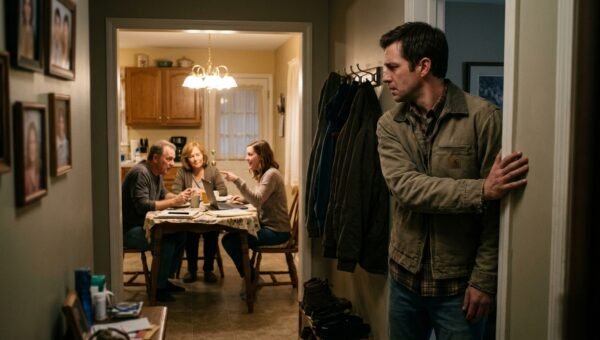
It was 11:30 in the morning. My father’s truck was in the gravel driveway, alongside Clara’s SUV. When I walked up the front steps, I didn’t knock. I pushed the front door open.
They were all in the dining room, finishing late breakfast plates. Clara looked up, her fork halfway to her mouth, an arrogant smirk instantly spreading across her face.
“Look who came crawling back,” Clara said, leaning back in her chair. “Did you bring the bags, or did you just come to apologize?”
My father didn’t look up from his plate of eggs. “Set them on the sideboard, David. Then sit down. We have some ground rules to go over.”
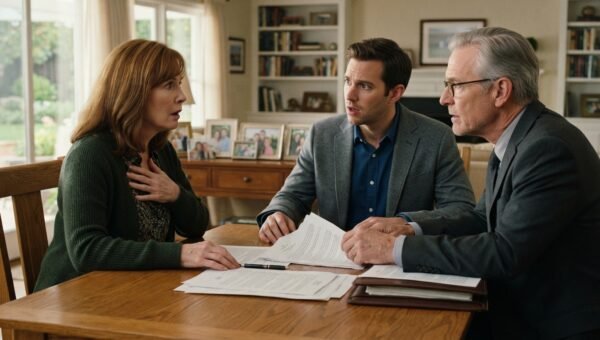
I walked directly to the dining table and laid the four-page certified deed flat on the wood right between my father’s coffee cup and his plate.
“Read page two,” I said.
My father frowned, annoyed at being interrupted, and picked up the paper. As his eyes tracked down the legal description to the trust designation and the signature line, the color drained out of his cheeks. His jaw worked silently.
“What is that?” Clara asked, reaching for it.
“Don’t touch it,” I told her.
Clara pulled her hand back, looking at my father. “Dad? What is he talking about?”
My father didn’t answer. He set the paper down, avoiding my eyes.
“You told me yesterday that if I crossed you, I would lose everything you promised me,” I said, keeping my voice low and direct so there was no mistaking my words. “You told me you held the deed to the back acreage. But you don’t. You haven’t owned that land since Grandpa died. Josie owns it. I control it.”
My mother’s hand went to her collar. “David, your grandfather wanted the family to stay together…”
“Grandpa knew exactly who your husband was,” I said, pointing at my father. “That’s why he bypassed him. And for three years, you watched me haul brush until my hands bled. You let me spend nearly seven thousand dollars fencing land you had no right to touch. You took my grocery money, you took my labor, and yesterday you handed my daughter a broken toy from a trash bag and told her she didn’t count.”
“David, you are blowing this completely out of proportion,” Clara said, her voice rising in panic. “We’re a family. We share things.”
“We don’t share anything,” I replied. “Clara, that driveway you use to get to your rental house crosses twenty feet of Parcel B. As of noon today, I am locking the gate at the county road. You have forty-eight hours to move your cars out to the shoulder, or you can cut your own road through Dad’s sixteen acres.”
Clara jumped up from the table. “Dad, tell him he can’t do that! That’ll cost thousands of dollars!”
My father sat entirely still. He knew property law. He knew the survey lines. For the first time in my adult life, he looked small, slumped over in his chair with nothing left to hold over my head.
“Get out of my house,” my father muttered, his voice barely a rasp.
“With pleasure,” I said. “And if any of you ever speaks to my daughter like that again, my lawyer will be filing for every dime of property taxes I improperly paid on your behalf over the last three years.”
ENDING
I walked out the door and never looked back.
That afternoon, I bought a heavy-duty steel chain and a commercial padlock from the hardware store. I drove out to the back parcel, wrapped the chain around the tubular gate that connected the county road to the access lane, and snapped the lock shut. Clara’s husband came out to the fence line thirty minutes later, screaming and waving his arms, but I didn’t even turn around to acknowledge him. The legal property line was clearly marked by the orange surveyor stakes I had verified with the county that morning.
By the end of the week, Clara had to park her SUV on the muddy public shoulder and walk two hundred yards through the wet weeds to reach her front door. Within a month, my father had to spend nearly $4,500 of his own savings to hire a bulldozer crew to cut a separate driveway through his own timber so Clara could reach her house without trespassing on Josephine’s property.
Neither my parents nor Clara reached out to apologize, and I didn’t expect them to. When a bully loses the only weapon he has, he doesn’t become humble; he just hides behind his anger.
The $1,050 refund from the watch and the leather handbag went straight into a dedicated high-yield savings account under Josephine’s name. A few days later, I took fifty dollars of my own cash and took Josie to a real tack-and-feed shop thirty miles out in the country. She picked out a sturdy, hand-carved wooden stable set with two chestnut mares that had velvet manes and braided tails.
That broken plastic horse stayed on my workbench in the garage for exactly three days before I tossed it into the burn barrel. I didn’t need a reminder of what they thought of us.
Spring came early that year. On a mild Saturday in late March, I loaded two camp chairs and a cooler into the bed of my truck and drove Josie out to the back six acres. We sat together near the crest of the hill, looking out over the open pasture, the newly strung wire fence catching the late afternoon sun.
Josie held her wooden horse in her lap, looking around the green grass.
“Daddy,” she said, looking up at me. “Is this where our house is going to be?”
“Right here,” I said, putting my arm around her shoulder. “Every single foot of it belongs to you.”