PART 1
For six years, I sat at my daughter’s kitchen table and bit the inside of my cheek until it bled. Every single visit, her husband, Greg, found a way to turn her into a punchline. He would lean back against the counter, shake his head with an easy grin, and tell whoever was in the room that Jenna could not do a single thing without him. If she reached for her purse to pay for takeout, he took the wallet right out of her fingers, saying she was terrible at math.
When we planned a trip to the grocery store, he took the car keys off the hook because she got too nervous behind the wheel. If I asked her a simple question about her own life, Greg answered before she could draw breath.
I hated it, but I stayed quiet because I convinced myself that interfering would only push her away. Every mother with a married daughter tells herself that lie at least once. You convince yourself that keeping the peace keeps the door open, so you laugh along at the small insults, swallow your temper, and pray she asks for help before the walls close in completely.
Then, four weeks ago on a rainy Tuesday morning, Jenna pulled into my driveway completely alone.
It was the first time in nearly four years she had arrived without Greg sitting in the passenger seat. Her car was still running when she walked through the side door, soaking wet, clutching a red thumb drive in her fist.
Her face was gray, the skin tight over her cheekbones, and she was breathing so fast her shoulders twitched.
She didn’t take off her coat. She didn’t let me fix her a cup of coffee. She grabbed my arm and dragged me straight toward the small back office where I keep my desktop computer.
“Mom, I need your printer,” she said. Her voice was thin, like paper tearing. “Please tell me it has paper.”
“It does, sweetheart,” I told her, reaching for her hand, but she pulled away. “Jenna, what is going on? Where is Greg?”
“He thinks I’m at the dentist in Canton,” she whispered, glancing back toward the kitchen window like his truck might appear in the driveway any second. “I have forty minutes before he expects me to text him that I’m in the waiting room.”
She plugged the drive into the tower. The little laser printer groaned to life, spitting out warm pages into the tray, one after another.
I watched the sheets stack up: scanned bank records, legal forms, vehicle registrations, and pages of typed logs. Forty pages in total.
Before I could look closely at the top sheet, Jenna snatched the stack, slid it into a heavy brown clasp envelope she pulled from under her jacket, and pressed the metal prongs flat. Then she took a roll of clear packing tape from my desk drawer and wound it around the flap three times.
She turned and pressed the heavy envelope against my ribs.
“Do not open this,” she said. Her hands were shaking so hard the paper rattled. “Keep it in your house. Hide it somewhere he will never look if he comes over.”
“Jenna, talk to me,” I begged, grabbing her wrists. “Let me help you. If he’s hurting you, you don’t have to go back there.”
“You can’t help me yet,” she said, her eyes wide and wild. “If he knows I have this, everything falls apart.
Mom, listen to me carefully. If my number shows up on your phone, you pick up, and I hang up twice in a row without talking, you call the police immediately. You give them our address, and you give them this envelope. Promise me. Swear it on Dad’s memory.”
The terror in her face knocked the air straight out of me. I looked at that sealed brown envelope, then looked into my girl’s eyes.
“I swear it,” I whispered.
She didn’t hug me. She ran back out to her car, backed down the driveway too fast, and vanished down the road.
Two weeks passed. Fourteen endless days where my stomach churned every time my phone buzzed. I saw Greg once during that time, when they came by on a Sunday afternoon to drop off some garden tools. He had his arm clamped around Jenna’s neck like a heavy collar, laughing about how she had almost lost her car keys again. Jenna smiled a small, obedient smile, never once looking in my direction. The envelope sat tucked underneath the spare towels in the bottom of my cedar chest.
Then last night came.
At 2:07 in the morning, the harsh ring of my landline tore me out of a dead sleep.
My heart felt like it was hammering against my teeth. I threw the covers off, stumbled into the hallway, and grabbed the receiver off the wall.
“Jenna?” I gasped.
Nothing. Just the sound of someone breathing fast and shallow on the other end, followed by the soft click of a dead connection.
I stood in the dark, my knuckles white on the plastic. Three seconds later, the phone in my hand rang again.
PART 2
The second ring cut through the dark like a knife.
I hit the button and brought the receiver back to my ear. “Jenna!”
Click. The dial tone hummed in my ear, flat and steady.
She had hung up twice. Exactly like she told me.
Panic rushed through my chest, but behind the panic, every maternal instinct I had spent six years choking down snapped into place. I didn’t second-guess her. I pressed the hook down to clear the line, dialed 911, and gave the dispatcher Jenna and Greg’s address on Miller Creek Road.
“My daughter is in immediate danger,” I told the woman, my voice shaking so hard I had to lean against the wall. “She gave me a prearranged signal. Her husband is controlling and unstable. Send an officer right now. I am coming behind them with evidence.”
I dropped the phone, ran to the bedroom, pulled on my sneakers and a heavy coat over my nightgown, and hauled the brown envelope out from under the towels in the cedar chest.
Miller Creek Road was twelve minutes away through back roads. My hands gripped the steering wheel until my fingers went numb. When I turned onto their gravel driveway, the flashing red and blue lights of two sheriff’s patrol cruisers were already painting the pine trees in harsh, strobing bursts.
The front door of the house was wide open. The porch light was buzzing.
A young deputy stopped me before I could reach the steps, holding his palm up against my chest. “Ma’am, you need to stay back by your vehicle.”
“That’s my daughter,” I said, pointing toward the door. “I’m the one who called. I have what she told me to bring.”
Through the front window, I could see Greg. He wasn’t in handcuffs, but an older deputy had him backed against the living room wall. Greg was dressed in sweatpants and an old flannel shirt, his hair sticking up, waving his hands with that same confident, dismissive smirk I had watched him use for half a decade.
“Officer, this is ridiculous,” Greg was saying, his voice carrying clearly into the yard. “My mother-in-law is paranoid, and my wife had a panic attack. Jenna dropped her phone twice while trying to set her alarm, that’s all this was. Jenna, tell him. Tell the deputy you’re fine.”
Jenna was sitting on the edge of the brick hearth. She had her knees pulled up toward her chin, her arms wrapped around her shins. She didn’t look up, and she didn’t say a word.
“She doesn’t have to say anything to you,” I called out, pushing past the younger deputy’s arm.
Greg’s eyes snapped to me as I walked through the door. His smile dropped for a split second, replaced by pure irritation, before he adjusted his face back into patient amusement.
“Carol, go home,” Greg said softly, shaking his head. “Jenna is confused. She had a bad night. You’re making a scene out of nothing, like you always do.”
“She didn’t drop her phone,” I said, looking straight at the older deputy, a sergeant named Miller whose name tag caught the light. “She came to my house two weeks ago. She told me if she called and hung up twice, it meant she couldn’t speak because he would hear her, and that I was to bring this.”
I held out the heavy clasp envelope, sealed tight with three layers of packing tape.
Greg stared at the brown paper in my hand. For the very first time in six years, the relaxed, condescending posture drained completely out of his body. His hands dropped to his sides. His jaw clenched so tight the muscle beneath his ear jumped.
“What is that?” Greg asked, his voice losing its smooth rhythm. “Jenna, what did you give her?”
Jenna slowly lifted her head from her knees. Her cheeks were wet, but when she looked at Greg, the terrified child I had seen in my office two weeks earlier was gone.
“Open it, Sergeant,” Jenna said, her voice clear and completely steady. “Please open it right now.”
PART 3
Sergeant Miller took the envelope from my hands, pulled a pocketknife from his belt, and sliced through the clear tape. He pulled out the forty pages and stepped under the living room ceiling fan to read.
Greg took a step forward, but the younger deputy immediately shifted his weight, blocking his path. “Stay where you are, sir.”
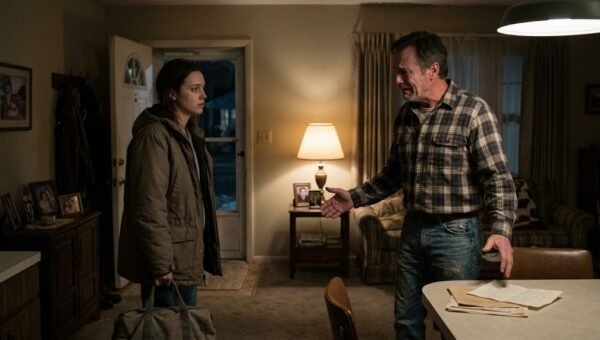
“That is private household paperwork,” Greg snapped, his voice rising, the polished facade cracking open. “She took that out of my home office without permission. She’s not well, Officer. She doesn’t manage our finances because she isn’t capable of it.”
“I was capable enough to run an audit,” Jenna said. She stood up from the hearth. Her hands were at her sides now, steady and unclenched.
Sergeant Miller was turning the pages slowly, his face hardening as he read.
For six years, Greg had maintained total dominance by telling everyone Jenna was incompetent. He made sure her name was kept off the primary checking accounts, managed every utility, and paid every bill from a private dashboard she wasn’t allowed to access. Whenever family was around, he played the long-suffering, devoted husband carrying the weight of a helpless wife.
The forty pages told an entirely different story.
Jenna had spent eight months secretly tracking their household records after finding an unopened certified letter hidden in Greg’s golf bag. Greg hadn’t been protecting her from financial stress; he had been systematically liquidating their joint assets to cover massive losses from private, unauthorized options trading.
To keep his trading afloat, he had taken out a $65,000 home equity line of credit against their house. He couldn’t obtain the loan on his signature alone because the deed was held jointly. So, he had forged Jenna’s signature on the bank documents, along with a forged notary stamp from a shipping store in town where his cousin worked.
When the equity money evaporated, he transferred the title of Jenna’s car into his sole name using another forged power of attorney, borrowing against the vehicle title to pay the minimum balances on three credit cards he had opened under her Social Security number.
The logs Jenna had printed weren’t just bank statements. She had obtained certified copies of the loan applications directly from the regional bank branch while he thought she was running errands, complete with the bogus signature lines. Attached to them were printouts of his trading account balances, showing a deficit of over $112,000, and copies of past-due foreclosure notices Greg had intercepted from the mailbox and hidden in his locked tool chest.
He hadn’t kept her isolated because she was weak. He kept her isolated so she would never look at a piece of mail.
“She set up her own phone,” Jenna told the sergeant, pointing at Greg. “Two nights ago, the bank left a message on our home phone about the missed equity payment. He heard it before I could erase it. Tonight, he took my car keys, locked my purse in his gun safe, and shut off the cellular data on my phone through our carrier app so I couldn’t send messages.”
She looked at Greg, whose face had gone completely dark, his fists trembling against his thighs.
“He forgot the landline had an extension in the laundry room behind the dryer,” Jenna whispered. “He was sitting right here watching the front door, waiting for me to come out and apologize for asking where our savings went. He thought I was trapped.”
Sergeant Miller looked up from the forged notary page. He didn’t ask Greg for an explanation. He looked at his partner.
“Step outside with Mr. Vance,” the sergeant said quietly. “Call the detective on duty. We have aggravated identity theft, forgery, and grand larceny here.”
Greg lunged toward Jenna, his face twisted in fury. “You stupid little bitch, you ruined us! Everything I did was to get us back on our feet!”
The younger deputy grabbed Greg by the shoulder, twisted him around, and shoved him hard against the front doorframe, pulling his wrists behind his back. The metal clicks of the handcuffs echoed through the small house, loud and final.
ENDING
Greg didn’t post bail until two days later, and by the time his brother picked him up from the county jail, Jenna had already changed the deadbolts on the house with an emergency protective order taped to the front window.
The legal fallout took nearly nine months to untangle. The regional bank froze the fraudulent equity line of credit once the county prosecutor formally filed felony forgery and identity theft charges against Greg. It was a long, ugly slog through paperwork, notarized fraud affidavits, and depositions, but the prosecutor’s office forced the cancellation of the fraudulent debts under Jenna’s name. Greg eventually took a plea agreement that included five years of probation, full restitution, and a permanent criminal record. Jenna filed for divorce three days after his arrest, and she never spoke to him outside of a courtroom again.
For the first couple of months, Jenna stayed in my spare bedroom.
She spent the first week mostly sleeping, fifteen hours a day, like her body was finally collapsing after years of running on pure adrenaline. When she was awake, she sat on my back porch with a legal pad, writing down every single account, every password, and every detail of her life she had surrendered to a man who convinced her she couldn’t survive on her own.
I had to face my own shame during those weeks. I had let myself believe that keeping quiet was the loving thing to do. I had sat at their table, seen the way he diminished her, and convinced myself it wasn’t my place to interfere until she asked. I thought I was respecting her marriage, but really, I was just protecting myself from an uncomfortable fight.
Last Saturday, Jenna bought a used Honda Civic with money she earned from her new job managing logistics at a medical supply warehouse in town.
She drove it over to my house in the afternoon to show me. She parked by the curb, hopped out, and tossed the spare key straight onto my kitchen counter.
“Just in case,” she said with a grin.
We sat at the kitchen table, drinking tea out of the chipped blue mugs her father had bought decades ago. She told me about her morning, about the budget she had balanced down to the penny, and about how she was planning to repaint the front porch of her little rental cottage next weekend.
She didn’t look at the door. She didn’t check the clock. When the tea went cold, she stood up, poured herself another cup, and sat back down, completely at ease in the quiet of her own life.