PART 1
My father walked out the front door when I was nine years old, and he never called once. There were no birthday cards in the mailbox, no awkward twenty-dollar bills folded into envelopes, and no visits. My mother spent a couple of years staring out the kitchen window with a cigarette burning down to the filter, but eventually she stopped looking. We learned how to live around the empty space he left behind.
By the time I turned twenty-two, I had buried him in my mind. He was just a ghost who used to sit in the worn brown recliner in our living room.
That was the summer I got accepted into the nursing program. It felt like a miracle until I sat down at the kitchen table with the financial aid packet and realized what it actually meant. Tuition was $34,000. For someone whose mother worked the customer service desk at an auto parts store and whose own bank account sat at $412 from bussing tables, $34,000 might as well have been three million. I spent two solid weeks filling out every grant, work-study request, and local scholarship form I could find. Most required essays about overcoming hardship, and I typed them out on a borrowed laptop until my eyes burned. Every single one came back with the same polite rejection letter.
Then, three weeks before the semester started, a letter arrived from the university bursar’s office.
It stated that an anonymous donor had established an educational grant in my name. The award was $8,500 a semester, renewable for all four years as long as I maintained a 3.0 grade point average. That was $68,000 in total assistance, covering tuition and lab fees completely. There was no donor name, no foundation letterhead, and no family trust listed. The bursar simply said the donor had requested complete anonymity through an outside legal trust.
I stood in the campus administration building holding that paper, crying so hard the receptionist handed me a box of tissues. I told myself it was some wealthy alumnus who had set up a fund for struggling healthcare students. I promised myself I would earn every single dollar of it.
For four years, I worked like my life depended on it, because it did.
I studied through the night, survived on cheap coffee and peanut butter sandwiches, and made the Dean’s list every term. When I graduated at twenty-six, I had honors cords draped over my shoulders. My mother sat in the third row, dabbing her eyes with a handkerchief, proud that we had beaten the odds.
Soon after, I started my residency at Mercy Hospital, earning $61,000 a year as a staff nurse. For the first time in my life, I could pay my rent on the first of the month without feeling sick to my stomach. I bought a reliable used car. I put money into savings. I built a real, steady life on the foundation that anonymous check had built.
Then, a month after my thirtieth birthday, another official envelope from the university arrived in my mailbox.
I opened it leaning over my kitchen sink. The letter was short. It said: “Your anonymous donor has passed away. Per his written instructions, we are releasing his identity to you.”
Underneath was a name, Frank Miller, and an address.
Frank Miller was my father. The address was a small residential street just six miles from my apartment.
PART 2
I didn’t move for ten minutes. I stood there staring at the ink on the paper, waiting for it to turn into a clerical mistake.
Frank Miller had not spoken a word to me in twenty-one years. When I was nine, he packed two duffel bags into the trunk of a faded blue Chevy and backed down our driveway while I watched from behind the living room curtain. My mother had filed for child support, but the state enforcement letters came back marked undeliverable for years. He had vanished into thin air. We had survived eviction notices, cold winters where we turned the thermostat down to fifty-eight degrees, and the quiet humiliation of food stamps.
Now, a university letter was telling me he had lived six miles away from my apartment while paying $68,000 to put me through school.
I grabbed my keys, walked down to my car, and drove. I didn’t plan what I was going to say. I didn’t even turn on the radio. My hands gripped the steering wheel until my knuckles were white. The GPS took me through neighborhoods I drove past every week on my way to the grocery store. It brought me to an older part of town with narrow streets and tall, untrimmed oak trees.
The house was small, with peeling green trim around the porch and a mailbox tilted slightly to the left. The front yard was raked clean. A rusted pickup truck sat parked in the short asphalt driveway.
I sat at the curb with the engine running. A part of me wanted to put the car in reverse and drive away. I had lived thirty years without him; I didn’t need to step into his ghost story now. But the sheer weight of the $68,000 kept me glued to the seat. You don’t take that kind of money from someone who abandoned you without demanding an answer.
I shut off the ignition, walked up the three wooden porch steps, and knocked.
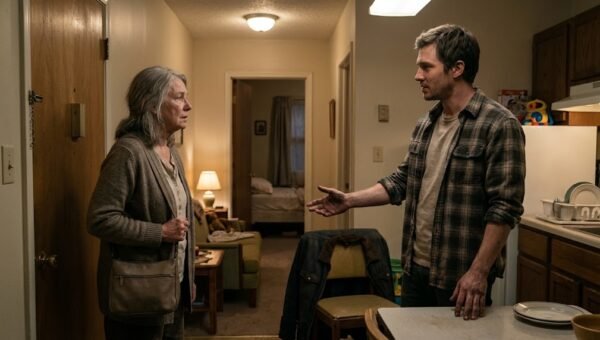
The door opened after a few moments. A woman stood there, maybe in her late fifties, wearing an oversized gray cardigan with faded floral embroidery. Her eyes were red-rimmed and tired.
“Can I help you?” she asked softly.
“I’m looking for Frank Miller,” I said. My voice sounded flat and unfamiliar to my own ears. “I received a letter from the university.”
The woman stopped. Her eyes moved over my face, lingering on my forehead and jawline, and then she let out a slow, trembling breath.
“You’re Clara,” she said.
“Yes,” I answered.
“I’m Martha,” she said, stepping back from the door frame. “I was his wife. Please come in.”
The inside of the house smelled like black coffee and cedar shavings. It was modest and clean, filled with dated furniture that looked like it had been bought second-hand thirty years ago. On the side table sat a folded American flag in a wooden case and a brass urn surrounded by a few white carnations.
Martha didn’t offer me tea or ask me to sit. She walked over to a small desk in the corner of the room, opened the bottom drawer, and lifted out a worn cardboard shoebox taped at the corners. She carried it over and set it on the kitchen table between us.
“He died three weeks ago,” Martha said, her voice shaking slightly. “Congestive heart failure. He’d been sick for a long time, but he refused to go into an assisted facility because he wanted to make sure the trust was fully funded before he went.”
“Why did he do it?” I asked. The question came out sharp, almost angry. “He left us with nothing. My mother worked herself to the bone. We had nothing. And he was living six miles away, writing checks?”
Martha looked down at her hands. “He watched every graduation from the parking lot,” she said. “High school. Nursing school. He sat in his truck with the windows cracked so he could hear the loudspeakers. He wanted to come in. God knows he wanted to walk through those doors. I told him you’d forgive him if you just saw him. But he told me you shouldn’t have to.”
PART 3
Martha pulled a chair out and gestured toward the box. “He said forgiveness wasn’t something a man could buy back after what he did. He said if he came back into your life, you’d feel obligated to carry his shame for him. He wanted you to have a clean slate, not his baggage.”
My throat felt tight. I reached out and pulled the lid off the shoebox.
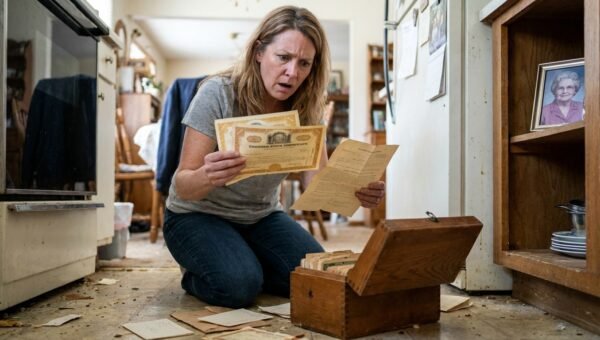
Right on top was my school picture from the fourth grade, the year after he left. I was wearing an orange sweater with yarn pigtails, smiling with a gap between my two front teeth. Underneath that was my fifth-grade portrait. Then sixth grade. Seventh grade. Every single school photo I had ever taken was in that box, preserved in cheap plastic sleeves.
There were folded newspaper clippings from my middle school track meets, with my name circled in red pen. There were copies of my high school report cards, which my mother must have shared with an old family friend who passed them along. There was a clipped announcement from the local paper about my nursing school Dean’s list honors.
And tucked beneath the clippings was a small, formal card: the wedding announcement my mother had placed in the county paper when she remarried nine years after he walked out. He had kept every single scrap of my life while remaining completely invisible.
“He worked two jobs,” Martha said quietly from the other side of the table. “He was a machinist during the day and cleaned commercial office buildings four nights a week until his lungs started failing. Every extra dime went into an irrevocable educational trust. The lawyer had strict orders not to release his name until after the funeral was over and the final account was closed.”
“It doesn’t make sense,” I whispered. The anger that had sustained me for twenty-one years was suddenly coming loose at the edges, leaving behind a hollow ache. “If he loved me this much, why leave? Why walk out on a nine-year-old child?”
Martha didn’t answer right away. She reached into the bottom of the shoebox and pulled out a yellowed piece of paper, folded into quarters.
“He kept this in his Bible until the week he died,” she said, placing it on top of the photographs. “He said you were old enough now to know what happened that year.”
I picked up the paper. It wasn’t a letter or a diary entry. It was an itemized hospital bill from St. Jude’s Memorial, dated November 14, nineteen years ago.
I remembered that week. I had been seven years old. I had contracted a severe case of hemorrhagic pneumonia following an untreated strep infection. I remembered the cold chill, the oxygen tent, the bright lights, and the terrified look on my mother’s face. I had nearly died in the pediatric intensive care unit.
I looked down at the lines on the yellowed bill.
It listed emergency blood transfusions. Two units of rare B-negative whole blood, administered during emergency stabilization.
Stapled behind the billing statement was a pink laboratory donor receipt. The date on the receipt matched the night my fever had spiked to one hundred and five degrees.
The donor name on the pink slip wasn’t Frank Miller.
It was a local business owner my mother had worked for back then, a man who owned the car dealership three towns over. And under the donor information, written in clear, block clinical ink, was the blood compatibility test result:
“Child recipient antigen match confirms direct biological paternity.”
ENDING
I sat motionless at the kitchen table, staring at the clinical ink on that thirty-year-old hospital slip.
The room was completely quiet except for the low hum of Martha’s refrigerator.
Frank had stayed by my bedside the night I almost died at seven. He had signed the admission papers, paid the emergency room intake fees, and waited while the doctors tested blood types to save my life. And in that hospital hallway, in the middle of the night while I was fighting to breathe, the laboratory paperwork had proven that he wasn’t my biological father.
My mother had carried that secret into their marriage, and the hospital forms had broken it wide open.
“He tried to stay,” Martha said softly, her voice barely above a whisper. “He stayed for two more years after that night. But every time he looked at your mother, the anger ate him alive. He told me he started drinking, started yelling, started turning into someone mean and ugly in that house. One night, he caught himself shouting